
2000 - 2019年全球呼吸道肿瘤死亡率与经济水平的相关性研究
Global respiratory tumor mortality correlation study with economic level, 2000-2019.
作者信息
Wang Mingjie, Chen Zhiyuan
机构信息
Department of Emergency Medicine, Qilu Hospital of Shandong University, Jinan, China.
Shandong Provincial Clinical Research Center for Emergency and Critical Care Medicine, NMPA Key Laboratory for Clinical Research and Evaluation of Innovative Drug, Medical and Pharmaceutical Basic Research Innovation Center of Emergency and Critical Care Medicine, China's Ministry of Education, Shandong Provincial Engineering Laboratory for Emergency and Critical Care Medicine, Key Laboratory of Cardiopulmonary-Cerebral Resuscitation Research of Shandong Province, Qilu Hospital of Shandong University, Jinan, China.
出版信息
Front Public Health. 2025 Aug 19;13:1647634. doi: 10.3389/fpubh.2025.1647634. eCollection 2025.
OBJECTIVE
The study aimed to investigate the relationship between global tracheobronchial lung cancer mortality rates and economic levels and assess the associated regional economic burden. Understanding these associations is crucial for global health resource allocation, informing cancer prevention and control strategies, and providing data to support the development of lung cancer and economic policies worldwide.
METHODS
We analyzed respiratory cancer mortality data (International Classification of Diseases (ICD)-10 codes C33-C34) obtained from the World Health Organization (WHO) Mortality Database (2000-2019). Age-standardized mortality rates (ASMRs) were calculated to describe the spatiotemporal distribution characteristics. Non-parametric comparisons (Wilcoxon rank-sum test) were performed to assess gender differences in mortality. Spearman's partial rank correlation analysis was performed to evaluate the association between national income levels (World Bank classification) and disease mortality.
RESULTS
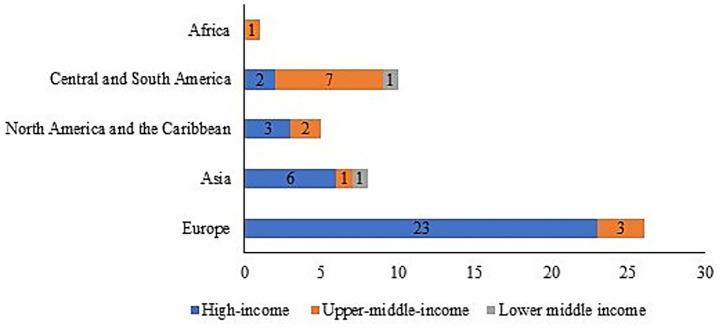
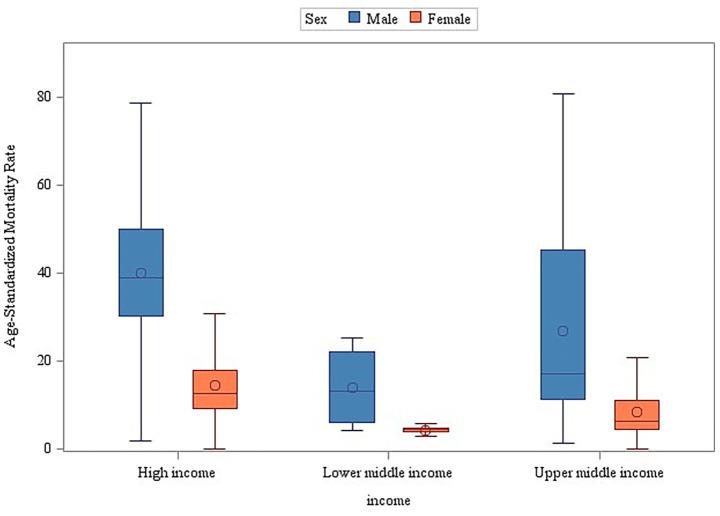
The core cohort included 50 countries with sufficient data. The global mean ASMR for respiratory cancers showed a decreasing trend from 2000 to 2019. Countries included in the Global Respiratory Tumor Mortality Registry System (GRTMRS) were predominantly high-income (68%) and European (52%). A significant positive correlation was observed between income levels and respiratory cancer mortality (Spearman's = 0.422, 0.001). ASMRs were consistently and significantly higher among male individuals than female individuals (Wilcoxon rank-sum test, < 0.001).
CONCLUSION
Between 2000 and 2019, global tracheobronchial lung cancer mortality appeared to be positively correlated with national economic level, particularly in high- and middle-income countries. Age-standardized mortality rates were significantly higher in male individuals than in female individuals. Paradoxically, these findings suggest that increasing economic development may be associated with elevated respiratory cancer mortality rates, emphasizing the critical need for balanced prevention strategies tailored to both high- and low-income settings.
目的
本研究旨在调查全球气管支气管肺癌死亡率与经济水平之间的关系,并评估相关的区域经济负担。了解这些关联对于全球卫生资源分配、为癌症预防和控制策略提供信息以及为全球肺癌和经济政策的制定提供数据至关重要。
方法
我们分析了从世界卫生组织(WHO)死亡率数据库(2000 - 2019年)获得的呼吸道癌症死亡率数据(国际疾病分类(ICD)-10编码C33 - C34)。计算年龄标准化死亡率(ASMR)以描述时空分布特征。进行非参数比较(Wilcoxon秩和检验)以评估死亡率的性别差异。进行Spearman偏秩相关分析以评估国民收入水平(世界银行分类)与疾病死亡率之间的关联。
结果
核心队列包括50个有足够数据的国家。2000年至2019年期间,全球呼吸道癌症的平均ASMR呈下降趋势。全球呼吸道肿瘤死亡率登记系统(GRTMRS)纳入的国家主要是高收入国家(68%)和欧洲国家(52%)。收入水平与呼吸道癌症死亡率之间存在显著正相关(Spearman's = 0.422, 0.001)。男性的ASMR始终显著高于女性(Wilcoxon秩和检验, < 0.001)。
结论
2000年至2019年期间,全球气管支气管肺癌死亡率似乎与国家经济水平呈正相关,特别是在高收入和中等收入国家。男性的年龄标准化死亡率显著高于女性。矛盾的是,这些发现表明经济发展的增加可能与呼吸道癌症死亡率的升高有关,强调了针对高收入和低收入环境制定平衡预防策略的迫切需求。


 Zotero 插件