
2004 - 2021年意大利不同宿主的基因组分析:多样性、抗菌药物耐药性和毒力谱。
Genomic analysis of from different hosts in Italy 2004-2021: diversity, antimicrobial resistance, and virulence profiles.
作者信息
Cucco Lucilla, Albini Elisa, Blasi Francesca, Orsini Serenella, Fiorucci Alessandro, Dettori Annalisa, Petrin Sara, Peruzzo Arianna, Salaris Silvano, Paniccià Marta, Pezzotti Giovanni, Massacci Francesca Romana, Magistrali Chiara Francesca
机构信息
Istituto Zooprofilattico Sperimentale dell'Umbria e delle Marche "Togo Rosati", Perugia, Italy.
Istituto Zooprofilattico Sperimentale delle Venezie, Padova, Italy.
出版信息
Front Vet Sci. 2025 Aug 19;12:1645885. doi: 10.3389/fvets.2025.1645885. eCollection 2025.
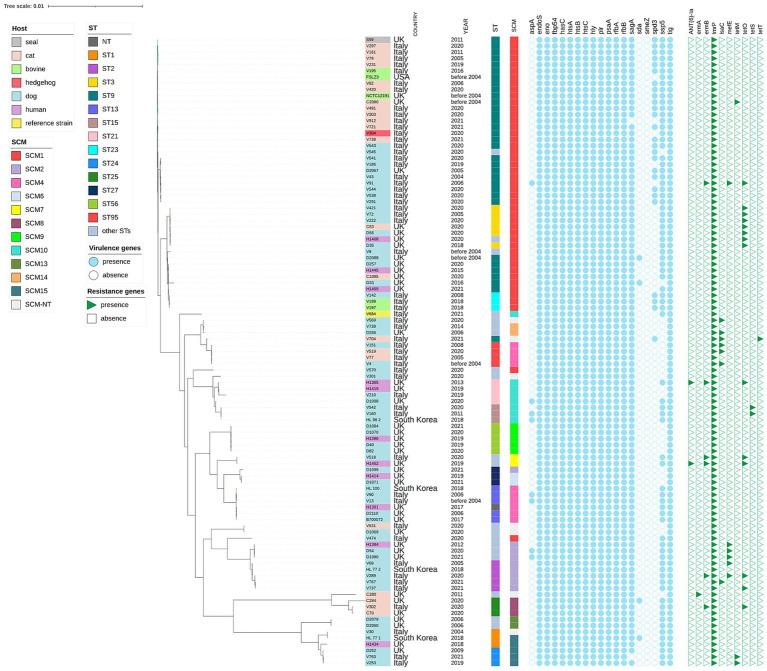
, a multi-host pathogen commonly isolated from dogs and cats has been occasionally reported in severe cases of human infection. This study aimed to explore the genetic diversity, antimicrobial resistance (AMR), and pathogenicity of isolates collected between 2004-2021, in Italy. Fifty-five isolates from clinical cases in domestic animals were investigated for susceptibility to antibiotics and then characterized for sequence type (ST), virulence profile, and antimicrobial-resistant genes through whole genome sequencing (WGS). All isolates were susceptible to beta-lactams, while frequently exhibiting resistance to lincosamides, chlortetracyclines, and macrolides. Six out of 55 isolates of all collected between 2020 and 2021, were multi-drug resistant (MDR). The most common AMR gene in the dataset was conferring resistance for streptogramin, tetracycline, macrolide, streptogramin A, and lincosamide. Other determinants of AMR were the genes. Twenty-one distinct STs were identified, with ST9 being the most prevalent in our collection. Regarding the virulence genes, forty-three isolates were positive for the gene, which encodes an agglutinin receptor. Comparison with other 46 genomes available in public repositories revealed that the Italian isolates clustered by the M-like (SCM) protein gene and ST and did not group according to their host, area, or year of origin. In conclusion, our study underscores the susceptibility of Italian isolates to beta-lactam antibiotics, which remain the first line of defense in managing infections. In Italy, ST9 represents the predominant clone of this pathogen. Despite the diversity in species of origin and the various STs identified, our findings confirm that has not adapted to different ecological niches and corroborate the accidental pathogenic nature of human cases.
一种常见于狗和猫身上的多宿主病原体偶尔会在人类严重感染病例中被报告。本研究旨在探索2004年至2021年期间在意大利收集的该病原体分离株的遗传多样性、抗菌药物耐药性(AMR)和致病性。对来自家畜临床病例的55株该病原体分离株进行了抗生素敏感性研究,然后通过全基因组测序(WGS)对其序列类型(ST)、毒力谱和抗菌耐药基因进行了表征。所有分离株对β-内酰胺类药物敏感,但经常对林可酰胺类、金霉素和大环内酯类药物耐药。在2020年至2021年期间收集的所有55株该病原体分离株中,有6株为多重耐药(MDR)。数据集中最常见的AMR基因赋予对链阳菌素、四环素、大环内酯、链阳菌素A和林可酰胺的耐药性。AMR的其他决定因素是某些基因。鉴定出21种不同的STs,其中ST9在我们的收集中最为普遍。关于毒力基因,43株分离株编码凝集素受体的基因呈阳性。与公共数据库中其他46个该病原体基因组的比较显示,意大利分离株根据M样(SCM)蛋白基因和ST进行聚类,并未根据其宿主、地区或来源年份进行分组。总之我们的研究强调了意大利该病原体分离株对β-内酰胺类抗生素的敏感性,β-内酰胺类抗生素仍是治疗感染的一线药物。在意大利,ST9是该病原体的主要克隆株。尽管来源物种多样且鉴定出了各种STs,但我们的研究结果证实该病原体尚未适应不同的生态位,并证实了人类病例的偶发性致病性质。
 Zotero 插件