
粪菌移植治疗帕金森病的安全性和有效性:一项临床试验的系统评价
Safety and efficacy of fecal microbiota transplantation in the treatment of Parkinson's disease: a systematic review of clinical trials.
作者信息
Chen Kewei, Sun Lirong, Liu Yilan, Chen Ran
机构信息
Department of Neurology Shaoxing Hospital of Traditional Chinese Medicine, Shaoxing TCM Hospital Affiliated to Zhejiang Chinese Medical University, Shaoxing, China.
Shaoxing City Keqiao District Hospital of Traditional Chinese Medicine, Shaoxing, China.
出版信息
Front Neurosci. 2025 Aug 20;19:1639911. doi: 10.3389/fnins.2025.1639911. eCollection 2025.
INTRODUCTION
Parkinson's disease (PD) is the second most common neurodegenerative disease with limited treatment options and increasing incidence. The Microbiota-Gut-Brain Axis (MGBA) offers new insights for PD treatment, as gut microbiota imbalances are linked to PD. Fecal microbiota transplantation (FMT) shows potential to improve gut dysbiosis and has gained attention for PD treatment.
METHODS
We conducted a review following PRISMA 2009 guidelines, searching PubMed, EMBASE, Web of Science, and Scopus up to December 1, 2024. We included clinical trials of FMT for PD patients, regardless of stage or type, with outcomes related to efficacy or safety. Non-clinical trials were excluded. Two investigators independently assessed studies, extracted data, and evaluated risk of bias and quality.
RESULTS
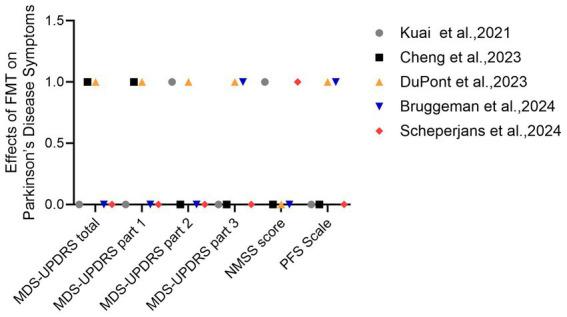
A total of 1,147 articles were retrieved, and six studies involving 104 patients were included. Four were randomized controlled trials, one was a cohort study, and one was a case series. Patients had a mean age of 63.2 years and disease duration of 5.6 years. After FMT, some patients showed improvements in UPDRS scores, H-Y grades, NMSS scores, and constipation symptoms, but results varied across studies. No serious FMT-related adverse events occurred. Most were mild gastrointestinal issues. Gut microbiota diversity and beneficial bacterial abundance changed after FMT, correlating with clinical outcomes. FMT materials were mostly from unrelated donors with diverse preparation and delivery methods.
DISCUSSION
FMT shows efficacy and safety in PD treatment but is insufficient as a standard due to study heterogeneity and small sample sizes. Future research needs larger samples, unified tools, and standardized FMT procedures. Combining FMT with other therapies may improve efficacy.
引言
帕金森病(PD)是第二常见的神经退行性疾病,治疗选择有限且发病率不断上升。微生物群-肠-脑轴(MGBA)为PD治疗提供了新的见解,因为肠道微生物群失衡与PD有关。粪便微生物群移植(FMT)显示出改善肠道菌群失调的潜力,并在PD治疗中受到关注。
方法
我们按照PRISMA 2009指南进行了一项综述,检索了截至2024年12月1日的PubMed、EMBASE、科学网和Scopus。我们纳入了针对PD患者的FMT临床试验,无论疾病阶段或类型如何,只要结果与疗效或安全性相关。非临床试验被排除。两名研究人员独立评估研究、提取数据并评估偏倚风险和质量。
结果
共检索到1147篇文章,纳入了6项涉及104名患者的研究。4项为随机对照试验,1项为队列研究,1项为病例系列。患者的平均年龄为63.2岁,病程为5.6年。FMT后,一些患者的统一帕金森病评定量表(UPDRS)评分、 Hoehn-Yahr(H-Y)分级、非运动症状评分量表(NMSS)评分和便秘症状有所改善,但研究结果各不相同。未发生与FMT相关的严重不良事件。大多数是轻微的胃肠道问题。FMT后肠道微生物群多样性和有益细菌丰度发生了变化,与临床结果相关。FMT材料大多来自无关供体,制备和给药方法多样。
讨论
FMT在PD治疗中显示出疗效和安全性,但由于研究的异质性和样本量小,不足以作为标准治疗方法。未来的研究需要更大的样本、统一的工具和标准化的FMT程序。将FMT与其他疗法相结合可能会提高疗效。


 Zotero 插件