
校准德康G7可改善其在1型糖尿病患者重复进行休闲水肺潜水情况下的性能。
Calibrating Dexcom G7 improves its performance in the context of repetitive recreational scuba diving in people with type 1 diabetes.
作者信息
Gamarra Elena, Careddu Giovanni, Fazi Andrea, Turra Valentina, Morelli Ambra, Trimboli Pierpaolo
机构信息
Servizio di Endocrinologia e Diabetologia, Repubblica e Cantone Ticino Ente Ospedaliero Cantonale, Bellinzona, TI, Switzerland.
Endocrinologia Diabetologia e Malattie del Ricambio, ASL 3 Genovese, Genoa, Liguria, Italy.
出版信息
BMJ Open Sport Exerc Med. 2025 Sep 1;11(3):e002809. doi: 10.1136/bmjsem-2025-002809. eCollection 2025.
BACKGROUND
The use of continuous glucose monitors (CGM) in scuba diving for patients with type 1 diabetes (T1DM) shows potential but faces challenges related to accuracy. Previous research has highlighted the poor accuracy of the Dexcom G7 (DG7) in repetitive diving contexts. This study investigates the impact of calibration on the accuracy of DG7, providing valuable insights for patients and clinicians.
MATERIALS AND METHODS
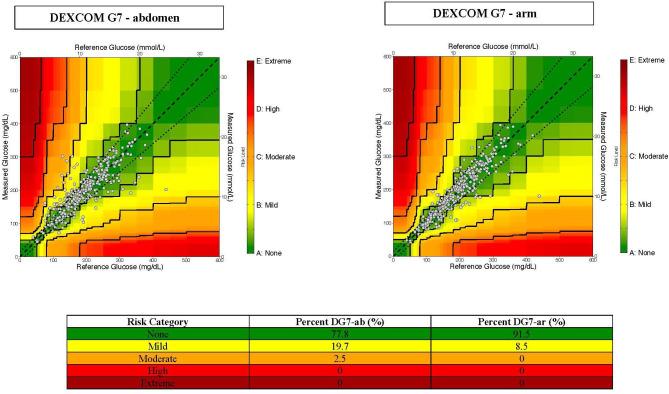
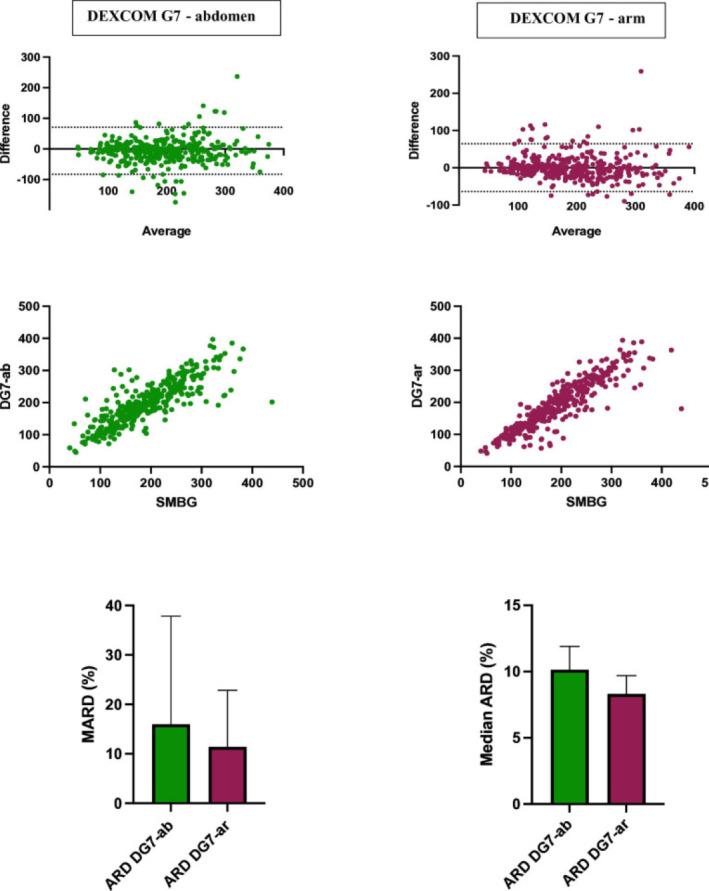
In August 2024, 'Diabete Sommerso' organised a 4-day diving cruise around Elba Island (Italy) with 15 participants, including individuals with T1DM. Each participant with diabetes wore two DG7 sensors (one on the arm and one on the abdomen), calibrated daily and compared the results to capillary glucose (Beurer GL50Evo as the reference). Accuracy was assessed using mean absolute relative difference (MARD)/median ARD, Food and Drug Administration (FDA) integrated continuous glucose monitoring (iCGM) criteria and Surveillance Error Grid (SEG) analysis. Hypoglycaemia detection and trends were also evaluated.
RESULTS
Eight participants with T1DM completed the study using 16 DG7 sensors with no detachments or skin reactions. Analysis of 765 sensor-capillary glucose pairs during 68 dives showed an overall MARD of 13.7%, with arm sensors (11% MARD) outperforming abdomen sensors (16%, p=0.0001). SEG analysis revealed that more than 97% of readings fell within the no-risk zone; however, the FDA's iCGM criteria for non-adjunctive use were not met.
CONCLUSIONS
Calibration improved the accuracy of DG7 in repetitive diving for patients with T1DM. However, capillary glucose checks remain essential, as non-adjunctive criteria were not met.
背景
连续血糖监测仪(CGM)在1型糖尿病(T1DM)患者水肺潜水中的应用显示出潜力,但面临与准确性相关的挑战。先前的研究强调了德康G7(DG7)在重复潜水环境中的准确性较差。本研究调查了校准对DG7准确性的影响,为患者和临床医生提供了有价值的见解。
材料与方法
2024年8月,“糖尿病潜水”组织了一次为期4天的环绕厄尔巴岛(意大利)的潜水巡航,有15名参与者,包括T1DM患者。每位糖尿病参与者佩戴两个DG7传感器(一个在手臂上,一个在腹部),每天进行校准,并将结果与毛细血管血糖(以博勒GL50Evo作为参考)进行比较。使用平均绝对相对差异(MARD)/中位数ARD、美国食品药品监督管理局(FDA)综合连续血糖监测(iCGM)标准和监测误差网格(SEG)分析来评估准确性。还评估了低血糖检测和趋势。
结果
8名T1DM参与者使用16个DG7传感器完成了研究,没有出现传感器脱落或皮肤反应。在68次潜水中对765对传感器 - 毛细血管血糖进行分析,总体MARD为13.7%,手臂传感器(MARD为11%)的表现优于腹部传感器(16%,p = 0.0001)。SEG分析显示,超过97%的读数落在无风险区域;然而,未达到FDA非辅助使用的iCGM标准。
结论
校准提高了DG7在T1DM患者重复潜水中的准确性。然而,由于未达到非辅助标准,毛细血管血糖检查仍然至关重要。
 Zotero 插件