
两种异构体硼氮稠合芳香骨架的区域选择性构建,用于超长室温磷光材料的合成。
Regioselective construction of two isomeric BN-fused aromatic frameworks enabling the synthesis of ultralong room-temperature phosphorescence materials.
作者信息
Feng Qiang, Yao Junxiong, Wu Qianxin, Qiu Yang, Wang Zicheng, Wang Xia, Chen Weilin, Tong Sibo, Cao Xiaohua, Sun Jianqi, Ye Qianqian, Liu Jianhua, Wang Dianyuan, Wang Jianguo, Huang Huanan
机构信息
College of Chemistry and Chemical Engineering, Jiangxi Province Engineering Research Center of Ecological Chemical Industry, Jiujiang University Jiujiang 332005 China
College of Chemistry and Chemical Engineering, College of Green Chemistry and Environment, Institutes of Biomedical Sciences, Inner Mongolia Key Laboratory of Synthesis and Application of Organic Functional Molecules, Inner Mongolia University Hohhot 010021 P. R. China
出版信息
Chem Sci. 2025 Aug 25. doi: 10.1039/d5sc05061h.
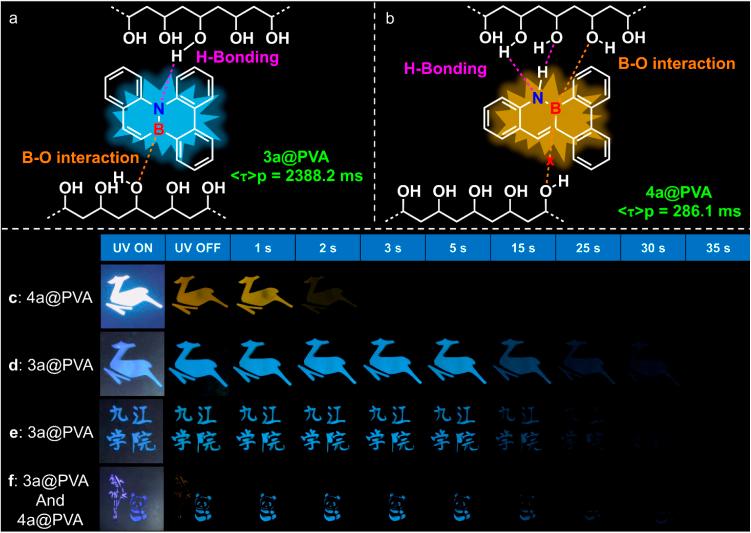
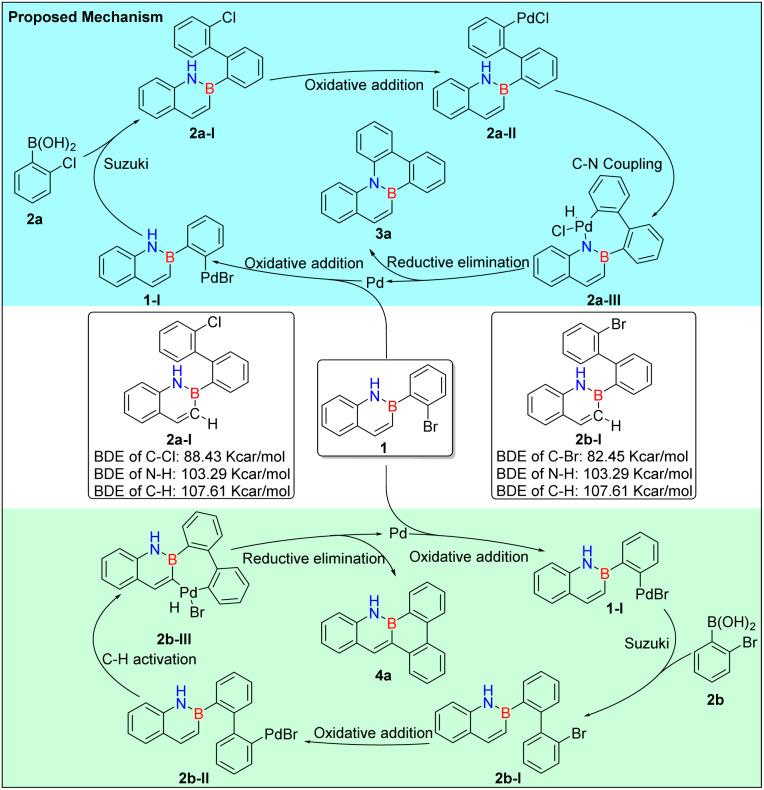
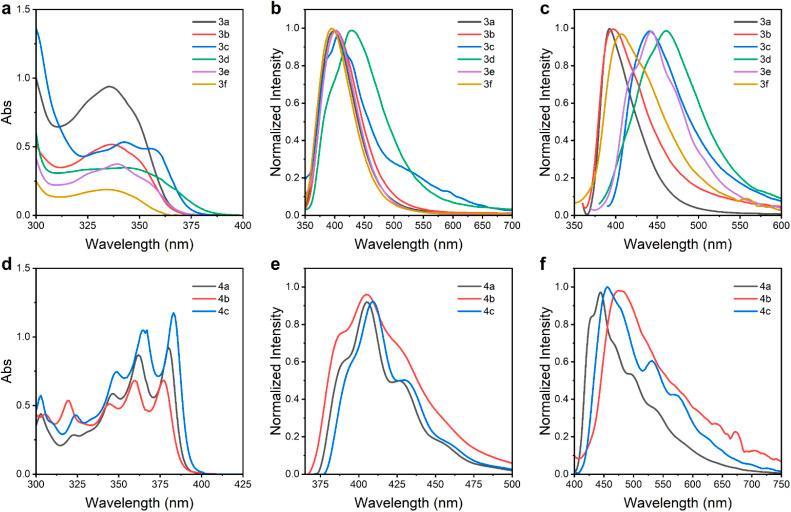
BN-fused aromatic compounds have garnered significant attention due to their unique electronic structures and exceptional photophysical properties, positioning them as highly promising candidates for applications in organic optoelectronics. However, the regioselective synthesis of BN isomers remains a formidable challenge, primarily stemming from the difficulty in precisely controlling reaction sites, limiting structural diversity and property tunability. Herein, we propose a regioselective synthetic strategy that employs 2,1-BN-naphthalene derivatives, wherein selective activation of N-H and C-H bonds is achieved in conjunction with -halogenated phenylboronic acids. Under uniform reaction conditions, two distinct boron-nitrogen fused ring isomers were successfully synthesized. A computational analysis of C-X bond dissociation energies indicates that the observed regioselectivity is most likely governed by the interplay of halogen electronegativity, atomic radius, and bond dissociation energy parameters. Interestingly, the two isomers exhibit markedly distinct room-temperature phosphorescence (RTP) in polyvinyl alcohol (PVA). Specifically, 3a@PVA demonstrates ultralong RTP characteristics, featuring an exceptionally long phosphorescence lifetime of up to 2388.2 ms and an afterglow persisting for more than 30 seconds, significantly longer than the 286.1 ms observed for 4a@PVA. Theoretical investigations reveal that 3a possesses a higher spin-orbit coupling constant and more intersystem crossing channels than 4a. Additionally, the dual-sided fixation of the 3a@PVA system imposes significant constraints on intramolecular motions, effectively suppressing non-radiative decay pathways, which accounts for its distinct afterglow behaviors. These divergent photophysical characteristics significantly enhance their potential applications in advanced anti-counterfeiting technologies. This work not only establishes a versatile synthetic strategy for the regioselective construction of BN-fused isomers but also provides fundamental insights into the rational design of BN-incorporating organic RTP systems.
硼氮(BN)稠合芳香化合物因其独特的电子结构和优异的光物理性质而备受关注,使其成为有机光电子学应用中极具潜力的候选材料。然而,BN异构体的区域选择性合成仍然是一个巨大的挑战,主要源于精确控制反应位点的困难,这限制了结构多样性和性能可调性。在此,我们提出了一种区域选择性合成策略,该策略采用2,1-BN-萘衍生物,其中通过与卤代苯硼酸结合实现N-H和C-H键的选择性活化。在均匀的反应条件下,成功合成了两种不同的硼氮稠合环异构体。对C-X键解离能的计算分析表明,观察到的区域选择性很可能受卤素电负性、原子半径和键解离能参数相互作用的支配。有趣的是,这两种异构体在聚乙烯醇(PVA)中表现出明显不同的室温磷光(RTP)。具体而言,3a@PVA表现出超长RTP特性,具有长达2388.2 ms的超长磷光寿命和持续超过30秒的余辉,明显长于4a@PVA观察到的286.1 ms。理论研究表明,3a比4a具有更高的自旋-轨道耦合常数和更多的系间窜越通道。此外,3a@PVA体系的双侧固定对分子内运动施加了显著限制,有效抑制了非辐射衰变途径,这解释了其独特的余辉行为。这些不同的光物理特性显著增强了它们在先进防伪技术中的潜在应用。这项工作不仅为区域选择性构建BN稠合异构体建立了一种通用的合成策略,还为含BN有机RTP体系的合理设计提供了基本见解。


 Zotero 插件