
脑力劳动与生物衰老之间的关联:内脏脂肪指数的中介作用。
Association between mental work and biological aging: the mediating role of visceral adiposity index.
作者信息
Zhang Kangnan, Xu Rongdi, Liu Yuhe, Wu Wenqian, Zhou Yong
机构信息
Clinical Research Institute, Shanghai General Hospital, Shanghai Jiao tong University School of Medicine, Shanghai, China.
出版信息
Innov Aging. 2025 Jul 8;9(8):igaf077. doi: 10.1093/geroni/igaf077. eCollection 2025 Aug.
BACKGROUND AND OBJECTIVES
This study aimed to investigate the relationship between mental work, work intensity, and accelerated biological aging, focusing on the mediating role of the Visceral Adiposity Index (VAI).
RESEARCH DESIGN AND METHODS
In this cross-sectional study, data were collected from the Kailuan physical activity cohorts in the Asia-Pacific region. Biological aging was assessed using PhenoAge and Klemera-Doubal method age (KDMAge) acceleration. Multivariable linear regression models examined the link between mental work and biological aging, while mediation analysis assessed the role of VAI.
RESULTS
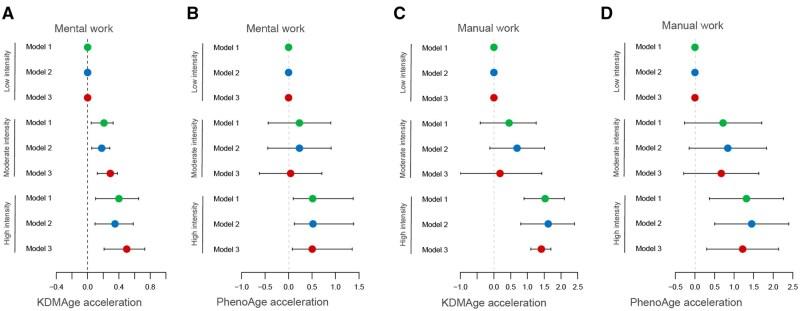
Among 3,933 participants (mean age 56.4 years; 55.6% male), mental workers showed greater biological age (BA) acceleration: KDMAge acceleration increased by 1.52 years ( for trend = .04) and PhenoAge by 1.46 years ( for trend < .001) compared to manual workers, after adjusting for age and sex. In mental workers, high labor intensity was associated with greater BA acceleration: KDMAge β = 0.40, 95% CI [0.10-0.65]; PhenoAge β = 0.51, 95% CI [0.10-1.38]. In manual workers, high labor intensity also correlated with increased BA acceleration: KDMAge β = 1.53, 95% CI [0.91-2.12]; PhenoAge β = 1.32, 95% CI [0.37-2.26]. Mediation analysis showed that VAI mediated 9.8% of the mental work-PhenoAge relationship and 20.9% of the KDMAge relationship.
DISCUSSION AND IMPLICATIONS
Mental work is associated with accelerated biological aging. These results highlight the importance of interventions targeting work intensity and metabolic health to reduce age-related disease burdens.
背景与目的
本研究旨在调查脑力劳动、工作强度与生物衰老加速之间的关系,重点关注内脏脂肪指数(VAI)的中介作用。
研究设计与方法
在这项横断面研究中,收集了亚太地区开滦体力活动队列的数据。使用PhenoAge和Klemera-Doubal方法年龄(KDMAge)加速来评估生物衰老。多变量线性回归模型检验了脑力劳动与生物衰老之间的联系,中介分析评估了VAI的作用。
结果
在3933名参与者(平均年龄56.4岁;55.6%为男性)中,与体力劳动者相比,脑力劳动者的生物年龄(BA)加速更大:调整年龄和性别后,KDMAge加速增加1.52岁(趋势P = 0.04),PhenoAge增加1.46岁(趋势P < 0.001)。在脑力劳动者中,高劳动强度与更大的BA加速相关:KDMAge β = 0.40,95%置信区间[0.10 - 0.65];PhenoAge β = 0.51,95%置信区间[0.10 - 1.38]。在体力劳动者中,高劳动强度也与BA加速增加相关:KDMAge β = 1.53,95%置信区间[0.91 - 2.12];PhenoAge β = 1.32,95%置信区间[0.37 - 2.26]。中介分析表明,VAI介导了9.8%的脑力劳动 - PhenoAge关系和20.9%的KDMAge关系。
讨论与启示
脑力劳动与生物衰老加速有关。这些结果凸显了针对工作强度和代谢健康进行干预以减轻与年龄相关疾病负担的重要性。
 Zotero 插件