
造血干细胞移植受者中碳青霉烯酶产生菌的定植及碳青霉烯酶产生菌血症的风险
Carbapenemase-Producing Colonization and the Risk of Carbapenemase-Producing Bacteremia in Hematopoietic Stem Cell Transplant Recipients.
作者信息
Kang Sung-Woon, Lim So Yun, Chang Euijin, Jung Jiwon, Chong Yong Pil, Park Hyunkyung, Park Han-Seung, Choi Yunsuk, Lee Jung-Hee, Lee Je-Hwan, Kim Sung-Han
机构信息
Department of Infectious Diseases, Asan Medical Center, University of Ulsan College of Medicine, Seoul, Republic of Korea.
Department for Infection Control, Armed Forces Daejeon Hospital, Daejeon, Republic of Korea.
出版信息
Open Forum Infect Dis. 2025 Sep 2;12(9):ofaf516. doi: 10.1093/ofid/ofaf516. eCollection 2025 Sep.
BACKGROUND
Carbapenemase-producing (CPE) are globally concerning pathogens due to limited therapeutic options. Despite the increasing incidence of CPE infections, evidence supporting effective empirical treatments for individuals undergoing hematopoietic stem cell transplantation (HSCT) remains limited.
METHODS
From January 2019 to December 2023, individuals undergoing HSCT screened for CPE colonization via perianal swabs upon admission before HSCT were retrospectively analyzed. Culture-based identification and carbapenemase-specific polymerase chain reaction were performed. The occurrence of bacteremia within 100 days post-HSCT was monitored. Propensity-score (PS) matching and competing risk analyses were used to evaluate the relationship between CPE colonization and bacteremia risk.
RESULTS
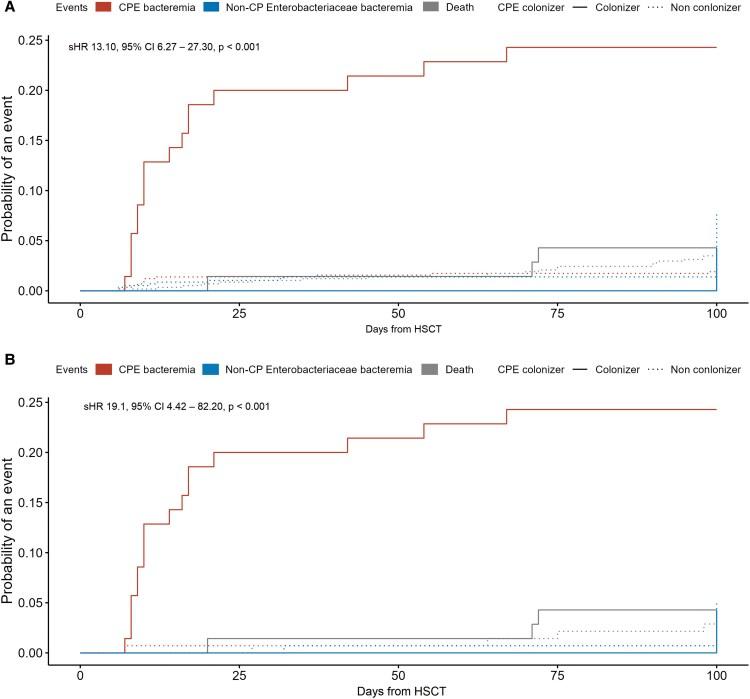
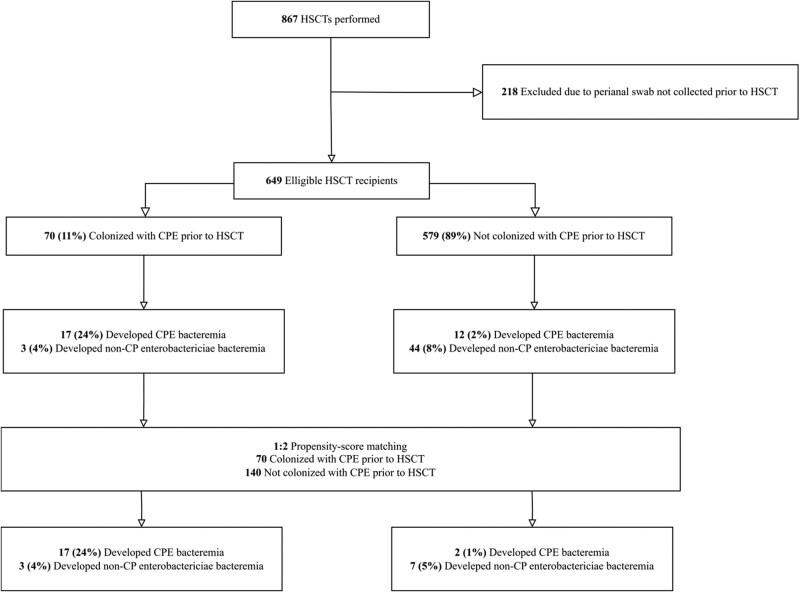
Among 649 patients undergoing HSCT, 70 (11%) were colonized with CPE. bacteremia occurred in 20 (29%) CPE-colonized and 56 (10%) noncolonized individuals ( < .001). Among these cases, 17/20 (85%) in the colonized group and 12/56 (21%) in the noncolonized group were caused by CPE ( < .001). After 1:2 PS matching, these rates remained consistent (85% vs 22%, = .004). All CPE isolates recovered from blood were identical in species and carbapenemase type to those detected in pre-HSCT swabs. Competing risk analyses showed that pre-HSCT CPE colonization was significantly associated with CPE bacteremia (subdistribution hazard ratio [sHR] 13.1, 95% confidence interval [CI] 6.27-27.3, < .001; after matching: sHR 19.1, 95% CI 4.42-82.20, < .001).
CONCLUSIONS
Pre-HSCT CPE colonization increases bacteremia risk. Routine screening and empirical CPE-directed therapy are essential to improving clinical outcomes.
背景
产碳青霉烯酶肠杆菌(CPE)是全球关注的病原体,因为治疗选择有限。尽管CPE感染的发病率不断上升,但支持对接受造血干细胞移植(HSCT)的个体进行有效经验性治疗的证据仍然有限。
方法
回顾性分析2019年1月至2023年12月期间,在HSCT入院时通过肛周拭子筛查CPE定植的接受HSCT的个体。进行基于培养的鉴定和碳青霉烯酶特异性聚合酶链反应。监测HSCT后100天内菌血症的发生情况。采用倾向评分(PS)匹配和竞争风险分析来评估CPE定植与菌血症风险之间的关系。
结果
在649例接受HSCT的患者中,70例(11%)被CPE定植。20例(29%)CPE定植患者和56例(10%)未定植个体发生了菌血症(P<0.001)。在这些病例中,定植组17/20(85%)和未定植组12/56(21%)由CPE引起(P<0.001)。在1:2 PS匹配后,这些比率保持一致(85%对22%,P = 0.004)。从血液中分离出的所有CPE菌株在种类和碳青霉烯酶类型上与HSCT前拭子中检测到的菌株相同。竞争风险分析表明,HSCT前CPE定植与CPE菌血症显著相关(亚分布风险比[sHR] 13.1,95%置信区间[CI] 6.27 - 27.3,P<0.001;匹配后:sHR 19.1,95% CI 4.42 - 82.20,P<0.001)。
结论
HSCT前CPE定植增加菌血症风险。常规筛查和经验性CPE导向治疗对于改善临床结局至关重要。
 Zotero 插件