
行走速度及其与骨质疏松症和病理性骨折的关联:来自英国生物银行的见解
Walking pace and its association with osteoporosis and pathological fractures: insights from UK biobank.
作者信息
Hu Qin, Liu Haoran, Du Yuchen, Duan Runchen, Li Linpeng, Yang Daishui, Ouyang Zhengxiao
机构信息
Department of Orthopedics, The Second Xiangya Hospital, Central South University, Changsha, Hunan, China.
Emergency Medicine Center, Sichuan Provincial People's Hospital, University of Electronic Science and Technology of China, Chengdu, China.
出版信息
Front Endocrinol (Lausanne). 2025 Aug 26;16:1635999. doi: 10.3389/fendo.2025.1635999. eCollection 2025.
BACKGROUNDS
Osteoporosis is a prevalent bone disease. Previous research has indicated that various forms of exercise have different protective effects on bone health, yet there are limited studies on the impact of walking pace on bone mineral density (BMD) and skeletal health. This study aims to investigate the correlation between usual walking pace and osteoporosis, including related fractures, while considering potential interactions with genetic vulnerability.
METHODS
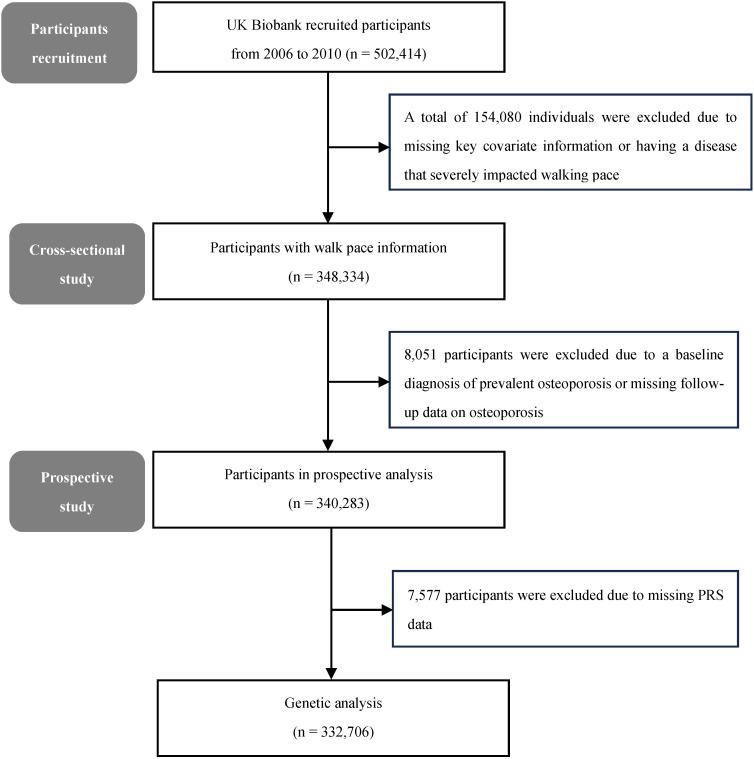
Survey responses from 348,334 participants in the UK Biobank were analyzed, obtaining information on usual walking pace, BMD, osteoporosis incidence, and genetic vulnerability. Multiple linear regression, Cox proportional hazards regression models, and stratified analysis methods were employed. A weighted genetic risk score for osteoporosis was calculated.
RESULTS
Cross-sectional analysis revealed a notable upward trend in BMD and a downward trend in the risk of osteoporosis and fractures from slow to brisk walking pace ( <0.001). Slow walking was associated with the highest risk of osteoporosis [hazard ratio (HR) 2.18, 95% confidence interval (CI) 2.03 - 2.34] and fractures (HR 2.25, 95% CI 1.79 - 2.81). Prospective analysis showed that brisk walking was significantly linked to reduced incident osteoporosis (HR 0.85, 95% CI 0.79 - 0.91) and fractures (HR 0.75, 95% CI 0.63 - 0.89) after excluding baseline cases.
CONCLUSIONS
The findings provide evidence that walking pace is closely related to the prevalence of osteoporosis and fracture incidence. Therefore, integrating walking into national physical activity initiatives and encouraging individuals to increase their walking pace could serve as an effective preventive measure against osteoporosis.
背景
骨质疏松症是一种常见的骨骼疾病。先前的研究表明,各种形式的运动对骨骼健康有不同的保护作用,但关于步行速度对骨密度(BMD)和骨骼健康影响的研究有限。本研究旨在探讨日常步行速度与骨质疏松症(包括相关骨折)之间的相关性,同时考虑与遗传易感性的潜在相互作用。
方法
分析了英国生物银行中348,334名参与者的调查回复,获取了有关日常步行速度、骨密度、骨质疏松症发病率和遗传易感性的信息。采用了多元线性回归、Cox比例风险回归模型和分层分析方法。计算了骨质疏松症的加权遗传风险评分。
结果
横断面分析显示,从慢步到快步,骨密度呈显著上升趋势,骨质疏松症和骨折风险呈下降趋势(<0.001)。慢步与骨质疏松症的最高风险相关[风险比(HR)2.18,95%置信区间(CI)2.03 - 2.34]和骨折(HR 2.25,95% CI 1.79 - 2.81)。前瞻性分析表明,排除基线病例后,快步与降低骨质疏松症发病率(HR 0.85,95% CI 0.79 - 0.91)和骨折(HR 0.75,95% CI 0.63 - 0.89)显著相关。
结论
研究结果提供了证据,表明步行速度与骨质疏松症的患病率和骨折发生率密切相关。因此,将步行纳入国家体育活动倡议并鼓励个人加快步行速度可作为预防骨质疏松症的有效措施。
 Zotero 插件