
1990年至2021年五个东亚国家不孕症的疾病负担及2050年预测:基于2021年全球疾病负担研究的分析
Disease burden of infertility in five East Asian countries from 1990 to 2021 and prediction for 2050: An analysis of the Global Burden of Disease study 2021.
作者信息
Sun Fengze, Wang Wenyu, Ding Guixin, Wang Yini, Liu Hongquan, Chi Youwei, Guo Yicheng, Ma Xiaohong, Ma Jian, Wu Jitao
机构信息
Department of Urology, Yantai Yuhuangding Hospital, Qingdao University, Yantai, Shandong, China.
The second clinical medical college, Binzhou Medical University, Yantai, Shandong, China.
出版信息
PLoS One. 2025 Sep 11;20(9):e0331617. doi: 10.1371/journal.pone.0331617. eCollection 2025.
BACKGROUND
With the development of society, fertility seems to have become a public health issue in East Asian countries. At present, there is insufficient attention to infertility, especially male infertility. Understanding the burden and trends of infertility in men and women aged 20-49 years in East Asia is essential for fertility issues.
METHOD
The related data in China, Democratic People's Republic of Korea, Japan, Mongolia and Republic of Korea, was extracted from the Global Burden of Disease (GBD) Study 2021 including prevalence, disability-adjusted life-year (DALY), age-standardized prevalence rate (ASPR) and age-standardized DALY rate. Annual percentage change (APC) and average annual percentage change (AAPC) were conducted by joinpoint analysis. The impact of age, period and birth cohort on the infertility was calculated by age-period-cohort model. We also predicted the future burden of infertility using Bayesian age period cohort (BAPC) analysis.
RESULT
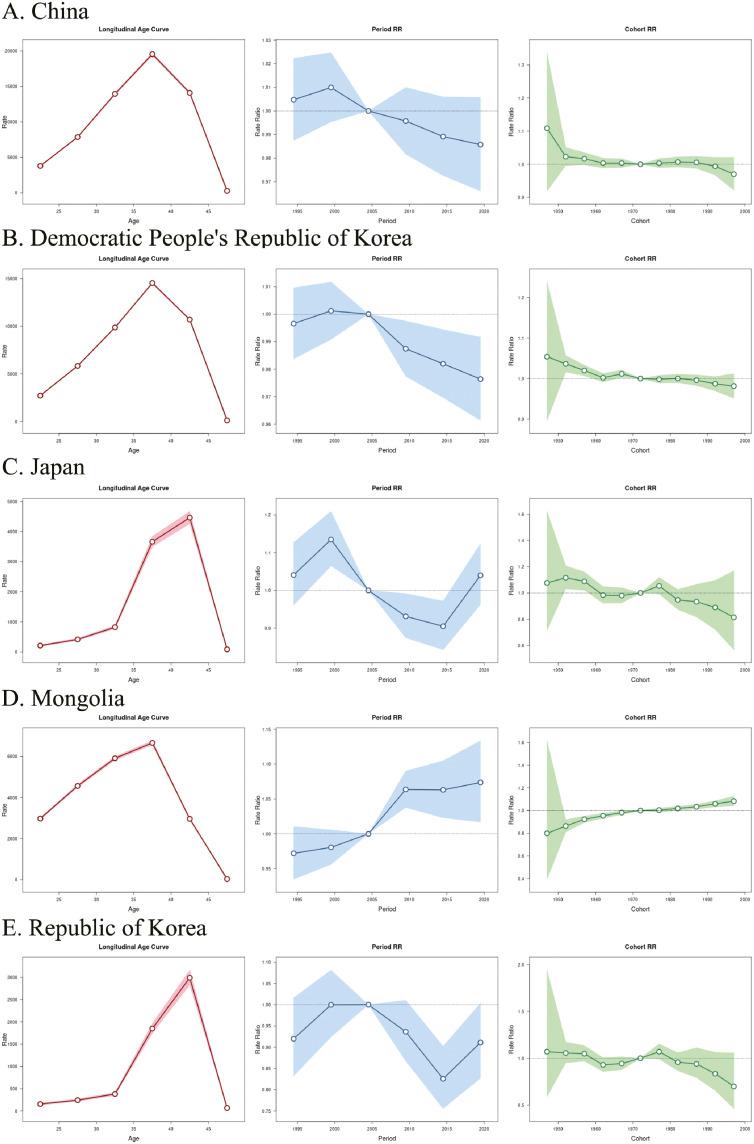
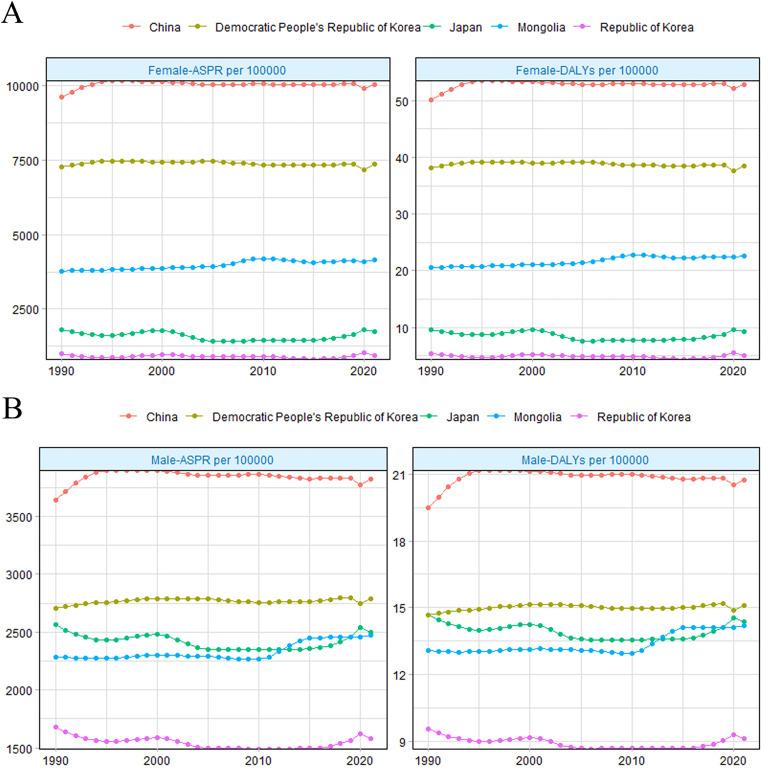
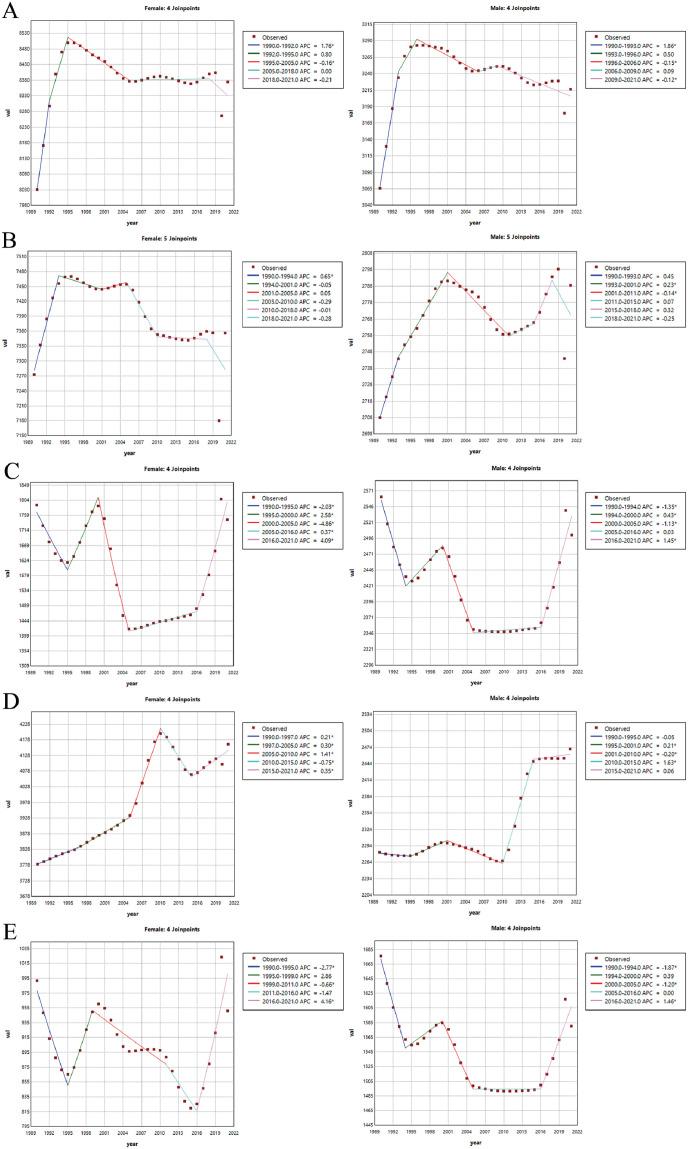
The burden of infertility aged 20-49 years group varied across five East Asian countries from 1990 to 2021, in which the trend of China (AAPC: FI 0.12, 95%UI: 0.01 to 0.22; MI 0.14, 95%UI: 0.02 to 0.27) and Mongolia (AAPC: FI 0.3, 95%UI: 0.24 to 0.35; MI 0.25, 95%UI: 0.21 to 0.28) showed increased, and the others were stable. The risk of male prevalence was significantly higher than that of female in two developed countries, while it was contrary in three developing countries. The burden of infertility increased with age in developing countries and reached the highest at the age of 35-39. In developed countries, the 40-44 age group has the highest burden of infertility. The future burden of infertility showed a downward trend to 2050 in China and Democratic People's Republic of Korea, while it predicted to increase in Japan, Mongolia and Republic of Korea. These differences may be affected by socio-economic factors and health policies, highlighting significant differences between countries.
CONCLUSION
The infertility burden in the five East Asian countries aged 20-49 years varies among age group and gender from 1990 to 2021, which is still a public threat. It is necessary to formulate appropriate strategies according to different situations to alleviate the burden of infertility.
背景
随着社会的发展,生育问题在东亚国家似乎已成为一个公共卫生问题。目前,对不孕症,尤其是男性不育症的关注不足。了解东亚20至49岁男性和女性不孕症的负担及趋势对于生育问题至关重要。
方法
从《2021年全球疾病负担研究》中提取中国、朝鲜民主主义人民共和国、日本、蒙古和韩国的相关数据,包括患病率、伤残调整生命年(DALY)、年龄标准化患病率(ASPR)和年龄标准化DALY率。通过连接点分析计算年度百分比变化(APC)和平均年度百分比变化(AAPC)。采用年龄-时期-队列模型计算年龄、时期和出生队列对不孕症的影响。我们还使用贝叶斯年龄时期队列(BAPC)分析预测了不孕症的未来负担。
结果
1990年至2021年期间,东亚五个国家20至49岁年龄组的不孕症负担各不相同,其中中国(AAPC:女性不孕症0.12,95%UI:0.01至0.22;男性不孕症0.14,95%UI:0.02至0.27)和蒙古(AAPC:女性不孕症0.3,95%UI:0.24至0.35;男性不孕症0.25,95%UI:0.21至0.28)的趋势呈上升,其他国家则较为稳定。在两个发达国家,男性患病率风险显著高于女性,而在三个发展中国家情况则相反。在发展中国家,不孕症负担随年龄增长而增加,在35至39岁时达到最高。在发达国家,40至44岁年龄组的不孕症负担最高。中国和朝鲜民主主义人民共和国的不孕症未来负担到2050年呈下降趋势,而日本、蒙古和韩国预计会增加。这些差异可能受社会经济因素和卫生政策影响,凸显了国家间的显著差异。
结论
1990年至2021年期间,东亚五个国家20至49岁年龄组的不孕症负担在年龄组和性别上存在差异,这仍是一个公共威胁。有必要根据不同情况制定适当策略以减轻不孕症负担。

 Zotero 插件