
急性冠状动脉综合征合并心源性休克患者早期血运重建或引入机械循环支持的优先事项——一项系统评价和荟萃分析
Priorities for Early Revascularization or Introduction of Mechanical Circulatory Support in Patients With Acute Coronary Syndrome Complicated by Cardiogenic Shock - A Systematic Review and Meta-Analysis.
作者信息
Katasako-Yabumoto Aya, Sakamoto Kazuo, Hashiba Katsutaka, Yamamoto Takeshi, Nakayama Naoki, Hanada Hiroyuki, Nakashima Takahiro, Kirigaya Jin, Ishizu Tomoko, Hosoya Yumiko, Kondo Toru, Okazaki Yusuke, Yamamoto Masahiro, Osawa Takumi, Arai Marina, Tahara Yoshio, Nonogi Hiroshi, Noguchi Teruo, Tsujimoto Yasushi, Kikuchi Migaku, Matoba Tetsuya
机构信息
Department of Cardiovascular Medicine, National Cerebral and Cardiovascular Center Osaka Japan.
Department of Cardiovascular Medicine, Kyushu University Graduate School of Medical Sciences Fukuoka Japan.
出版信息
Circ Rep. 2025 Jul 23;7(9):715-726. doi: 10.1253/circrep.CR-25-0098. eCollection 2025 Sep 10.
BACKGROUND
The optimal timing for mechanical circulatory support (MCS) initiation in patients with acute myocardial infarction complicated by cardiogenic shock (CS) is unknown, so in this study we analyzed whether MCS implementation before percutaneous coronary intervention (PCI) is associated with better outcomes compared to after PCI.
METHODS AND RESULTS
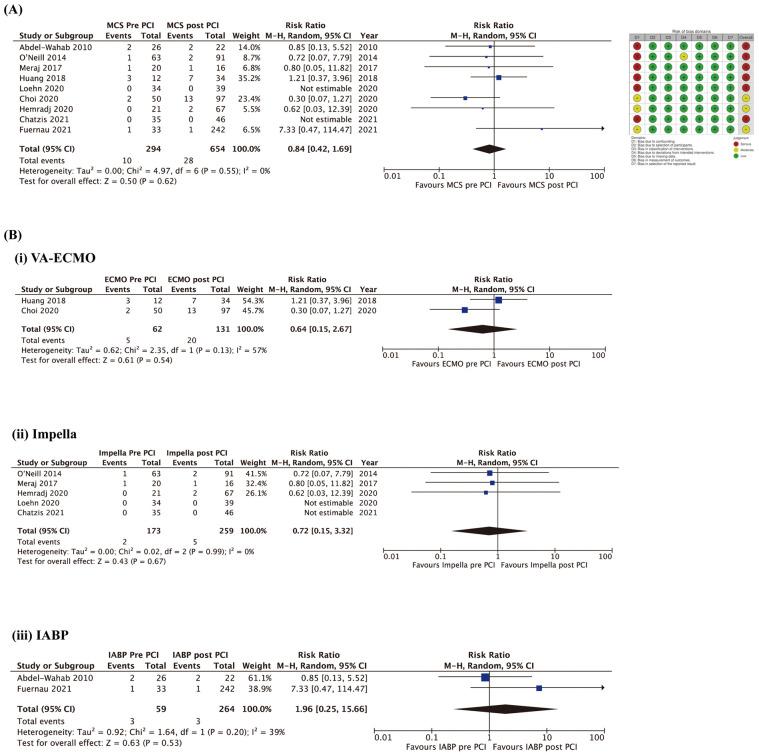
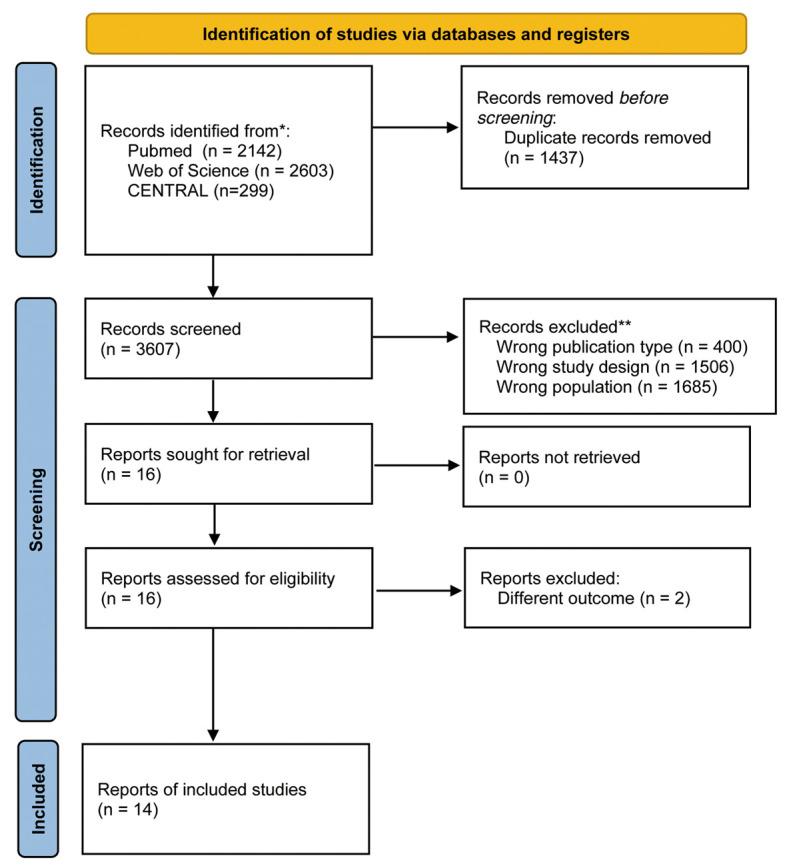
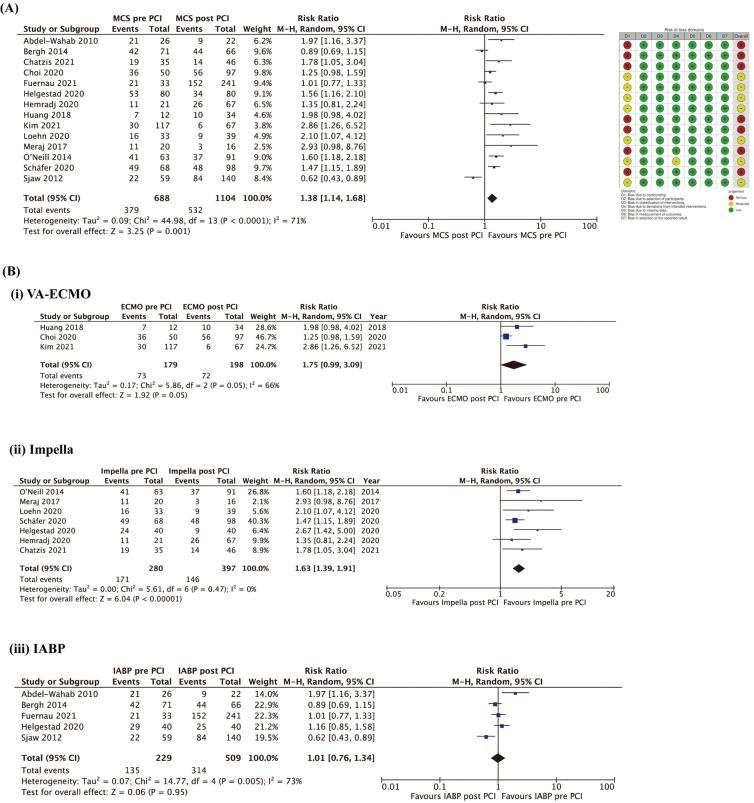
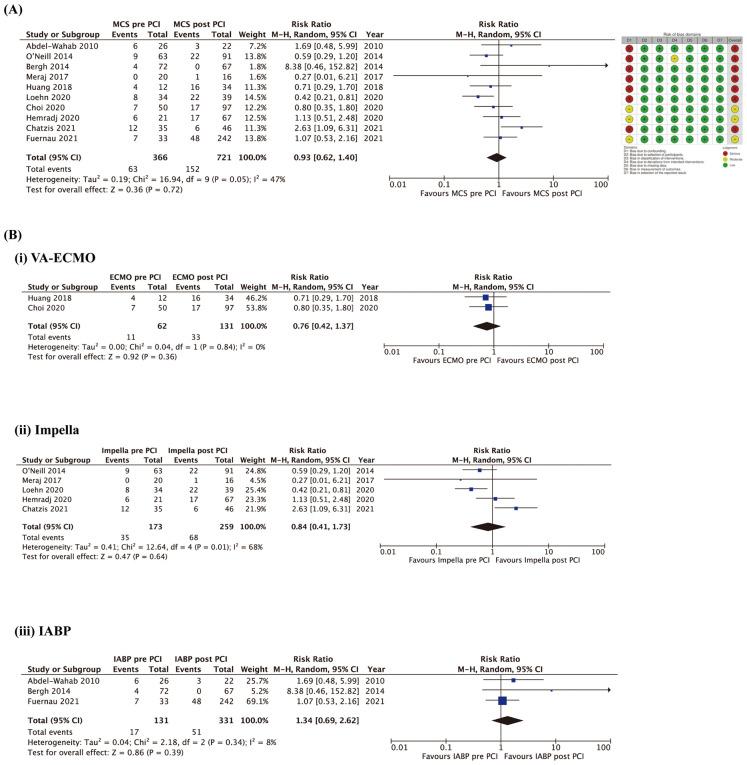
We conducted a systematic review and meta-analysis using a random-effects model to account for potential heterogeneity. Risk ratios and 95% confidence intervals were used for dichotomous outcomes. PubMed, Web of Science, and CENTRAL were searched up to April 30, 2023. Certainty of evidence was evaluated according to the Risk of Bias in Non-Randomized Studies of Interventions-I tool. A total of 14 observational studies met the inclusion criteria. We found that venoarterial-extracorporeal membrane oxygenation (VA-ECMO) may have little to no positive effect on short-term survival, but the evidence was very uncertain. Impella use probably increases short-term survival (moderate certainty of evidence), whereas the timing of intra-aortic balloon pump (IABP) insertion improves outcomes (very low certainty of evidence). Pre- and post-PCI MCS implementation may result in little to no difference in bleeding complications or stroke incidence across all device types (low to very low certainty of evidence).
CONCLUSIONS
Early Impella implementation before PCI may increase short-term survival, whereas the timing of ECMO or IABP implementation may have little to no effect on outcomes; however, the evidence is very uncertain.
背景
急性心肌梗死合并心源性休克(CS)患者开始机械循环支持(MCS)的最佳时机尚不清楚,因此在本研究中,我们分析了与经皮冠状动脉介入治疗(PCI)后相比,在PCI前实施MCS是否与更好的预后相关。
方法和结果
我们进行了一项系统评价和荟萃分析,使用随机效应模型来考虑潜在的异质性。风险比和95%置信区间用于二分结局。检索了截至2023年4月30日的PubMed、科学网和CENTRAL。根据干预非随机研究中的偏倚风险-I工具评估证据的确定性。共有14项观察性研究符合纳入标准。我们发现静脉-动脉体外膜肺氧合(VA-ECMO)对短期生存可能几乎没有积极影响,但证据非常不确定。使用Impella可能会提高短期生存率(证据确定性中等),而主动脉内球囊泵(IABP)置入时机可改善预后(证据确定性非常低)。在所有设备类型中,PCI前后实施MCS在出血并发症或卒中发生率方面可能几乎没有差异(证据确定性低至极低)。
结论
PCI前早期使用Impella可能会提高短期生存率,而ECMO或IABP的实施时机可能对预后几乎没有影响;然而,证据非常不确定。
 Zotero 插件