
牛至精油和噬菌体phiLLS对食源性病原体生物膜的协同破坏作用:原子力显微镜观察
Synergistic Disruption of Foodborne Pathogen Biofilms by Oregano Essential Oil and Bacteriophage phiLLS: Atomic Force Microscopy Insights.
作者信息
Kao Godínez Ana Karina, Regalado-González Carlos, Villicaña Claudia, Heredia José Basilio, Valdez-Torres José Benigno, Muy-Rangel María, Escamilla-García Monserrat, León-Félix Josefina
机构信息
Centro de Investigación en Alimentación y Desarrollo, A.C., Culiacán 80110, Mexico.
Facultad de Química, Universidad Autónoma de Querétaro, Cerro de las Campanas, Querétaro 76010, Mexico.
出版信息
Molecules. 2025 Aug 30;30(17):3552. doi: 10.3390/molecules30173552.
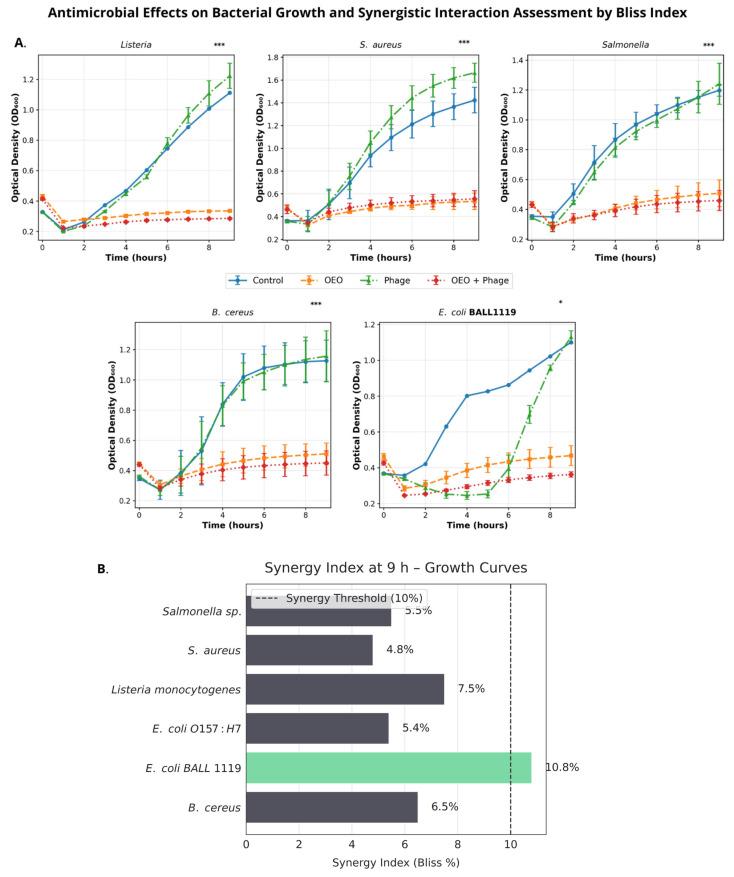
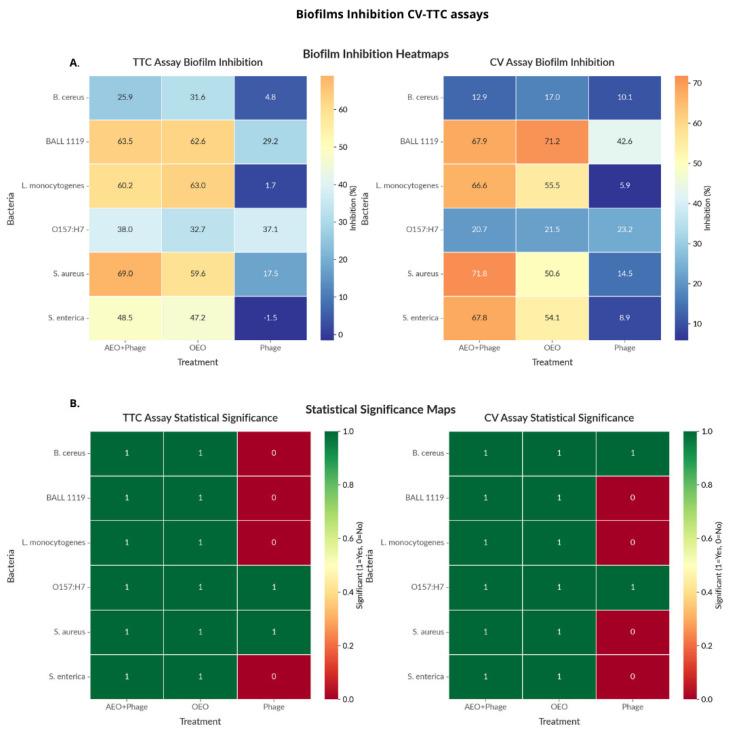
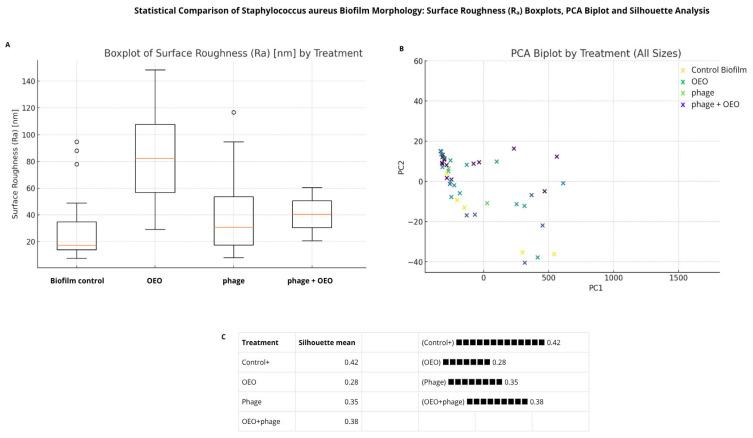
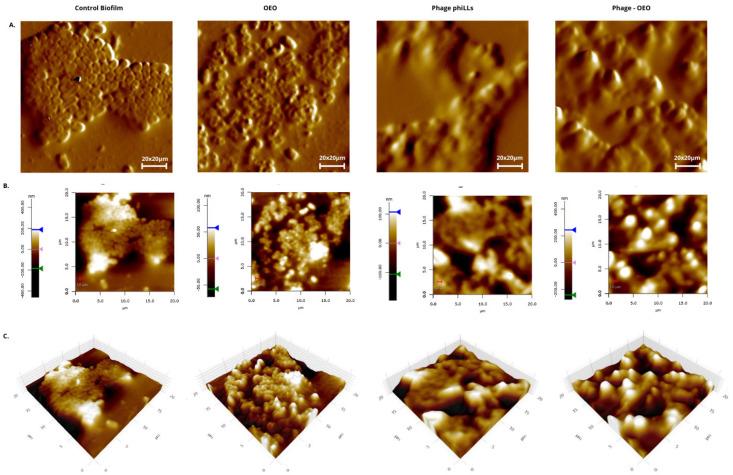
Foodborne pathogenic biofilms pose significant challenges to food safety due to their enhanced resistance to conventional antimicrobial agents. In this study, we evaluated the synergistic antibiofilm activity of oregano essential oil (OEO) from and the lytic bacteriophage phiLLS against six foodborne bacteria. GC-MS analysis achieved a 100% identification ratio, revealing that OEO was mainly composed of carvacrol (58.9%), p-cymene (28.6%), γ-terpinene (2.9%), and caryophyllene (2.6%). The MIC and MBC of OEO were 1 and 2 mg/mL, respectively, for all strains except BALL1119 (MIC = 2 mg/mL). We assessed biofilm biomass by crystal violet (CV) staining and metabolic activity using the TTC assay under both individual and combined treatments, monitored 9-hour planktonic growth kinetics to calculate Bliss and HSA synergy indexes, and employed atomic force microscopy (AFM) to visualize nanoscale alterations in and BALL1119 biofilms. Combined OEO (2 mg/mL) and phiLLS (MOI 1) treatments achieved significantly greater biofilm biomass reduction than single agents, notably yielding >70% inhibition of biofilms ( < 0.05) and a Bliss synergy index of 10.8% in BALL1119 growth kinetics, whereas other strains were additive. In biofilm assays, and spp. showed the highest reductions in biomass (CV) (71.0% and 67.8%, ΔHSA = 27.0% and 17.4%; ΔBliss = 21.1% and 13.8%) and metabolic activity (TTC) (68.6% and 48.5%). AFM revealed that OEO alone smoothed the extracellular matrix (averaging a 35% reduction in roughness), whereas the combined treatment caused fracturing (≈68 nm roughness) and prominent lytic pits. Although variability in biofilm architecture precluded statistically significant pairwise comparisons, AFM topography and consistent trends in Ra/Rz parameters provided clear visual corroboration of the significant reductions detected by CV and TTC assays. These complementary data indicate that OEO primes the biofilm matrix for enhanced phage-mediated collapse, offering a green, two-step strategy for controlling resilient foodborne biofilms.
食源性病原体生物膜由于其对传统抗菌剂的抗性增强,对食品安全构成了重大挑战。在本研究中,我们评估了牛至精油(OEO)和裂解性噬菌体phiLLS对六种食源细菌的协同抗生物膜活性。气相色谱 - 质谱联用(GC - MS)分析的鉴定率达到100%,表明OEO主要由香芹酚(58.9%)、对伞花烃(28.6%)、γ - 萜品烯(2.9%)和石竹烯(2.6%)组成。除BALL1119菌株(MIC = 2 mg/mL)外,OEO对所有菌株的最低抑菌浓度(MIC)和最低杀菌浓度(MBC)分别为1和2 mg/mL。我们通过结晶紫(CV)染色评估生物膜生物量,并在单独和联合处理下使用TTC测定法评估代谢活性,监测9小时的浮游生长动力学以计算布利斯(Bliss)和HSA协同指数,并采用原子力显微镜(AFM)观察和BALL1119生物膜的纳米级变化。联合使用OEO(2 mg/mL)和phiLLS(感染复数1)处理比单一试剂显著降低了生物膜生物量,特别是对生物膜的抑制率>70%(P < 0.05),并且在BALL1119生长动力学中布利斯协同指数为10.8%,而其他菌株表现为相加作用。在生物膜测定中,和 spp. 的生物量(CV)降低幅度最大(分别为71.0%和67.8%,ΔHSA = 27.0%和17.4%;ΔBliss = 21.1%和13.8%),代谢活性(TTC)降低幅度也最大(分别为68.6%和48.5%)。AFM显示单独使用OEO使细胞外基质变得平滑(粗糙度平均降低35%),而联合处理导致破裂(粗糙度约为68 nm)和明显的裂解坑。尽管生物膜结构的变异性使得无法进行具有统计学意义的成对比较,但AFM形貌以及Ra/Rz参数的一致趋势为CV和TTC测定检测到的显著降低提供了清晰的视觉证实。这些互补数据表明,OEO使生物膜基质更易于噬菌体介导的崩溃,为控制具有弹性的食源生物膜提供了一种绿色的两步策略。



 Zotero 插件