
1990年至2021年全球儿童腹泻负担及其流行病学特征
The global burden of childhood diarrhea and its epidemiological characteristics from 1990 to 2021.
作者信息
Zhu Hai-Yan, Xu Fan, Zhao Wen-Zhuo, Wang Hai-Xiao, Wang Hong-Gang
机构信息
Department of Pediatrics, The Affiliated Huaian No.1 People's Hospital of Nanjing Medical University, Huai'an, Jiangsu, China.
Department of Gastroenterology, The Affiliated Huaian No.1 People's Hospital of Nanjing Medical University, Huai'an, Jiangsu, China.
出版信息
Front Pediatr. 2025 Aug 28;13:1656234. doi: 10.3389/fped.2025.1656234. eCollection 2025.
INTRODUCTION
Diarrhea diseases remains a major contributor to global mortality and morbidity in children. This study aims to provide an updated assessment of rates in diarrhoea prevalence, incidence, mortality, and disability-adjusted life-years (DALYs) from 1990-2021, specifically focusing on including prevalence investigation alongside other measures. The analysis is stratified by sex, age, and socio-demographic index (SDI) at global, regional, and national levels.
METHODS
Data for this study was obtained from the 2021 Global Burden of Diseases, Injuries, and Risk Factors Study (GBD). Children aged 0-14 years with diarrhea were included in the analysis. The analyses were disaggregated by gender, 3 age categories, 21 GBD regions, 204 nations/territories, and 5 SDI quintiles. Incidence, all-cause mortality, cause-specific mortality, disability-adjusted life years (DALYs), and the corresponding estimated annual percent changes (EAPCs) were investigated.
RESULTS
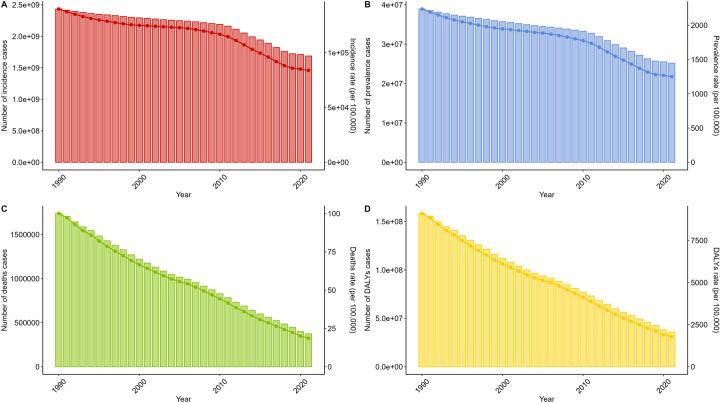
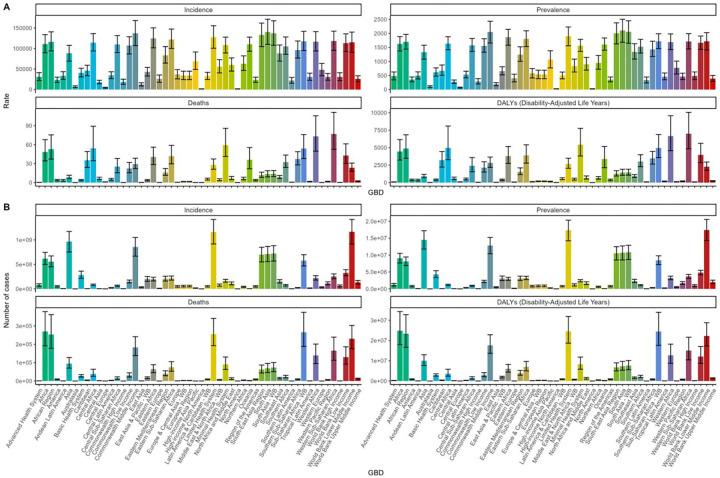
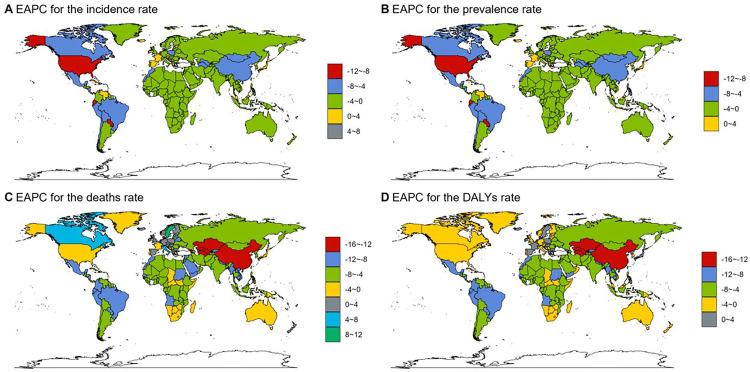
In 2021, the global burden of diarrhea diseases remained substantial, with a total of 2,432,874,591 cases with an ASPR of 1,252.09 cases per 100,000 individuals (95% UI: 1,032.41-1,474.93). The ASIR was 83,866.84 per 100,000 people (95% UI: 66,140.64-101,854.13), while the ASDR was 18.6 per 100,000 persons (95% UI: 13.99-24.79). Additionally, the age-standardized DALY rate was 1,784.28 per 100,000 individuals (95%UI: 1,361.38-2,320.22). Regionally, areas with high-middle SDI exhibited the greatest ASPR, ASIR, ASDR, and age-standardized DALY rates, whereas high SDI regions had the lowest rates. The ASPR is mostly concentrated in children aged 10-14 years old, among which the ASPR of children under 5 years old has the most significant decline, from 3,138.81 per 100,000 people (95% UI: 2,749.19-3,557.51) in 1,990-885.07 per 100,000 people (95% UI: 755.93-1,029.39), a decrease of 71%. Geospatially, South Asia had the highest ASPR and the highest ASIR. The most pronounced increase was noted in the high-income Asia-Pacific region, which is the only area exhibiting growth, with an EAPC of 1.46 (95% CI: 1.11-1.82). Interestingly, between 1990 and 2021, the ASDR in Western Europe displayed the most pronounced rise, with an EAPC of 0.81, whereas the steepest decline was observed in East Asia. The greatest ASDR and age-standardized DALY rates were observed in the western region of sub-Saharan Africa, West Africa and Central Africa. Among countries, Madagascar had both the highest ASIR and ASDR. Furthermore, African countries exhibited the highest age-standardized DALY rate. Globally, unsafe water sources remained the primary risk factor for childhood diarrhea mortality and disability-adjusted life years (DALYs) from 1990-2021. While predominant in all Sociodemographic Index (SDI) regions except high-SDI areas, high-SDI regions reported non-exclusive breastfeeding and childhood wasting as leading mortality risk factors. Unsafe water sources are expected to persist as the principal contributor in the future.
DISCUSSION
The burden of childhood diarrhea diseases globally has been decreasing but remains a substantial contributor to DALYs. Low-middle SDI regions show persistently high age-standardized rates, with South Asia bearing the highest burden. Our study clarifies the global and regional epidemiology of childhood diarrheal diseases and identifies unsafe water sources as the predominant risk factor. These findings highlight the need for region-specific water safety initiatives in high-burden areas and are vital for shaping public health strategies and policy decisions for prevention.
引言
腹泻病仍然是导致全球儿童死亡和发病的主要原因。本研究旨在对1990年至2021年期间腹泻病的患病率、发病率、死亡率和伤残调整生命年(DALYs)进行最新评估,特别注重将患病率调查与其他指标相结合。分析按全球、区域和国家层面的性别、年龄和社会人口指数(SDI)进行分层。
方法
本研究的数据来自2021年全球疾病、伤害及风险因素负担研究(GBD)。分析纳入了0至14岁患有腹泻的儿童。分析按性别、3个年龄组、21个GBD区域、204个国家/地区和5个SDI五分位数进行细分。调查了发病率、全因死亡率、特定病因死亡率、伤残调整生命年(DALYs)以及相应的估计年度百分比变化(EAPCs)。
结果
2021年,腹泻病的全球负担仍然很大,共有2432874591例病例,每10万人的年龄标准化患病率(ASPR)为1252.09例(95%UI:1032.41 - 1474.93)。每10万人的年龄标准化发病率(ASIR)为83866.84(95%UI:66140.64 - 101854.13),而每10万人的年龄标准化死亡率(ASDR)为18.6(95%UI:13.99 - 24.79)。此外,年龄标准化的伤残调整生命年率为每10万人1784.28(95%UI:1361.38 - 2320.22)。在区域层面,中高SDI地区的ASPR、ASIR、ASDR和年龄标准化DALY率最高,而高SDI地区的这些率最低。ASPR主要集中在10至14岁的儿童中,其中5岁以下儿童的ASPR下降最为显著,从1990年的每10万人3138.81例(95%UI:2749.19 - 3557.51)降至每10万人885.07例(95%UI:755.93 - 1029.39),下降了71%。在地理空间上,南亚的ASPR和ASIR最高。高收入亚太地区的增长最为显著,是唯一呈现增长的地区,EAPC为1.46(95%CI:1.11 - 1.82)。有趣的是,1990年至2021年期间,西欧的ASDR上升最为显著,EAPC为0.81,而东亚的下降最为陡峭。撒哈拉以南非洲西部地区、西非和中非的ASDR和年龄标准化DALY率最高。在国家层面,马达加斯加的ASIR和ASDR均最高。此外,非洲国家的年龄标准化DALY率最高。在全球范围内,1990年至2021年期间,不安全水源仍然是儿童腹泻死亡率和伤残调整生命年(DALYs)的主要风险因素。虽然在除高SDI地区外的所有社会人口指数(SDI)区域中都占主导地位,但高SDI地区报告非纯母乳喂养和儿童消瘦是主要的死亡风险因素。预计不安全水源在未来仍将是主要的促成因素。
讨论
全球儿童腹泻病的负担一直在下降,但仍然是伤残调整生命年的重要促成因素。中低SDI地区的年龄标准化率持续居高,南亚负担最重。我们的研究阐明了全球和区域儿童腹泻病的流行病学情况,并确定不安全水源是主要风险因素。这些发现凸显了在高负担地区开展针对特定区域的水安全倡议的必要性,对于制定预防公共卫生战略和政策决策至关重要。




 Zotero 插件