
人胎儿卵巢和睾丸生殖细胞中DAZL、VASA和OCT4表达的保守和差异模式。
Conserved and divergent patterns of expression of DAZL, VASA and OCT4 in the germ cells of the human fetal ovary and testis.
作者信息
Anderson Richard A, Fulton Norma, Cowan Gillian, Coutts Shona, Saunders Philippa Tk
机构信息
Division of Reproductive and Developmental Sciences, Queen's Medical Research Institute, Edinburgh EH16 4TJ, UK.
出版信息
BMC Dev Biol. 2007 Dec 18;7:136. doi: 10.1186/1471-213X-7-136.
BACKGROUND
Germ cells arise from a small group of cells that express markers of pluripotency including OCT4. In humans formation of gonadal compartments (cords in testis, nests in ovary) takes place during the 1st trimester (6-8 weeks gestation). In the 2nd trimester germ cells can enter meiotic prophase in females whereas in males this does not occur until puberty. We have used qRTPCR, Westerns and immunohistochemical profiling to determine which of the germ cell subtypes in the human fetal gonads express OCT4, DAZL and VASA, as these have been shown to play an essential role in germ cell maturation in mice.
RESULTS
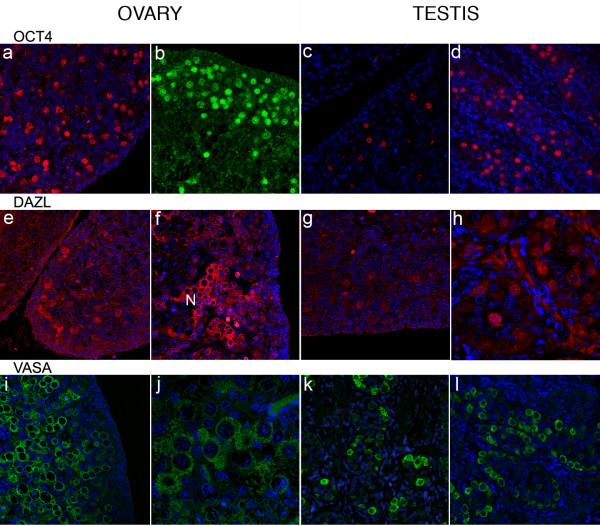
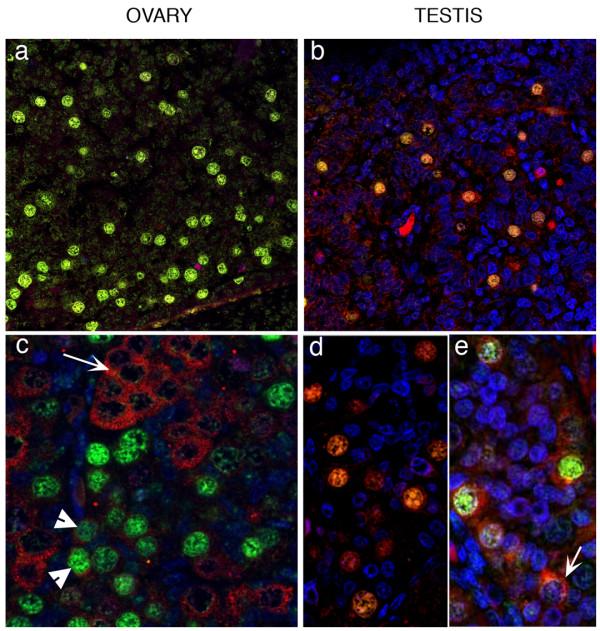
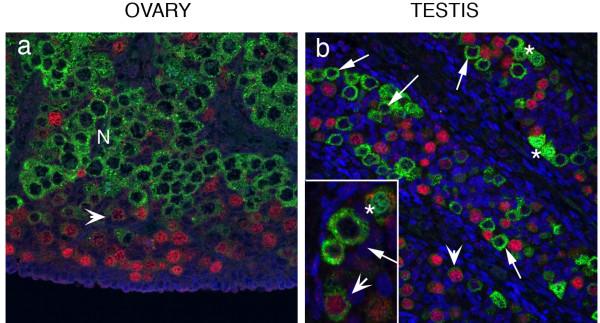
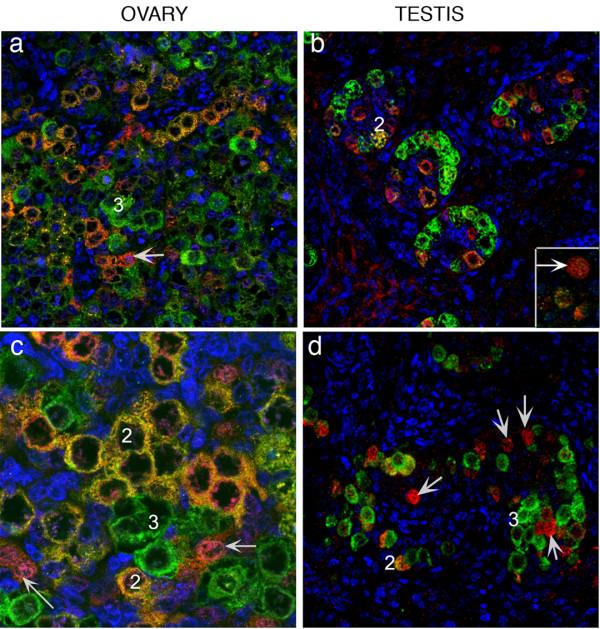
OCT4 mRNA and protein were detected in extracts from both 1st and 2nd trimester ovaries and testes. In ovarian extracts a marked increase in expression of VASA and DAZL mRNA and protein occurred in the 2nd trimester. In testicular extracts VASA mRNA and protein were low/undetectable in 1st trimester and increased in the 2nd trimester whereas the total amount of DAZL did not seem to change. During the 1st trimester, germ cells were OCT4 positive but did not express VASA. These results are in contrast to the situation in mice where expression of Vasa is initiated in Oct4 positive primordial germ cells as they enter the gonadal ridge. In the 2nd trimester germ cells with intense cytoplasmic staining for VASA were present in both sexes; these cells were OCT4 negative. DAZL expression overlapped with both OCT4 and VASA and changed from the nuclear to the cytoplasmic compartment as cells became OCT4-negative. In males, OCT4-positive and VASA-positive subpopulations of germ cells coexisted within the same seminiferous cords but in the ovary there was a distinct spatial distribution of cells with OCT4 expressed by smaller, peripherally located, germ cells whereas DAZL and VASA were immunolocalised to larger (more mature) centrally located cells.
CONCLUSION
OCT4, DAZL and VASA are expressed by human fetal germ cells but their patterns of expression are temporally and spatially distinct. In the 1st trimester OCT4 was detected in most germ cells. In the 2nd trimester the onset of expression of VASA was associated with the formation of oocytes and spermatogonia both of which were OCT-4 negative. Relocation of DAZL from nucleus to cytoplasm paralleled the down regulation of OCT4 and the onset of expression of VASA. These data reveal similarities between the expression of key regulatory proteins within germ cells as they mature in male and female fetal human gonads suggesting that in the female these maturational changes are not determined by entry into meiosis.
背景
生殖细胞起源于一小群表达包括OCT4在内的多能性标志物的细胞。在人类中,性腺隔室(睾丸中的索状结构,卵巢中的巢状结构)在妊娠早期(妊娠6 - 8周)形成。在妊娠中期,雌性生殖细胞可进入减数分裂前期,而雄性生殖细胞直到青春期才会如此。我们使用定量逆转录聚合酶链反应(qRTPCR)、蛋白质免疫印迹法(Westerns)和免疫组织化学分析来确定人类胎儿性腺中哪些生殖细胞亚型表达OCT4、DAZL和VASA,因为这些已被证明在小鼠生殖细胞成熟中起重要作用。
结果
在妊娠早期和中期的卵巢及睾丸提取物中均检测到OCT4 mRNA和蛋白质。在卵巢提取物中,VASA和DAZL mRNA及蛋白质的表达在妊娠中期显著增加。在睾丸提取物中,VASA mRNA和蛋白质在妊娠早期含量低/无法检测到,在妊娠中期增加,而DAZL的总量似乎没有变化。在妊娠早期,生殖细胞OCT4呈阳性,但不表达VASA。这些结果与小鼠的情况相反,在小鼠中,Vasa的表达在Oct4阳性的原始生殖细胞进入性腺嵴时开始。在妊娠中期,两性均存在VASA细胞质染色强烈的生殖细胞;这些细胞OCT4呈阴性。DAZL的表达与OCT4和VASA均有重叠,并且随着细胞OCT4呈阴性,其从细胞核转移到细胞质。在雄性中,OCT4阳性和VASA阳性的生殖细胞亚群共存于同一生精索内,但在卵巢中,OCT4由较小的、位于周边的生殖细胞表达,而DAZL和VASA免疫定位于较大的(更成熟的)位于中央的细胞,存在明显的空间分布。
结论
OCT4、DAZL和VASA在人类胎儿生殖细胞中表达,但其表达模式在时间和空间上是不同的。在妊娠早期,大多数生殖细胞中检测到OCT4。在妊娠中期,VASA表达的开始与卵母细胞和精原细胞的形成相关,这两种细胞OCT - 4均为阴性。DAZL从细胞核重新定位到细胞质与OCT4的下调和VASA表达的开始平行。这些数据揭示了人类胎儿性腺中生殖细胞成熟过程中关键调节蛋白表达之间的相似性,表明在雌性中,这些成熟变化不是由进入减数分裂决定的。


 Zotero 插件