
在日本犬类X连锁型肌营养不良症(CXMDJ)中,肌营养不良蛋白缺乏对膈肌肌球蛋白重链表达谱的改变比对胫骨前肌更为明显。
Dystrophin deficiency in canine X-linked muscular dystrophy in Japan (CXMDJ) alters myosin heavy chain expression profiles in the diaphragm more markedly than in the tibialis cranialis muscle.
作者信息
Yuasa Katsutoshi, Nakamura Akinori, Hijikata Takao, Takeda Shinichi
机构信息
Department of Anatomy and Cell Biology, Research Institute of Pharmaceutical Sciences, Faculty of Pharmacy, Musashino University, Nishi-tokyo, Tokyo 202-8585, Japan.
出版信息
BMC Musculoskelet Disord. 2008 Jan 9;9:1. doi: 10.1186/1471-2474-9-1.
BACKGROUND
Skeletal muscles are composed of heterogeneous collections of muscle fiber types, the arrangement of which contributes to a variety of functional capabilities in many muscle types. Furthermore, skeletal muscles can adapt individual myofibers under various circumstances, such as disease and exercise, by changing fiber types. This study was performed to examine the influence of dystrophin deficiency on fiber type composition of skeletal muscles in canine X-linked muscular dystrophy in Japan (CXMDJ), a large animal model for Duchenne muscular dystrophy.
METHODS
We used tibialis cranialis (TC) muscles and diaphragms of normal dogs and those with CXMDJ at various ages from 1 month to 3 years old. For classification of fiber types, muscle sections were immunostained with antibodies against fast, slow, or developmental myosin heavy chain (MHC), and the number and size of these fibers were analyzed. In addition, MHC isoforms were detected by gel electrophoresis.
RESULTS
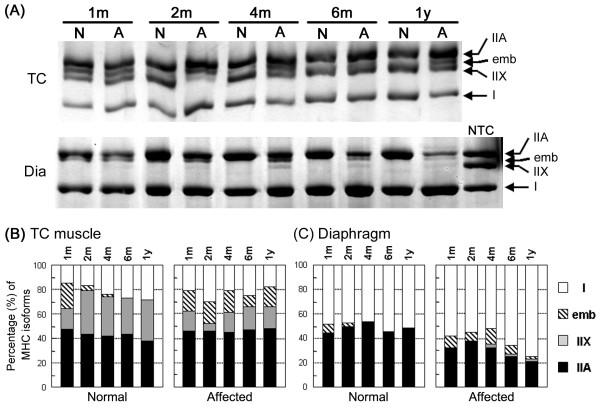
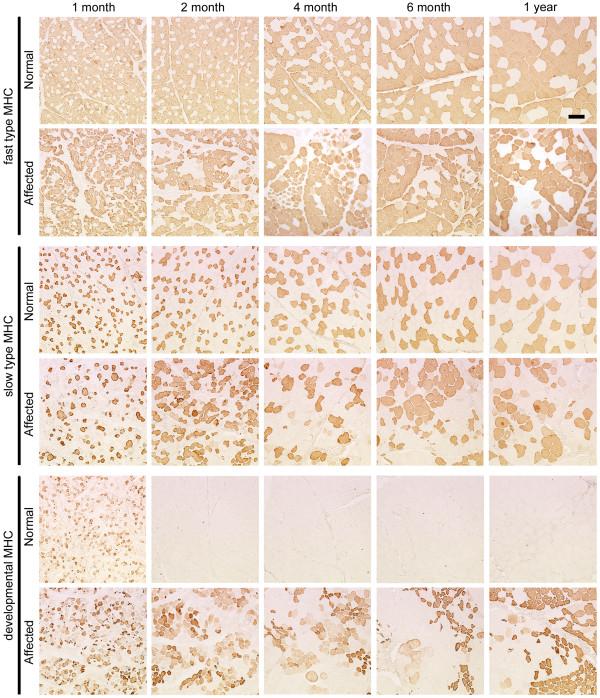
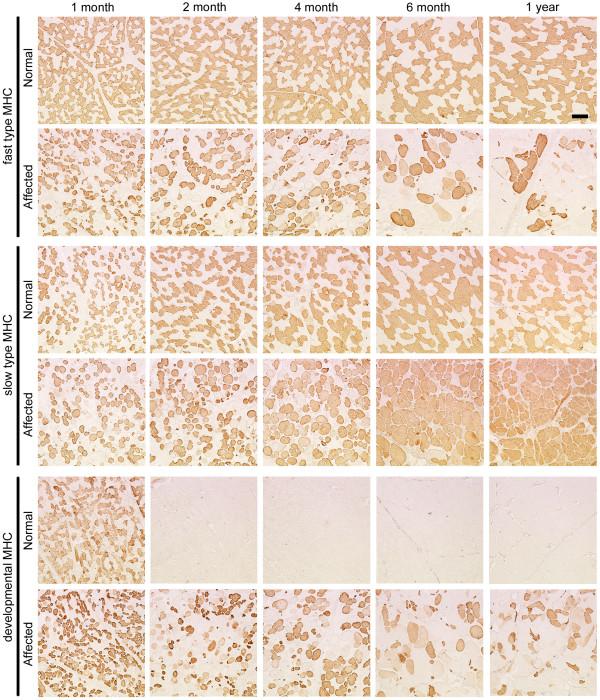
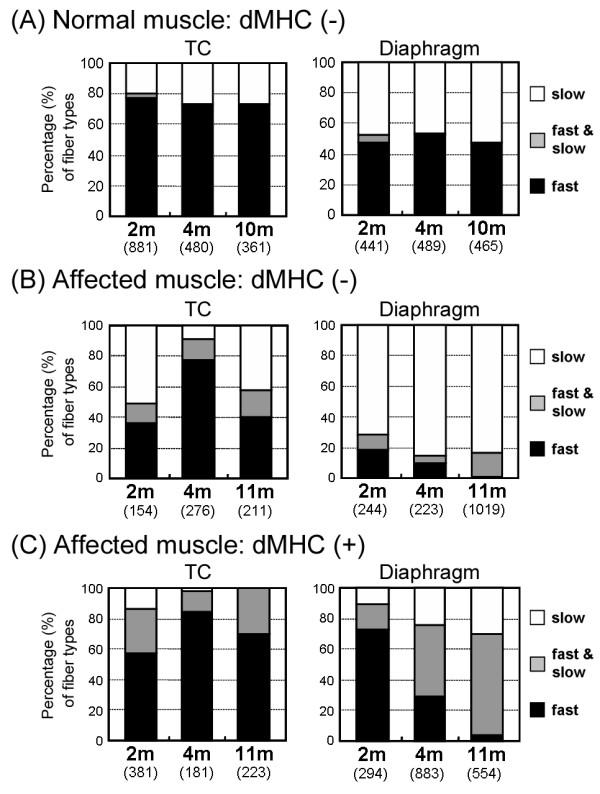
In comparison with TC muscles of CXMDJ, the number of fibers expressing slow MHC increased markedly and the number of fibers expressing fast MHC decreased with growth in the affected diaphragm. In populations of muscle fibers expressing fast and/or slow MHC(s) but not developmental MHC of CXMDJ muscles, slow MHC fibers were predominant in number and showed selective enlargement. Especially, in CXMDJ diaphragms, the proportions of slow MHC fibers were significantly larger in populations of myofibers with non-expression of developmental MHC. Analyses of MHC isoforms also indicated a marked increase of type I and decrease of type IIA isoforms in the affected diaphragm at ages over 6 months. In addition, expression of developmental (embryonic and/or neonatal) MHC decreased in the CXMDJ diaphragm in adults, in contrast to continuous high-level expression in affected TC muscle.
CONCLUSION
The CXMDJ diaphragm showed marked changes in fiber type composition unlike TC muscles, suggesting that the affected diaphragm may be effectively adapted toward dystrophic stress by switching to predominantly slow fibers. Furthermore, the MHC expression profile in the CXMDJ diaphragm was markedly different from that in mdx mice, indicating that the dystrophic dog is a more appropriate model than a murine one, to investigate the mechanisms of respiratory failure in DMD.
背景
骨骼肌由多种不同类型的肌纤维组成,其排列方式有助于多种肌肉类型发挥多种功能。此外,骨骼肌可在疾病和运动等各种情况下,通过改变纤维类型来使单个肌纤维发生适应性变化。本研究旨在探讨肌营养不良蛋白缺乏对日本犬X连锁型肌营养不良(CXMDJ)骨骼肌纤维类型组成的影响,CXMDJ是杜氏肌营养不良的一种大型动物模型。
方法
我们使用了1个月至3岁不同年龄段的正常犬以及患有CXMDJ的犬的胫骨前肌(TC)和膈肌。为了对纤维类型进行分类,用抗快肌、慢肌或发育型肌球蛋白重链(MHC)的抗体对肌肉切片进行免疫染色,并分析这些纤维的数量和大小。此外,通过凝胶电泳检测MHC同工型。
结果
与CXMDJ的TC肌肉相比,在受影响的膈肌中,随着生长,表达慢MHC的纤维数量显著增加,而表达快MHC的纤维数量减少。在CXMDJ肌肉中表达快和/或慢MHC但不表达发育型MHC的肌纤维群体中,慢MHC纤维数量占主导且呈现选择性增大。特别是在CXMDJ膈肌中,在不表达发育型MHC的肌纤维群体中,慢MHC纤维的比例显著更大。对MHC同工型的分析还表明,在6个月以上的受影响膈肌中,I型同工型显著增加,IIA型同工型减少。此外,与受影响的TC肌肉中持续高水平表达相反,成年CXMDJ膈肌中发育型(胚胎型和/或新生儿型)MHC的表达下降。
结论
CXMDJ膈肌的纤维类型组成与TC肌肉不同,显示出明显变化,这表明受影响的膈肌可能通过转变为主要是慢纤维而有效地适应营养不良应激。此外,CXMDJ膈肌中的MHC表达谱与mdx小鼠明显不同,表明营养不良犬是比小鼠更合适的模型,用于研究杜氏肌营养不良呼吸衰竭机制。


 Zotero 插件