
定量高通量筛选鉴定曼氏血吸虫氧化还原级联的抑制剂。
Quantitative high-throughput screen identifies inhibitors of the Schistosoma mansoni redox cascade.
机构信息
NIH Chemical Genomics Center, National Human Genome Research Institute, National Institutes of Health, Bethesda, Maryland, United States of America.
出版信息
PLoS Negl Trop Dis. 2008 Jan 2;2(1):e127. doi: 10.1371/journal.pntd.0000127.
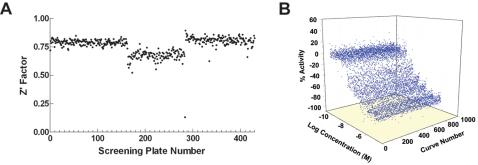
Schistosomiasis is a tropical disease associated with high morbidity and mortality, currently affecting over 200 million people worldwide. Praziquantel is the only drug used to treat the disease, and with its increased use the probability of developing drug resistance has grown significantly. The Schistosoma parasites can survive for up to decades in the human host due in part to a unique set of antioxidant enzymes that continuously degrade the reactive oxygen species produced by the host's innate immune response. Two principal components of this defense system have been recently identified in S. mansoni as thioredoxin/glutathione reductase (TGR) and peroxiredoxin (Prx) and as such these enzymes present attractive new targets for anti-schistosomiasis drug development. Inhibition of TGR/Prx activity was screened in a dual-enzyme format with reducing equivalents being transferred from NADPH to glutathione via a TGR-catalyzed reaction and then to hydrogen peroxide via a Prx-catalyzed step. A fully automated quantitative high-throughput (qHTS) experiment was performed against a collection of 71,028 compounds tested as 7- to 15-point concentration series at 5 microL reaction volume in 1536-well plate format. In order to generate a robust data set and to minimize the effect of compound autofluorescence, apparent reaction rates derived from a kinetic read were utilized instead of end-point measurements. Actives identified from the screen, along with previously untested analogues, were subjected to confirmatory experiments using the screening assay and subsequently against the individual targets in secondary assays. Several novel active series were identified which inhibited TGR at a range of potencies, with IC(50)s ranging from micromolar to the assay response limit ( approximately 25 nM). This is, to our knowledge, the first report of a large-scale HTS to identify lead compounds for a helminthic disease, and provides a paradigm that can be used to jump-start development of novel therapeutics for other neglected tropical diseases.
血吸虫病是一种与高发病率和死亡率相关的热带疾病,目前全球有超过 2 亿人受到影响。吡喹酮是唯一用于治疗该病的药物,随着其使用的增加,药物耐药性的可能性显著增加。血吸虫寄生虫可以在人类宿主中存活长达几十年,部分原因是它们具有一组独特的抗氧化酶,这些酶可以持续降解宿主先天免疫反应产生的活性氧。最近在曼氏血吸虫中鉴定出这种防御系统的两个主要成分是硫氧还蛋白/谷胱甘肽还原酶 (TGR) 和过氧化物酶 (Prx),因此这些酶为抗血吸虫病药物开发提供了有吸引力的新靶点。TGR/Prx 活性的抑制作用是在双酶格式中进行筛选的,还原当量通过 TGR 催化反应从 NADPH 转移到谷胱甘肽,然后通过 Prx 催化步骤转移到过氧化氢。针对 71028 种化合物进行了完全自动化的定量高通量 (qHTS) 实验,这些化合物以 7 至 15 点浓度系列测试,反应体积为 5 μL,在 1536 孔板格式中进行。为了生成稳健的数据集并最小化化合物自发荧光的影响,从动力学读数中得出的表观反应速率而不是终点测量值被用于代替。从筛选中鉴定出的活性化合物,以及以前未经测试的类似物,使用筛选测定法进行了确证实验,然后在次级测定法中针对各个靶标进行了实验。鉴定出了几种新型活性系列,它们在一定范围内抑制 TGR,IC50 范围从微摩尔到测定的反应极限(约 25 nM)。据我们所知,这是首次报道大规模 HTS 用于鉴定针对寄生虫病的先导化合物,并提供了一种可以用于启动其他被忽视热带病新型治疗药物开发的范例。



 Zotero 插件