
胰岛素通过Akt-TSC2-mTORC1信号通路刺激脂肪生成。
Insulin stimulates adipogenesis through the Akt-TSC2-mTORC1 pathway.
作者信息
Zhang Hui H, Huang Jingxiang, Düvel Katrin, Boback Bernard, Wu Shulin, Squillace Rachel M, Wu Chin-Lee, Manning Brendan D
机构信息
Department of Genetics and Complex Diseases, Harvard School of Public Health, Boston, MA, USA.
出版信息
PLoS One. 2009 Jul 10;4(7):e6189. doi: 10.1371/journal.pone.0006189.
BACKGROUND
The signaling pathways imposing hormonal control over adipocyte differentiation are poorly understood. While insulin and Akt signaling have been found previously to be essential for adipogenesis, the relative importance of their many downstream branches have not been defined. One direct substrate that is inhibited by Akt-mediated phosphorylation is the tuberous sclerosis complex 2 (TSC2) protein, which associates with TSC1 and acts as a critical negative regulator of the mammalian target of rapamycin (mTOR) complex 1 (mTORC1). Loss of function of the TSC1-TSC2 complex results in constitutive mTORC1 signaling and, through mTORC1-dependent feedback mechanisms and loss of mTORC2 activity, leads to a concomitant block of Akt signaling to its other downstream targets.
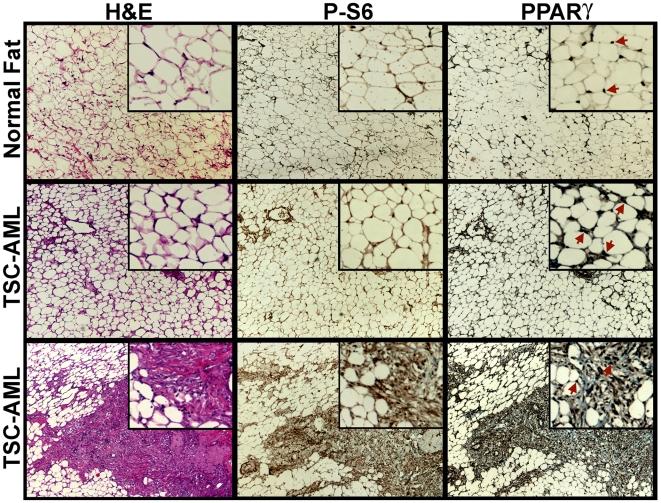
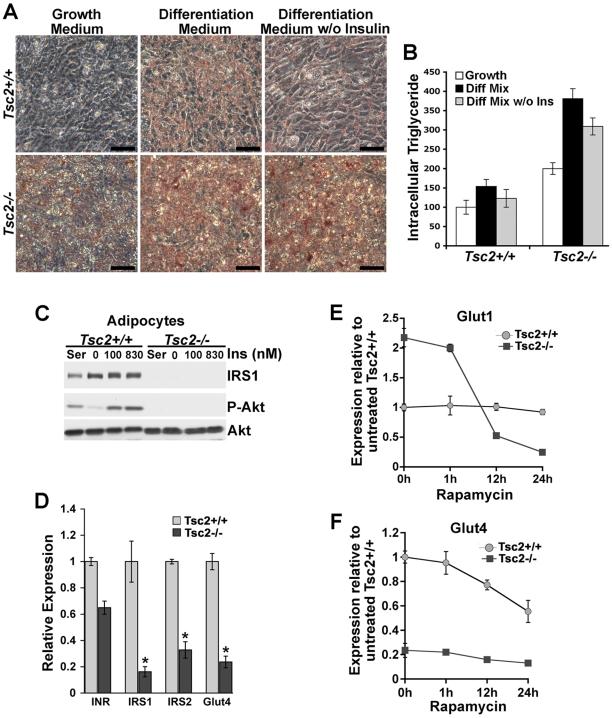
METHODOLOGY/PRINCIPAL FINDINGS: We find that, despite severe insulin resistance and the absence of Akt signaling, TSC2-deficient mouse embryo fibroblasts and 3T3-L1 pre-adipocytes display enhanced adipocyte differentiation that is dependent on the elevated mTORC1 activity in these cells. Activation of mTORC1 causes a robust increase in the mRNA and protein expression of peroxisome proliferator-activated receptor gamma (PPARgamma), which is the master transcriptional regulator of adipocyte differentiation. In examining the requirements for different Akt-mediated phosphorylation sites on TSC2, we find that only TSC2 mutants lacking all five previously identified Akt sites fully block insulin-stimulated mTORC1 signaling in reconstituted Tsc2 null cells, and this mutant also inhibits adipogenesis. Finally, renal angiomyolipomas from patients with tuberous sclerosis complex contain both adipose and smooth muscle-like components with activated mTORC1 signaling and elevated PPARgamma expression.
CONCLUSIONS/SIGNIFICANCE: This study demonstrates that activation of mTORC1 signaling is a critical step in adipocyte differentiation and identifies TSC2 as a primary target of Akt driving this process. Therefore, the TSC1-TSC2 complex regulates the differentiation of mesenchymal cell lineages, at least in part, through its control of mTORC1 activity and PPARgamma expression.
背景
目前对激素控制脂肪细胞分化的信号通路了解甚少。虽然之前已发现胰岛素和Akt信号传导对脂肪生成至关重要,但其众多下游分支的相对重要性尚未明确。Akt介导的磷酸化作用所抑制的一个直接底物是结节性硬化复合物2(TSC2)蛋白,它与TSC1结合,并作为雷帕霉素哺乳动物靶标(mTOR)复合物1(mTORC1)的关键负调节因子。TSC1 - TSC2复合物功能丧失会导致mTORC1信号持续激活,并通过mTORC1依赖性反馈机制以及mTORC2活性丧失,导致Akt信号传导至其其他下游靶标的过程同时受阻。
方法/主要发现:我们发现,尽管存在严重胰岛素抵抗且缺乏Akt信号传导,但TSC2缺陷型小鼠胚胎成纤维细胞和3T3 - L1前脂肪细胞仍表现出增强的脂肪细胞分化,这依赖于这些细胞中升高的mTORC1活性。mTORC1的激活导致过氧化物酶体增殖物激活受体γ(PPARγ)的mRNA和蛋白质表达显著增加,而PPARγ是脂肪细胞分化的主要转录调节因子。在研究TSC2上不同Akt介导的磷酸化位点的需求时,我们发现只有缺乏所有五个先前确定的Akt位点的TSC2突变体才能在重组的Tsc2基因敲除细胞中完全阻断胰岛素刺激的mTORC1信号传导,并且该突变体也抑制脂肪生成。最后,结节性硬化症患者的肾血管平滑肌脂肪瘤同时含有脂肪和平滑肌样成分,伴有激活的mTORC1信号传导和升高的PPARγ表达。
结论/意义:本研究表明,mTORC1信号的激活是脂肪细胞分化中的关键步骤,并确定TSC2是驱动这一过程的Akt的主要靶标。因此,TSC1 - TSC2复合物至少部分地通过控制mTORC1活性和PPARγ表达来调节间充质细胞谱系的分化。



 Zotero 插件