
果蝇的睡眠、衰老和寿命。
Sleep, aging, and lifespan in Drosophila.
机构信息
Dept of Psychiatry, University of Wisconsin/Madison, Madison, Wisconsin 53719, USA.
出版信息
BMC Neurosci. 2010 Apr 29;11:56. doi: 10.1186/1471-2202-11-56.
BACKGROUND
Epidemiological studies in humans suggest that a decrease in daily sleep duration is associated with reduced lifespan, but this issue remains controversial. Other studies in humans also show that both sleep quantity and sleep quality decrease with age. Drosophila melanogaster is a useful model to study aging and sleep, and inheriting mutations affecting the potassium current Shaker results in flies that sleep less and have a shorter lifespan. However, whether the link between short sleep and reduced longevity exists also in wild-type flies is unknown. Similarly, it is unknown whether such a link depends on sleep amount per se, rather than on other factors such as waking activity. Also, sleep quality has been shown to decrease in old flies, but it remains unclear whether aging-related sleep fragmentation is a generalized phenomenon.
RESULTS
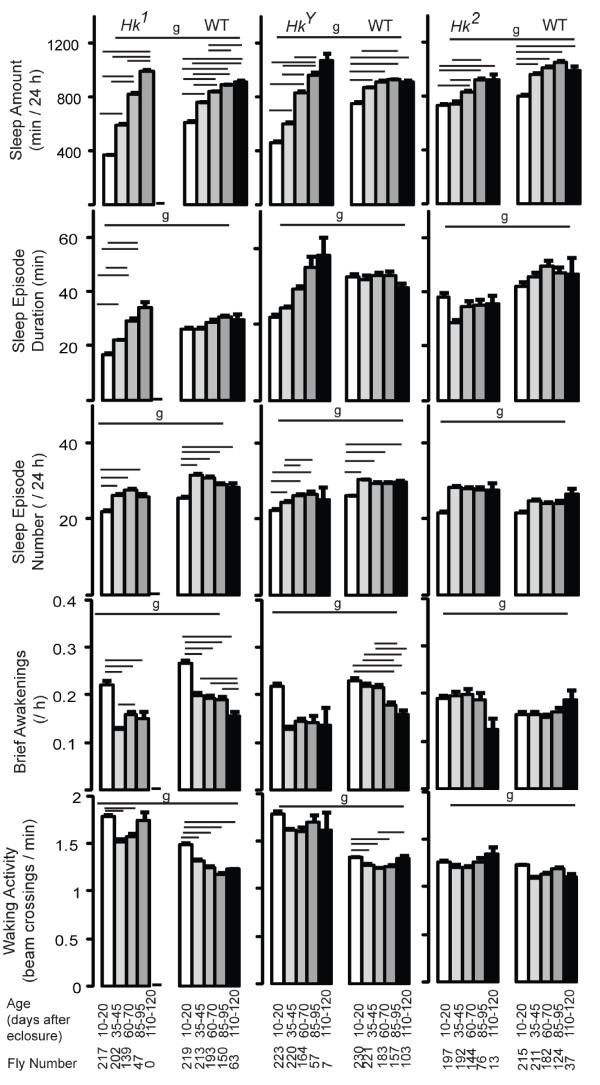
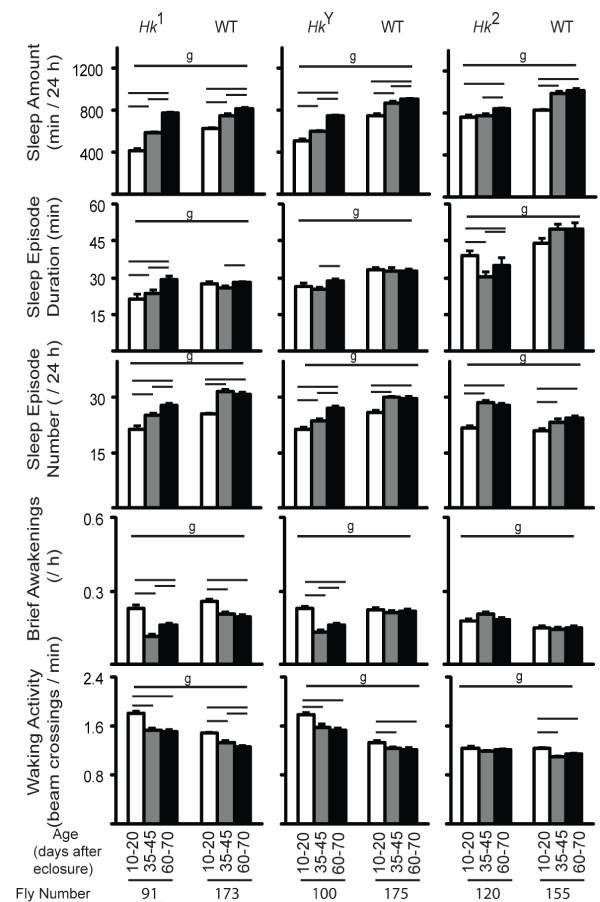
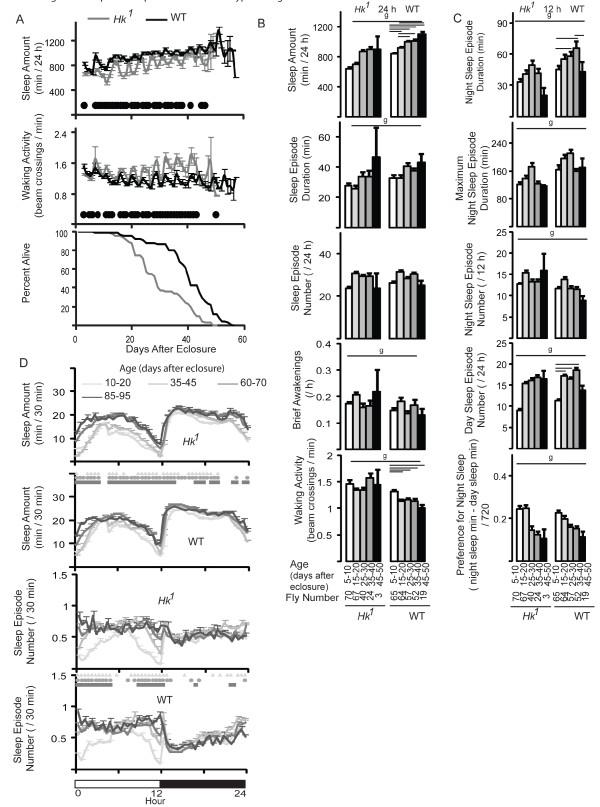
We compared 3 short sleeping mutant lines (Hk1, HkY and Hk2) carrying a mutation in Hyperkinetic, which codes for the beta subunit of the Shaker channel, to wild-type siblings throughout their entire lifespan (all flies kept at 20 degrees C). Hk1 and HkY mutants were short sleeping relative to wild-type controls from day 3 after eclosure, and Hk2 flies became short sleepers about two weeks later. All 3 Hk mutant lines had reduced lifespan relative to wild-type flies. Total sleep time showed a trend to increase in all lines with age, but the effect was most pronounced in Hk1 and HkY flies. In both mutant and wild-type lines sleep quality did not decay with age, but the strong preference for sleep at night declined starting in "middle age". Using Cox regression analysis we found that in Hk1 and HkY mutants and their control lines there was a negative relationship between total sleep amount during the first 2 and 4 weeks of age and hazard (individual risk of death), while no association was found in Hk2 flies and their wild-type controls. Hk1 and HkY mutants and their control lines also showed an association between total daily wake activity over the first 2 and 4 weeks of age and hazard. However, when both sleep duration and wake activity were used in the same regression, the effects of activity were much reduced, while most of the sleep effects remained significant. Finally, Hk1 flies and wild-type siblings were also tested at 25 degrees C, and results were similar to those at 20 degrees C. Namely, Hk1 mutants were short sleeping, hyperactive, and short lived relative to controls, and sleep quality in both groups did not decrease with age.
CONCLUSIONS
Different Hk mutations affect the sleep phenotype, and do so in an age-dependent manner. In 4 of the 6 lines tested sleep associates significantly with lifespan variation even after any effect of activity is removed, but activity does not associate significantly with lifespan after the effects of sleep are removed. Thus, in addition to environmental factors and genetic background, sleep may also affect longevity. Sleep quality does not necessarily decay as flies age, suggesting that aging-related sleep fragmentation may also depend on many factors, including genetic background and rearing conditions.
背景
人类的流行病学研究表明,每天睡眠时间的减少与寿命缩短有关,但这个问题仍然存在争议。人类的其他研究也表明,睡眠的数量和质量都会随着年龄的增长而下降。黑腹果蝇是研究衰老和睡眠的有用模型,遗传导致钾电流 Shaker 发生突变的突变会导致果蝇睡眠时间减少,寿命缩短。然而,在野生型果蝇中,短睡眠与寿命缩短之间是否存在联系尚不清楚。同样,这种联系是否取决于睡眠时间本身,而不是其他因素,如清醒活动。此外,睡眠质量在老年果蝇中已经下降,但睡眠片段化是否是一种普遍现象仍不清楚。
结果
我们比较了携带 Hyperkinetic 突变的 3 个短睡眠突变系(Hk1、HkY 和 Hk2)和它们的野生型兄弟姐妹,在整个生命周期(所有果蝇均保持在 20°C)中进行了比较。Hk1 和 HkY 突变体从出壳后第 3 天开始比野生型对照睡眠时间短,而 Hk2 突变体大约在两周后开始出现短睡眠。与野生型果蝇相比,所有 3 个 Hk 突变系的寿命都缩短了。总睡眠时间随着年龄的增长呈上升趋势,但在 Hk1 和 HkY 果蝇中最为明显。在突变体和野生型果蝇中,睡眠质量并没有随着年龄的增长而下降,但夜间睡眠的强烈偏好从“中年”开始下降。使用 Cox 回归分析,我们发现 Hk1 和 HkY 突变体及其对照系中,第 1 到 2 周和第 4 周的总睡眠时间与危险(个体死亡风险)呈负相关,而 Hk2 果蝇及其野生型对照系中则没有这种关系。Hk1 和 HkY 突变体及其对照系中,第 1 到 2 周和第 4 周的总日间清醒活动与危险之间也存在关联。然而,当将睡眠时间和清醒活动都用于同一回归时,活动的影响大大降低,而大部分睡眠影响仍然显著。最后,我们还在 25°C 下测试了 Hk1 果蝇及其野生型兄弟姐妹,结果与 20°C 下的结果相似。即 Hk1 突变体相对于对照睡眠时间短、活动过度、寿命短,两组的睡眠质量都不会随着年龄的增长而下降。
结论
不同的 Hk 突变影响睡眠表型,且呈年龄依赖性。在测试的 6 条线中的 4 条中,即使在去除任何活动影响后,睡眠与寿命变化仍有显著相关性,但在去除睡眠影响后,活动与寿命变化不再显著相关。因此,除了环境因素和遗传背景外,睡眠也可能影响寿命。随着果蝇的衰老,睡眠质量不一定会下降,这表明与衰老相关的睡眠片段化可能也取决于许多因素,包括遗传背景和饲养条件。






 Zotero 插件