
急性间日疟原虫感染期间增强的血浆微颗粒。
Augmented plasma microparticles during acute Plasmodium vivax infection.
机构信息
Centro de Pesquisas René Rachou/Fundação Oswaldo Cruz, Av, Augusto de Lima 1715, Belo Horizonte, MG 30190-002, Brazil.
出版信息
Malar J. 2010 Nov 16;9:327. doi: 10.1186/1475-2875-9-327.
BACKGROUND
In the last few years, the study of microparticles (MPs)--submicron vesicles released from cells upon activation or apoptosis--has gained growing interest in the field of inflammation and in infectious diseases. Their role in the human malaria parasite Plasmodium vivax remains unexplored. Because acute vivax malaria has been related to pro-inflammatory responses, the main hypothesis investigated in this study was that Plasmodium vivax infection is associated with elevated levels of circulating MPs, which may play a role during acute disease in non-immune patients.
METHODS
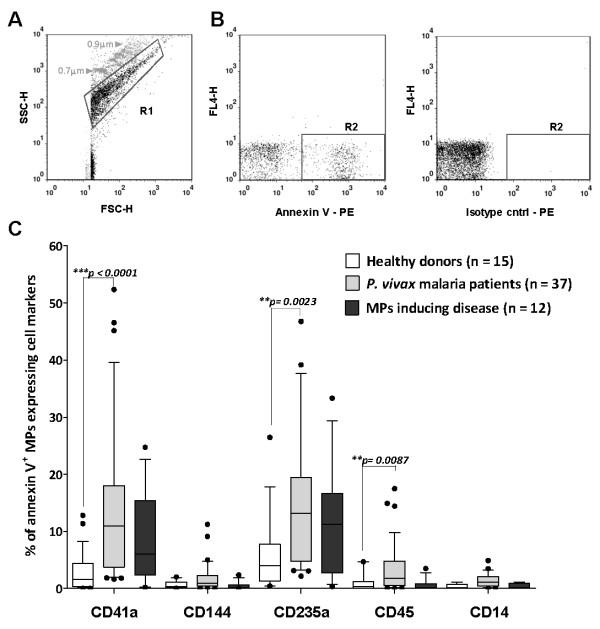
Plasma MPs were analysed among thirty-seven uncomplicated P. vivax infections from an area of unstable malaria transmission in the Brazilian Amazon. The MP phenotype was analysed by flow cytometry using the classical MP marker, annexin, and fluorochrome-labeled monoclonal antibodies against specific cell surface markers. The frequencies of plasma MPs in P. vivax patients (n=37) were further compared to malaria-unexposed controls (n=15) and ovarian carcinoma patients (n=12), a known MPs-inducing disease non-related to malaria.
RESULTS
The frequencies of plasma circulating MPs were markedly increased in P. vivax patients, as compared to healthy age-matched malaria-unexposed controls. Although platelets, erythrocytes and leukocytes were the main cellular sources of MPs during vivax malaria, platelet derived-MPs (PMPs) increased in a linear fashion with the presence of fever at the time of blood collection (β=0.06, p<0.0001) and length of acute symptoms (β=0.36, p<0.0001). Finally, the results suggest that plasma levels of PMPs diminish as patient experience more episodes of clinical malaria (β=0.07, p<0.003).
CONCLUSIONS
Abundant circulating MPs are present during acute P. vivax infection, and platelet derived-MPs may play a role on the acute inflammatory symptoms of malaria vivax.
背景
在过去的几年中,对微粒(MP)的研究——细胞在激活或凋亡时释放的亚微米囊泡——在炎症和传染病领域引起了越来越多的关注。它们在人类疟原虫恶性疟原虫中的作用仍未得到探索。由于急性间日疟与促炎反应有关,本研究的主要假设是间日疟感染与循环 MP 水平升高有关,这些 MP 可能在非免疫患者的急性疾病中发挥作用。
方法
在巴西亚马逊不稳定疟疾传播地区,对 37 例单纯性间日疟感染患者的血浆 MPs 进行了分析。通过流式细胞术,使用经典的 MP 标志物 annexin 和针对特定细胞表面标志物的荧光标记单克隆抗体分析 MP 表型。间日疟患者(n=37)的血浆 MPs 频率与疟疾未暴露对照者(n=15)和卵巢癌患者(n=12)进一步比较,后者是一种已知的与疟疾无关的诱导 MPs 的疾病。
结果
与年龄匹配的疟疾未暴露对照者相比,间日疟患者的血浆循环 MPs 频率明显升高。虽然血小板、红细胞和白细胞是间日疟期间 MPs 的主要细胞来源,但血小板衍生 MPs(PMPs)在发热时呈线性增加与采血时发热的存在(β=0.06,p<0.0001)和急性症状的持续时间(β=0.36,p<0.0001)。最后,结果表明,随着患者经历更多次临床疟疾发作,血浆 PMPs 水平下降(β=0.07,p<0.003)。
结论
在急性间日疟感染期间存在大量循环 MPs,血小板衍生 MPs 可能在间日疟的急性炎症症状中发挥作用。

 Zotero 插件