
白细胞介素-6 诱导的 STAT3 信号与急性肌肉损伤后人类肌肉卫星细胞的增殖有关。
IL-6 induced STAT3 signalling is associated with the proliferation of human muscle satellite cells following acute muscle damage.
机构信息
Department of Kinesiology, McMaster University, Hamilton, Ontario, Canada.
出版信息
PLoS One. 2011 Mar 9;6(3):e17392. doi: 10.1371/journal.pone.0017392.
BACKGROUND
Although the satellite cell (SC) is a key regulator of muscle growth during development and muscle adaptation following exercise, the regulation of human muscle SC function remains largely unexplored. STAT3 signalling mediated via interleukin-6 (IL-6) has recently come to the forefront as a potential regulator of SC proliferation. The early response of the SC population in human muscle to muscle-lengthening contractions (MLC) as mediated by STAT3 has not been studied.
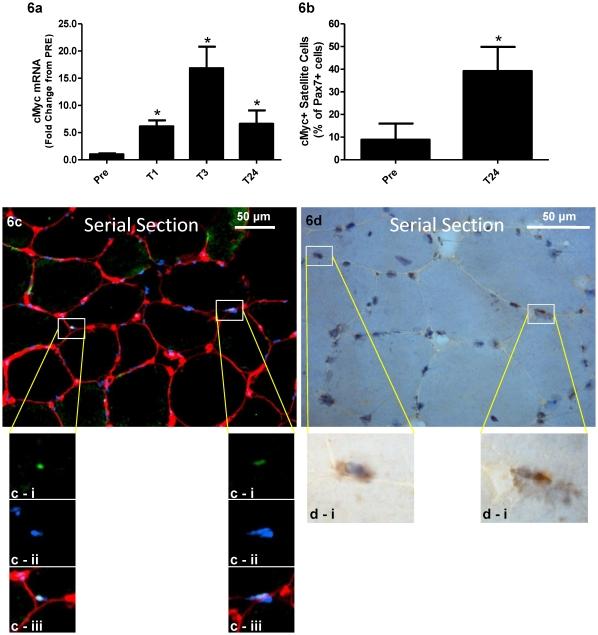
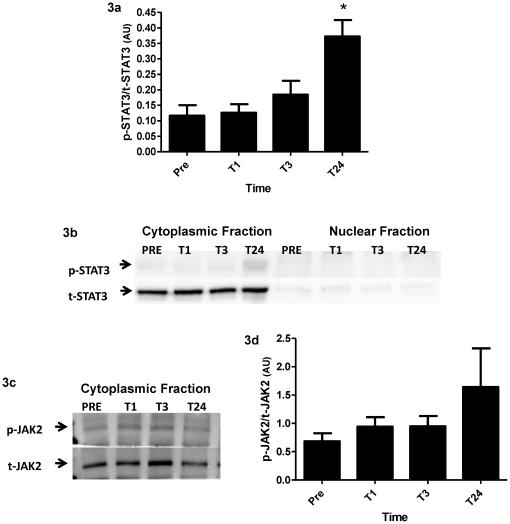
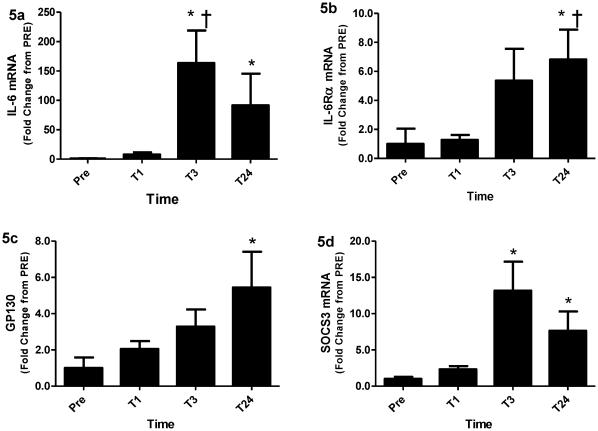
METHODOLOGY/PRINCIPAL FINDINGS: Twelve male subjects (21±2 y; 83±12 kg) performed 300 maximal MLC of the quadriceps femoris at 180°•s(-1) over a 55° range of motion with muscle samples (vastus lateralis) and blood samples (antecubital vein) taken prior to exercise (PRE), 1 hour (T1), 3 hours (T3) and 24 hours (T24) post-exercise. Cytoplasmic and nuclear fractions of muscle biopsies were purified and analyzed for total and phosphorylated STAT3 (p-STAT3) by western blot. p-STAT3 was detected in cytoplasmic fractions across the time course peaking at T24 (p<0.01 vs. PRE). Nuclear total and p-STAT3 were not detected at appreciable levels. However, immunohistochemical analysis revealed a progressive increase in the proportion of SCs expressing p-STAT3 with ∼60% of all SCs positive for p-STAT3 at T24 (p<0.001 vs. PRE). Additionally, cMyc, a STAT3 downstream gene, was significantly up-regulated in SCs at T24 versus PRE (p<0.05). Whole muscle mRNA analysis revealed induction of the STAT3 target genes IL-6, SOCS3, cMyc (peaking at T3, p<0.05), IL-6Rα and GP130 (peaking at T24, p<0.05). In addition, Myf5 mRNA was up-regulated at T24 (p<0.05) with no appreciable change in MRF4 mRNA.
CONCLUSIONS/SIGNIFICANT FINDINGS: We demonstrate that IL-6 induction of STAT3 signaling occurred exclusively in the nuclei of SCs in response to MLC. An increase in the number of cMyc+ SCs indicated that human SCs were induced to proliferate under the control of STAT3 signaling.
背景
卫星细胞(SC)是发育过程中肌肉生长和运动后肌肉适应的关键调节因子,但人类肌肉 SC 功能的调节仍在很大程度上未被探索。最近,白细胞介素 6(IL-6)介导的 STAT3 信号转导已成为调节 SC 增殖的潜在调节剂。STAT3 介导的人类肌肉中 SC 群体对肌肉拉长收缩(MLC)的早期反应尚未研究。
方法/主要发现:12 名男性受试者(21±2 岁;83±12 千克)以 180°•s(-1) 的速度进行 300 次最大 MLC,运动范围为 55°,在运动前(PRE)、1 小时(T1)、3 小时(T3)和 24 小时(T24)时采集股四头肌的肌肉样本(股外侧肌)和血液样本(肘前静脉)。通过 Western blot 分析肌肉活检的细胞质和核部分中总 STAT3(t-STAT3)和磷酸化 STAT3(p-STAT3)。在整个时间过程中,p-STAT3 均在细胞质部分中检测到,在 T24 时达到峰值(p<0.01 比 PRE)。核总 STAT3 和 p-STAT3 未检测到可观水平。然而,免疫组织化学分析显示,表达 p-STAT3 的 SC 比例逐渐增加,T24 时约有 60%的 SC 呈 p-STAT3 阳性(p<0.001 比 PRE)。此外,SC 中 STAT3 下游基因 cMyc 的表达在 T24 时明显上调,与 PRE 相比(p<0.05)。全肌 mRNA 分析显示,STAT3 靶基因 IL-6、SOCS3、cMyc(在 T3 时达到峰值,p<0.05)、IL-6Rα 和 GP130(在 T24 时达到峰值,p<0.05)的诱导。此外,Myf5mRNA 在 T24 时上调(p<0.05),而 MRF4mRNA 没有明显变化。
结论/重要发现:我们证明,IL-6 诱导的 STAT3 信号转导仅发生在 MLC 后 SC 的细胞核中。cMyc+ SC 数量的增加表明,人类 SC 在 STAT3 信号的控制下被诱导增殖。



 Zotero 插件