
端粒缩短与癌症风险增加相关:一项荟萃分析。
Shortened telomere length is associated with increased risk of cancer: a meta-analysis.
机构信息
Department of Epidemiology, The University of Texas MD Anderson Cancer Center, Houston, Texas, United States of America.
出版信息
PLoS One. 2011;6(6):e20466. doi: 10.1371/journal.pone.0020466. Epub 2011 Jun 10.
BACKGROUND
Telomeres play a key role in the maintenance of chromosome integrity and stability, and telomere shortening is involved in initiation and progression of malignancies. A series of epidemiological studies have examined the association between shortened telomeres and risk of cancers, but the findings remain conflicting.
METHODS
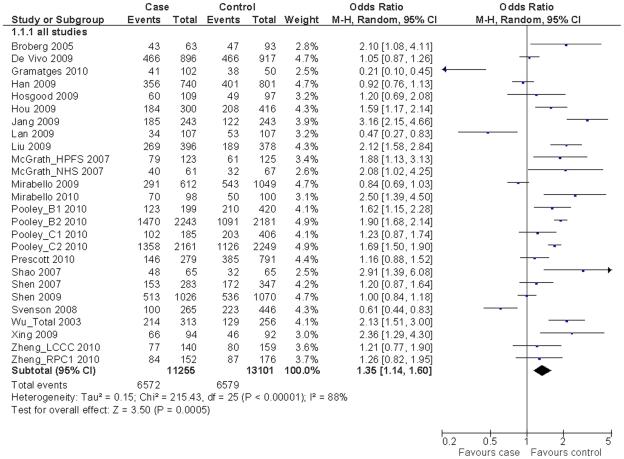
A dataset composed of 11,255 cases and 13,101 controls from 21 publications was included in a meta-analysis to evaluate the association between overall cancer risk or cancer-specific risk and the relative telomere length. Heterogeneity among studies and their publication bias were further assessed by the χ(2)-based Q statistic test and Egger's test, respectively.
RESULTS
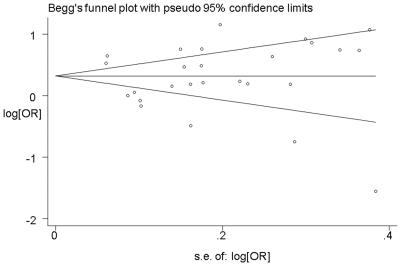
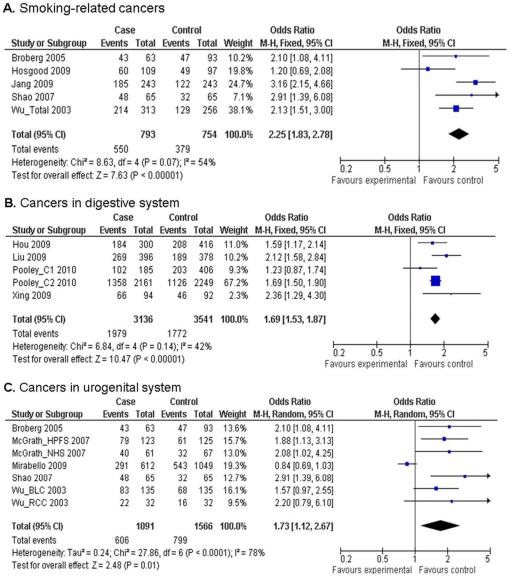
The results showed that shorter telomeres were significantly associated with cancer risk (OR = 1.35, 95% CI = 1.14-1.60), compared with longer telomeres. In the stratified analysis by tumor type, the association remained significant in subgroups of bladder cancer (OR = 1.84, 95% CI = 1.38-2.44), lung cancer (OR = 2.39, 95% CI = 1.18-4.88), smoking-related cancers (OR = 2.25, 95% CI = 1.83-2.78), cancers in the digestive system (OR = 1.69, 95% CI = 1.53-1.87) and the urogenital system (OR = 1.73, 95% CI = 1.12-2.67). Furthermore, the results also indicated that the association between the relative telomere length and overall cancer risk was statistically significant in studies of Caucasian subjects, Asian subjects, retrospective designs, hospital-based controls and smaller sample sizes. Funnel plot and Egger's test suggested that there was no publication bias in the current meta-analysis (P = 0.532).
CONCLUSIONS
The results of this meta-analysis suggest that the presence of shortened telomeres may be a marker for susceptibility to human cancer, but single larger, well-design prospective studies are warranted to confirm these findings.
背景
端粒在维持染色体完整性和稳定性方面起着关键作用,端粒缩短与恶性肿瘤的发生和进展有关。一系列流行病学研究已经研究了端粒缩短与癌症风险之间的关系,但研究结果仍存在争议。
方法
一项荟萃分析纳入了来自 21 项研究的 11255 例病例和 13101 例对照的数据集,以评估整体癌症风险或癌症特异性风险与相对端粒长度之间的关系。通过 χ(2)检验的 Q 统计量检验和 Egger 检验进一步评估研究之间的异质性和发表偏倚。
结果
结果表明,与较长的端粒相比,较短的端粒与癌症风险显著相关(OR=1.35,95%CI=1.14-1.60)。按肿瘤类型分层分析,在膀胱癌亚组(OR=1.84,95%CI=1.38-2.44)、肺癌亚组(OR=2.39,95%CI=1.18-4.88)、与吸烟相关的癌症亚组(OR=2.25,95%CI=1.83-2.78)、消化系统癌症亚组(OR=1.69,95%CI=1.53-1.87)和泌尿生殖系统癌症亚组(OR=1.73,95%CI=1.12-2.67)中,这种关联仍然显著。此外,结果还表明,在白人受试者、亚洲受试者、回顾性设计、医院为基础的对照和较小样本量的研究中,相对端粒长度与总体癌症风险之间的关联具有统计学意义。漏斗图和 Egger 检验表明,本荟萃分析中没有发表偏倚(P=0.532)。
结论
本荟萃分析的结果表明,端粒缩短可能是人类癌症易感性的标志物,但需要更大、设计更好的前瞻性研究来证实这些发现。

 Zotero 插件