
表观遗传衰老通过自我报告的种族差异影响乳腺癌风险。
Epigenetic aging differentially impacts breast cancer risk by self-reported race.
机构信息
Department of Population and Quantitative Health Sciences, School of Medicine, Case Western Reserve University, Cleveland, Ohio, United States of America.
University Hospitals Research in Surgical Outcomes and Effectiveness (UH-RISES), Cleveland, Ohio, United States of America.
出版信息
PLoS One. 2024 Oct 24;19(10):e0308174. doi: 10.1371/journal.pone.0308174. eCollection 2024.
BACKGROUND
Breast cancer (BrCa) is the most common cancer for women globally. BrCa incidence varies by age and differs between racial groups, with Black women having an earlier age of onset and higher mortality compared to White women. The underlying biological mechanisms of this disparity remain uncertain. Here, we address this knowledge gap by examining the association between overall epigenetic age acceleration and BrCa initiation as well as the mediating role of race.
RESULTS
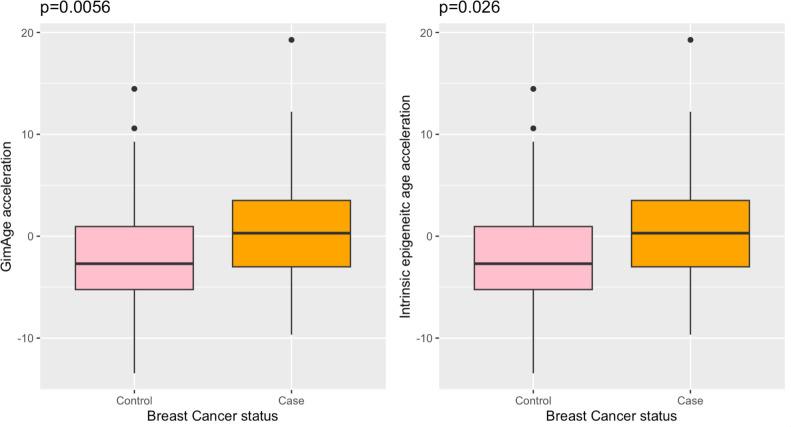
We measured whole-genome methylation (866,238 CpGs) using the Illumina EPIC array in blood DNA extracted from 209 women recruited from University Hospitals Cleveland Medical Center. Overall and intrinsic epigenetic age acceleration was calculated-accounting for the estimated white blood cell distribution-using the second-generation biological clock GrimAge. After quality control, 149 BrCa patients and 42 disease-free controls remained. The overall chronological mean age at BrCa diagnosis was 57.4 ± 11.4 years and nearly one-third of BrCa cases were self-reported Black women (29.5%). When comparing BrCa cases to disease-free controls, GrimAge acceleration was 2.48 years greater (p-value = 0.0056), while intrinsic epigenetic age acceleration was 1.72 years higher (p-value = 0.026) for cases compared to controls. After adjusting for known BrCa risk factors, we observed BrCa risk increased by 14% [odds ratio (OR) = 1.14; 95% CI: 1.05, 1.25] for a one-year increase in GrimAge acceleration. The stratified analysis by self-reported race revealed differing ORs for GrimAge acceleration: White women (OR = 1.17; 95% CI: 1.03, 1.36), and Black women (OR = 1.08; 95% CI: 0.96, 1.23). However, our limited sample size failed to detect a statistically significant interaction for self-reported race (p-value >0.05) when examining GrimAge acceleration with BrCa risk.
CONCLUSIONS
Our study demonstrated that epigenetic age acceleration is associated with BrCa risk, and the association suggests variation by self-reported race. Although our sample size is limited, these results highlight a potential biological mechanism for BrCa risk and identifies a novel research area of BrCa health disparities requiring further inquiry.
背景
乳腺癌(BrCa)是全球女性最常见的癌症。BrCa 的发病率因年龄而异,不同种族之间也存在差异,与白人女性相比,黑人女性发病年龄更早,死亡率更高。这种差异的潜在生物学机制尚不清楚。在这里,我们通过检查整体表观遗传年龄加速与 BrCa 发病的关系以及种族的中介作用来解决这一知识空白。
结果
我们使用 Illumina EPIC 阵列从克利夫兰大学医院招募的 209 名女性的血液 DNA 中测量了全基因组甲基化(866,238 个 CpG)。使用第二代生物钟 GrimAge 计算了整体和内在表观遗传年龄加速-考虑了估计的白细胞分布。经过质量控制,149 名 BrCa 患者和 42 名无病对照者仍然存在。BrCa 诊断时的总平均年龄为 57.4±11.4 岁,近三分之一的 BrCa 病例为自我报告的黑人女性(29.5%)。将 BrCa 病例与无病对照相比,GrimAge 加速高出 2.48 岁(p 值=0.0056),而病例组的内在表观遗传年龄加速比对照组高 1.72 岁(p 值=0.026)。在调整了已知的 BrCa 风险因素后,我们观察到 GrimAge 加速每增加一年,BrCa 风险增加 14%[比值比(OR)=1.14;95%可信区间(CI):1.05,1.25]。按自我报告的种族进行分层分析显示,GrimAge 加速的 OR 不同:白人女性(OR=1.17;95%CI:1.03,1.36)和黑人女性(OR=1.08;95%CI:0.96,1.23)。然而,当我们检查自我报告的种族与 BrCa 风险时,我们有限的样本量未能检测到统计学显著的交互作用(p 值>0.05)。
结论
我们的研究表明,表观遗传年龄加速与 BrCa 风险相关,并且这种关联表明与自我报告的种族有关。尽管我们的样本量有限,但这些结果强调了 BrCa 风险的潜在生物学机制,并确定了需要进一步研究的 BrCa 健康差异的新研究领域。
 Zotero 插件