
亨廷顿病小鼠模型纹状体直接和间接通路活性失衡。
Altered Balance of Activity in the Striatal Direct and Indirect Pathways in Mouse Models of Huntington's Disease.
机构信息
Intellectual and Developmental Disabilities Research Center, Department of Psychiatry and Biobehavioral Sciences, David Geffen School of Medicine, Semel Institute, University of California at Los Angeles Los Angeles, CA, USA.
出版信息
Front Syst Neurosci. 2011 Jun 16;5:46. doi: 10.3389/fnsys.2011.00046. eCollection 2011.
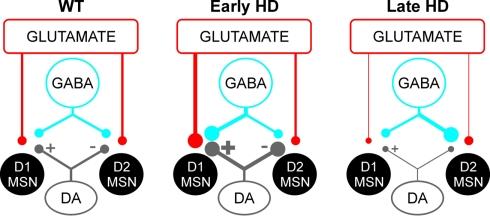
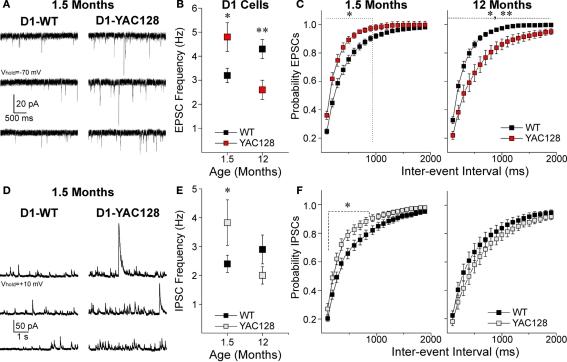
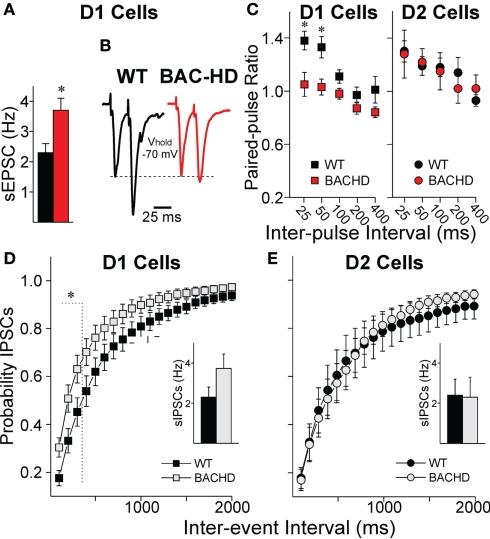
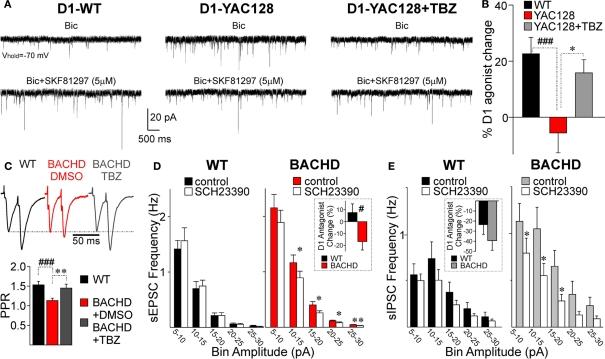
Imbalance in the activity of striatal direct and indirect pathway neurons contributes to motor disturbances in several neurodegenerative diseases. In Huntington's disease (HD), indirect pathway [dopamine (DA) D2 receptor-expressing] medium-sized spiny neurons (MSNs) are believed to show earlier vulnerability than direct pathway MSNs. We examined synaptic activity and DA modulation in MSNs forming the direct and indirect pathways in YAC128 and BACHD mouse models of HD. To visualize the two types of MSNs, we used mice expressing enhanced green fluorescent protein under the control of the promoter for the DA D1 or D2 receptor. Experiments were performed in early symptomatic (1.5 months) and symptomatic (12 months) mice. Behaviorally, early symptomatic mice showed increased stereotypies while symptomatic mice showed decreased motor activity. Electrophysiologically, at the early stage, excitatory and inhibitory transmission onto D1-YAC128 and D1-BACHD MSNs were increased, while there was no change in D2 MSNs. DA modulation of spontaneous excitatory postsynaptic currents (sEPSCs) in slices was absent in YAC128 cells at the early stage, but was restored by treating the slices with the DA depleter tetrabenazine (TBZ). In BACHD mice TBZ restored paired-pulse ratios and a D1 receptor antagonist induced a larger decrease of sEPSCs than in D1-WT cells, suggesting increased DA tone. Finally, TBZ decreased stereotypies in BACHD mice. These results indicate that by reducing DA or antagonizing D1 receptors, increases in inhibitory and excitatory transmission in early phenotypic direct pathway neurons can be normalized. In symptomatic YAC128 mice, excitatory synaptic transmission onto D1 MSNs was decreased, while inhibitory transmission was increased in D2 MSNs. These studies provide evidence for differential and complex imbalances in glutamate and GABA transmission, as well as in DA modulation, in direct and indirect pathway MSNs during HD progression.
纹状体直接和间接通路神经元活动失衡导致几种神经退行性疾病的运动障碍。在亨廷顿病(HD)中,间接通路(多巴胺(DA)D2 受体表达)中型多棘神经元(MSN)被认为比直接通路 MSN 更早出现脆弱性。我们检查了 YAC128 和 BACHD HD 小鼠模型中形成直接和间接通路的 MSN 的突触活动和 DA 调节。为了可视化两种类型的 MSN,我们使用在 DA D1 或 D2 受体启动子控制下表达增强型绿色荧光蛋白的小鼠。实验在早期症状(1.5 个月)和症状(12 个月)的小鼠中进行。行为上,早期症状的小鼠表现出增加的刻板行为,而症状的小鼠表现出减少的运动活动。电生理学上,在早期阶段,D1-YAC128 和 D1-BACHD MSN 上的兴奋性和抑制性传递增加,而 D2 MSN 没有变化。YAC128 细胞在早期阶段缺乏 DA 调制的自发兴奋性突触后电流(sEPSC),但用 DA 耗竭剂四苯嗪(TBZ)处理切片后得到恢复。在 BACHD 小鼠中,TBZ 恢复了成对脉冲比,D1 受体拮抗剂诱导的 sEPSC 减少大于 D1-WT 细胞,表明 DA 音调增加。最后,TBZ 减少了 BACHD 小鼠的刻板行为。这些结果表明,通过减少 DA 或拮抗 D1 受体,可以使早期表型直接通路神经元中增加的抑制性和兴奋性传递正常化。在有症状的 YAC128 小鼠中,D1 MSN 上的兴奋性突触传递减少,而 D2 MSN 上的抑制性传递增加。这些研究为 HD 进展过程中直接和间接通路 MSN 中谷氨酸和 GABA 传递以及 DA 调节的差异和复杂失衡提供了证据。


 Zotero 插件