
与儿童和青年成年人糖尿病诊断时出现糖尿病酮症酸中毒相关的因素:系统评价。
Factors associated with the presence of diabetic ketoacidosis at diagnosis of diabetes in children and young adults: a systematic review.
机构信息
General Practice and Primary Care Research Unit, University of Cambridge, Cambridge CB2 0SR, UK.
出版信息
BMJ. 2011 Jul 7;343:d4092. doi: 10.1136/bmj.d4092.
OBJECTIVE
To identify the factors associated with diabetic ketoacidosis at diagnosis of type 1 diabetes in children and young adults.
DESIGN
Systematic review.
DATA SOURCES
PubMed, EMBASE, Web of Science, Scopus, and Cinahl and article reference lists.
STUDY SELECTION
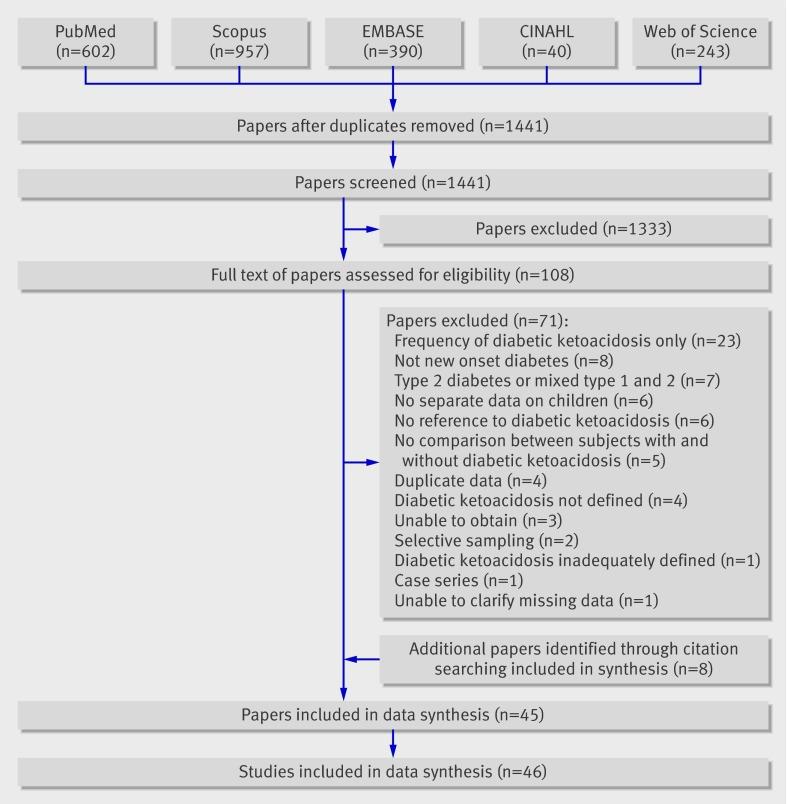
Cohort studies including unselected groups of children and young adults presenting with new onset type 1 diabetes that distinguished between those who presented in diabetic ketoacidosis and those who did not and included a measurement of either pH or bicarbonate in the definition of diabetic ketoacidosis. There were no restrictions on language of publication.
RESULTS
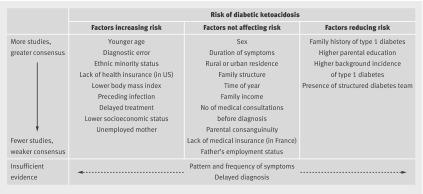
46 studies involving more than 24,000 children in 31 countries were included. Together they compared 23 different factors. Factors associated with increased risk were younger age (for <2 years old v older, odds ratio 3.41 (95% confidence interval 2.54 to 4.59), for <5 years v older, odds ratio 1.59 (1.38 to 1.84)), diagnostic error (odds ratio 3.35 (2.35 to 4.79)), ethnic minority, lack of health insurance in the US (odds ratio 3.20 (2.03 to 5.04)), lower body mass index, preceding infection (odds ratio 3.14 (0.94 to 10.47)), and delayed treatment (odds ratio 1.74 (1.10 to 2.77)). Protective factors were having a first degree relative with type 1 diabetes at the time of diagnosis (odds ratio 0.33 (0.08 to 1.26)), higher parental education (odds ratios 0.4 (0.20 to 0.79) and 0.64 (0.43 to 0.94) in two studies), and higher background incidence of type 1 diabetes (correlation coefficient -0.715). The mean duration of symptoms was similar between children presenting with or without diabetic ketoacidosis (16.5 days (standard error 6.2) and 17.1 days (6.0) respectively), and up to 38.8% (285/735) of children who presented with diabetic ketoacidosis had been seen at least once by a doctor before diagnosis.
CONCLUSIONS
Multiple factors affect the risk of developing diabetic ketoacidosis at the onset of type 1 diabetes in children and young adults, and there is potential time, scope, and opportunity to intervene between symptom onset and development of diabetic ketoacidosis for both parents and clinicians.
目的
确定儿童和青年 1 型糖尿病患者初诊时发生糖尿病酮症酸中毒的相关因素。
设计
系统评价。
资料来源
PubMed、EMBASE、Web of Science、Scopus 和 Cinahl 以及文章参考文献列表。
研究选择
包括新诊断为 1 型糖尿病的未选择儿童和青年群体的队列研究,这些研究将在糖尿病酮症酸中毒时就诊的患者与未就诊的患者区分开来,并在糖尿病酮症酸中毒的定义中测量 pH 值或碳酸氢盐。出版语言没有限制。
结果
共纳入来自 31 个国家的 46 项研究,涉及 24000 多名儿童。这些研究共比较了 23 个不同的因素。与糖尿病酮症酸中毒风险增加相关的因素包括年龄较小(<2 岁与>2 岁相比,比值比 3.41(95%置信区间 2.54 至 4.59),<5 岁与>5 岁相比,比值比 1.59(1.38 至 1.84))、诊断错误(比值比 3.35(2.35 至 4.79))、少数民族、在美国缺乏健康保险(比值比 3.20(2.03 至 5.04))、较低的体重指数、前驱感染(比值比 3.14(0.94 至 10.47))和延迟治疗(比值比 1.74(1.10 至 2.77))。保护因素包括在诊断时,一级亲属患有 1 型糖尿病(比值比 0.33(0.08 至 1.26))、父母受教育程度较高(两项研究中分别为比值比 0.4(0.20 至 0.79)和 0.64(0.43 至 0.94))和 1 型糖尿病背景发病率较高(相关系数-0.715)。有糖尿病酮症酸中毒的儿童与无糖尿病酮症酸中毒的儿童的症状持续时间相似(分别为 16.5 天(标准误差 6.2)和 17.1 天(6.0)),多达 38.8%(285/735)有糖尿病酮症酸中毒的儿童在诊断前至少有一次接受过医生的就诊。
结论
多种因素影响儿童和青年 1 型糖尿病患者初诊时发生糖尿病酮症酸中毒的风险,家长和临床医生在症状出现和糖尿病酮症酸中毒发展之间存在潜在的时间、范围和机会进行干预。



 Zotero 插件