
青蒿素类复方药物治疗非洲儿童无并发症疟疾的头对头比较:一项随机试验。
A head-to-head comparison of four artemisinin-based combinations for treating uncomplicated malaria in African children: a randomized trial.
出版信息
PLoS Med. 2011 Nov;8(11):e1001119. doi: 10.1371/journal.pmed.1001119. Epub 2011 Nov 8.
BACKGROUND
Artemisinin-based combination therapies (ACTs) are the mainstay for the management of uncomplicated malaria cases. However, up-to-date data able to assist sub-Saharan African countries formulating appropriate antimalarial drug policies are scarce.
METHODS AND FINDINGS
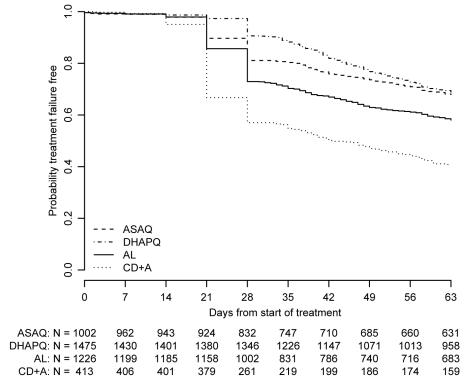
Between 9 July 2007 and 19 June 2009, a randomized, non-inferiority (10% difference threshold in efficacy at day 28) clinical trial was carried out at 12 sites in seven sub-Saharan African countries. Each site compared three of four ACTs, namely amodiaquine-artesunate (ASAQ), dihydroartemisinin-piperaquine (DHAPQ), artemether-lumefantrine (AL), or chlorproguanil-dapsone-artesunate (CD+A). Overall, 4,116 children 6-59 mo old with uncomplicated Plasmodium falciparum malaria were treated (1,226 with AL, 1,002 with ASAQ, 413 with CD+A, and 1,475 with DHAPQ), actively followed up until day 28, and then passively followed up for the next 6 mo. At day 28, for the PCR-adjusted efficacy, non-inferiority was established for three pair-wise comparisons: DHAPQ (97.3%) versus AL (95.5%) (odds ratio [OR]: 0.59, 95% CI: 0.37-0.94); DHAPQ (97.6%) versus ASAQ (96.8%) (OR: 0.74, 95% CI: 0.41-1.34), and ASAQ (97.1%) versus AL (94.4%) (OR: 0.50, 95% CI: 0.28-0.92). For the PCR-unadjusted efficacy, AL was significantly less efficacious than DHAPQ (72.7% versus 89.5%) (OR: 0.27, 95% CI: 0.21-0.34) and ASAQ (66.2% versus 80.4%) (OR: 0.40, 95% CI: 0.30-0.53), while DHAPQ (92.2%) had higher efficacy than ASAQ (80.8%) but non-inferiority could not be excluded (OR: 0.35, 95% CI: 0.26-0.48). CD+A was significantly less efficacious than the other three treatments. Day 63 results were similar to those observed at day 28.
CONCLUSIONS
This large head-to-head comparison of most currently available ACTs in sub-Saharan Africa showed that AL, ASAQ, and DHAPQ had excellent efficacy, up to day 63 post-treatment. The risk of recurrent infections was significantly lower for DHAPQ, followed by ASAQ and then AL, supporting the recent recommendation of considering DHAPQ as a valid option for the treatment of uncomplicated P. falciparum malaria.
TRIAL REGISTRATION
ClinicalTrials.gov NCT00393679; Pan African Clinical Trials Registry PACTR2009010000911750
背景
青蒿素类复方疗法(ACTs)是治疗无并发症疟疾的主要方法。然而,目前能够帮助撒哈拉以南非洲国家制定适当抗疟药物政策的数据还很缺乏。
方法和发现
2007 年 7 月 9 日至 2009 年 6 月 19 日,在七个撒哈拉以南非洲国家的 12 个地点进行了一项随机、非劣效性(疗效在第 28 天相差 10%的阈值)临床试验。每个地点比较了四种 ACT 中的三种,即阿莫地喹-青蒿琥酯(ASAQ)、双氢青蒿素-哌喹(DHAPQ)、青蒿琥酯-甲氟喹(AL)或氯喹-氨苯砜-青蒿琥酯(CD+A)。共有 4116 名 6-59 个月大的患有单纯性恶性疟原虫疟疾的儿童接受了治疗(1226 名接受 AL,1002 名接受 ASAQ,413 名接受 CD+A,1475 名接受 DHAPQ),在第 28 天主动随访,然后在接下来的 6 个月被动随访。在第 28 天,PCR 校正疗效,在三种配对比较中均确立了非劣效性:DHAPQ(97.3%)与 AL(95.5%)(比值比[OR]:0.59,95%CI:0.37-0.94);DHAPQ(97.6%)与 ASAQ(96.8%)(OR:0.74,95%CI:0.41-1.34)和 ASAQ(97.1%)与 AL(94.4%)(OR:0.50,95%CI:0.28-0.92)。PCR 未校正疗效,AL 明显不如 DHAPQ(72.7%比 89.5%)(OR:0.27,95%CI:0.21-0.34)和 ASAQ(66.2%比 80.4%)(OR:0.40,95%CI:0.30-0.53),而 DHAPQ(92.2%)的疗效高于 ASAQ(80.8%),但不能排除非劣效性(OR:0.35,95%CI:0.26-0.48)。CD+A 的疗效明显低于其他三种治疗方法。第 63 天的结果与第 28 天观察到的结果相似。
结论
这项在撒哈拉以南非洲进行的针对目前大多数可用 ACT 的大型头对头比较表明,AL、ASAQ 和 DHAPQ 在治疗后第 63 天之前具有良好的疗效。DHAPQ 的复发性感染风险明显较低,其次是 ASAQ,然后是 AL,这支持了最近关于将 DHAPQ 作为治疗单纯性恶性疟原虫疟疾的有效选择的建议。
试验注册
ClinicalTrials.gov NCT00393679;泛非临床试验注册处 PACTR2009010000911750

 Zotero 插件