
二氢青蒿素-哌喹与青蒿琥酯- 蒿甲醚治疗乌干达儿童无并发症恶性疟原虫疟疾的疗效和安全性:系统评价和随机对照试验的荟萃分析。
Efficacy and safety of dihydroartemisinin-piperaquine versus artemether-lumefantrine for treatment of uncomplicated Plasmodium falciparum malaria in Ugandan children: a systematic review and meta-analysis of randomized control trials.
机构信息
College of Health Sciences, Center for Innovative Drug Development and Therapeutic Trials for Africa (CDT-Africa), Addis Ababa University, P.O. Box 9086, Addis Ababa, Ethiopia.
Department of Nursing, College of Health Science and Medicine, Dilla University, Dilla, Ethiopia.
出版信息
Malar J. 2021 Apr 1;20(1):174. doi: 10.1186/s12936-021-03711-4.
BACKGROUND
The emergence of artemisinin resistance in Southeast Asia and Plasmodium falciparum kelch13 propeller gene mutations in sub-Saharan African pose the greatest threat to global efforts to control malaria. This is a critical concern in Uganda, where artemisinin-based combination therapy (ACT) is the first-line treatment for uncomplicated falciparum. The objective of this study was to compare the efficacy and safety of dihydroartemisinin-piperaquine (DHA-PQ) and artemether-lumefantrine (AL) for the treatment of uncomplicated falciparum malaria in Ugandan children.
METHODS
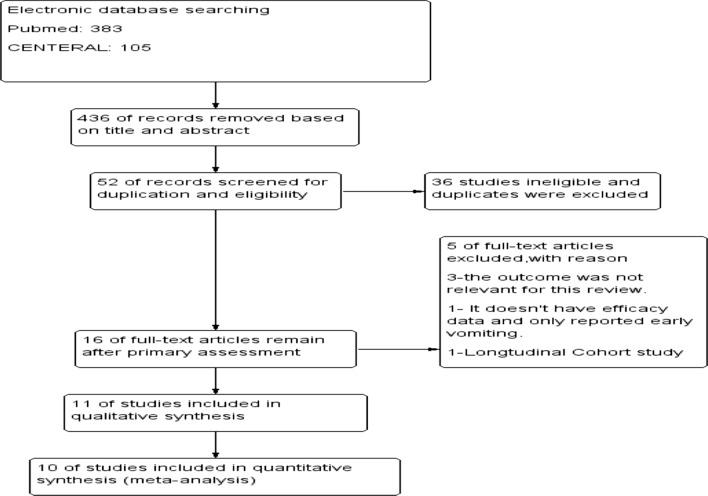
A search of PubMed and the Cochrane Central Register of Controlled Trials for retrieving randomized controlled trials comparing the efficacy and safety of DHA-PQ and AL for treatment of uncomplicated falciparum malaria in Ugandan children was done. The search was performed up to 31 August 2020. The data extracted from eligible studies and pooled as risk ratio (RR) with a 95% confidence interval (CI), using Rev Man Software (5.4). The protocol was registered in PROSPERO, ID: CRD42020182354.
RESULTS
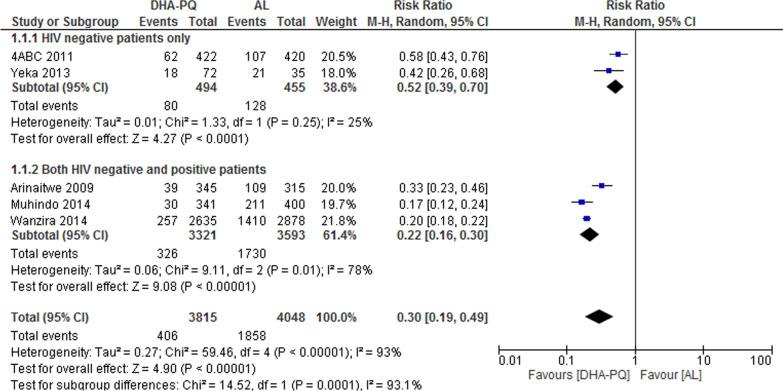
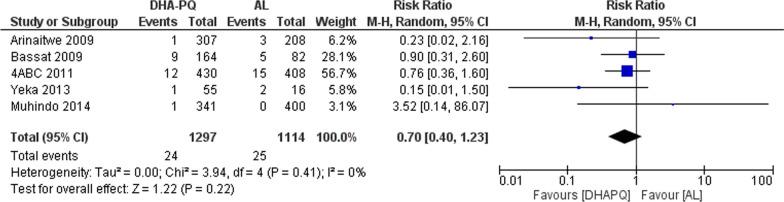
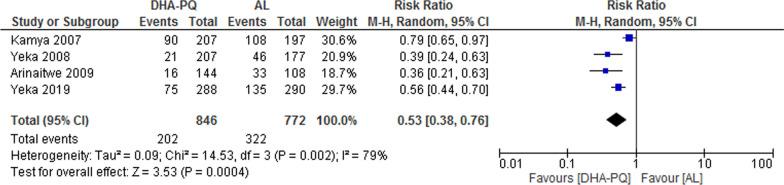
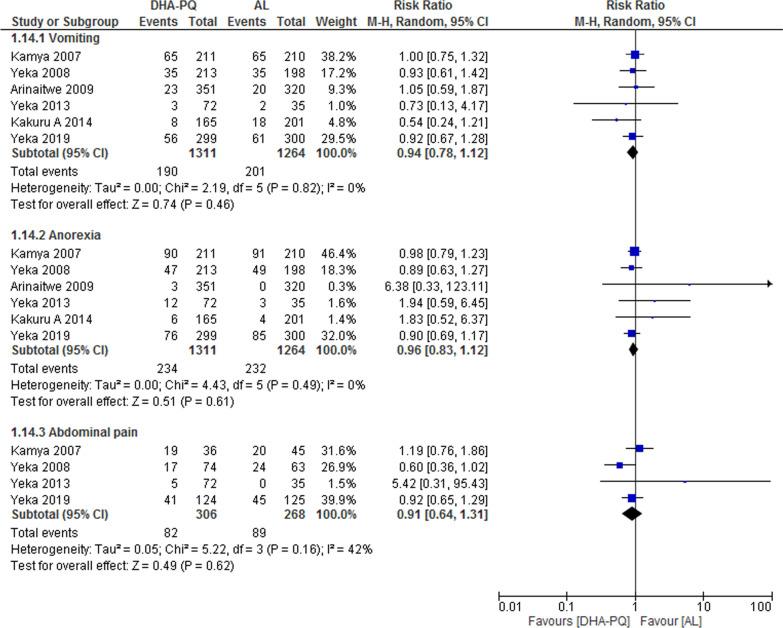
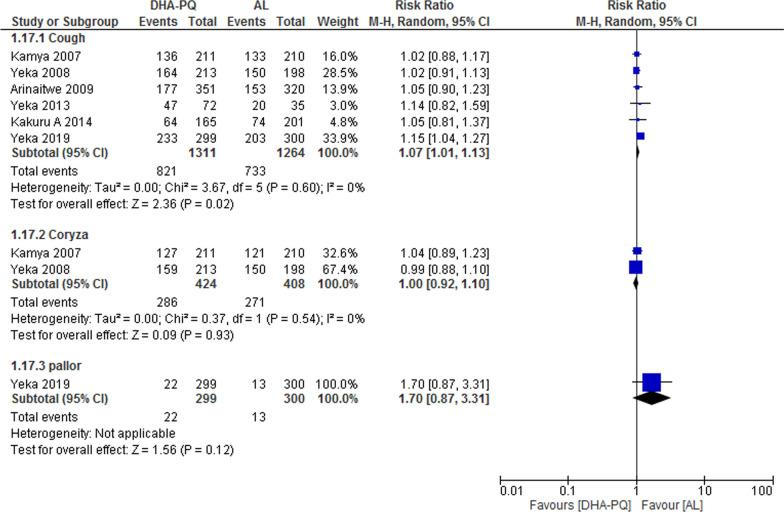
Eleven trials were included in this review and two of them only included under safety outcome. Total 3798 participants were enrolled. The PCR unadjusted treatment failure was significantly lower with DHA-PQ at day 28 (RR 0.30, 95% CI 0.19-0.49; participants = 7863; studies = 5; I = 93%, low quality evidence) and at day 42 (RR 0.53, 95% CI 0.38-0.76; participants = 1618; studies = 4; I = 79%, moderate quality of evidence). The PCR adjusted treatment failure at day 42 was significantly lower with DHA-PQ treatment group (RR 0.45, 95% CI 0.28 to 0.72; participants = 1370; studies = 5, high quality of evidence), and it was below 5% in both arms at day 28 (moderate quality of evidence). AL showed a longer prophylactic effect on new infections which may last for up to 63 days (PCR-adjusted treatment failure: RR 2.04, 95% CI 1.13-3.70; participants = 1311; studies = 2, moderate quality of evidence). Compared to AL, DHA-PQ was associated with a slightly higher frequency of cough (RR 1.07, 95% CI 1.01 to 1.13; 2575 participants; six studies; high quality of evidence). In both treatment groups, the risk of recurrent parasitaemia due to possible recrudescence was less than 5% at day 28. The appearance of gametocyte between 29 and 42 days was also significantly lower in DHA-PQ than AL (RR 0.26, 95% CI 0.12 to 0.56; participants = 623; studies = 2; I = 0%).
CONCLUSION
Compared to AL, DHA-PQ appeared to reduce treatment failure and gametocyte carriage in Ugandan children. This may trigger DHA-PQ to become the first-line treatment option. Both treatments were safe and well-tolerated.
背景
东南亚青蒿素耐药性的出现以及撒哈拉以南非洲地区恶性疟原虫kelch13 螺旋桨基因突变对全球疟疾控制工作构成了最大威胁。这在乌干达是一个关键问题,在乌干达,青蒿素为基础的联合疗法(ACT)是治疗无并发症恶性疟原虫的一线治疗方法。本研究旨在比较双氢青蒿素-哌喹(DHA-PQ)和青蒿琥酯-咯萘啶(AL)治疗乌干达儿童无并发症恶性疟原虫的疗效和安全性。
方法
检索 PubMed 和 Cochrane 对照试验中心注册库,以检索比较 DHA-PQ 和 AL 治疗乌干达儿童无并发症恶性疟原虫的疗效和安全性的随机对照试验。检索截至 2020 年 8 月 31 日。从合格研究中提取数据,并使用 Rev Man 软件(5.4 版)汇总为风险比(RR)和 95%置信区间(CI)。该方案已在 PROSPERO 中注册,编号为 CRD42020182354。
结果
本综述共纳入 11 项试验,其中两项仅纳入安全性结局。共有 3798 名参与者入选。PCR 未调整的治疗失败率在第 28 天(RR 0.30,95%CI 0.19-0.49;参与者=7863;研究=5;I=93%,低质量证据)和第 42 天(RR 0.53,95%CI 0.38-0.76;参与者=1618;研究=4;I=79%,中等质量证据)时,DHA-PQ 明显较低。第 42 天 PCR 调整的治疗失败率在 DHA-PQ 治疗组明显较低(RR 0.45,95%CI 0.28 至 0.72;参与者=1370;研究=5,高质量证据),并且在第 28 天两个治疗组的治疗失败率均低于 5%(中等质量证据)。AL 对新感染有较长的预防作用,最长可达 63 天(PCR 调整的治疗失败率:RR 2.04,95%CI 1.13-3.70;参与者=1311;研究=2,中等质量证据)。与 AL 相比,DHA-PQ 咳嗽的频率稍高(RR 1.07,95%CI 1.01-1.13;2575 名参与者;6 项研究;高质量证据)。在两组治疗中,第 28 天因可能复发而导致复发性寄生虫血症的风险均低于 5%。第 29 天至 42 天之间配子体的出现也明显低于 AL(RR 0.26,95%CI 0.12-0.56;参与者=623;研究=2;I=0%)。
结论
与 AL 相比,DHA-PQ 似乎可降低乌干达儿童的治疗失败率和配子体携带率。这可能会促使 DHA-PQ 成为一线治疗选择。两种治疗方法均安全且耐受良好。





 Zotero 插件