
双氢青蒿素哌喹治疗非复杂性恶性疟
Dihydroartemisinin-piperaquine for treating uncomplicated Plasmodium falciparum malaria.
作者信息
Zani Babalwa, Gathu Michael, Donegan Sarah, Olliaro Piero L, Sinclair David
机构信息
South African Cochrane Centre, South African Medical Research Council, P. O. Box 19070, Tygerberg, Cape Town, Western Cape, South Africa, 7505.
出版信息
Cochrane Database Syst Rev. 2014 Jan 20;2014(1):CD010927. doi: 10.1002/14651858.CD010927.
BACKGROUND
The World Health Organization (WHO) recommends Artemisinin-based Combination Therapy (ACT) for treating uncomplicated Plasmodium falciparum malaria. This review aims to assist the decision-making of malaria control programmes by providing an overview of the relative effects of dihydroartemisinin-piperaquine (DHA-P) versus other recommended ACTs.
OBJECTIVES
To evaluate the effectiveness and safety of DHA-P compared to other ACTs for treating uncomplicated P. falciparum malaria in adults and children.
SEARCH METHODS
We searched the Cochrane Infectious Diseases Group Specialized Register; the Cochrane Central Register of Controlled Trials (CENTRAL) published in The Cochrane Library; MEDLINE; EMBASE; LILACS, and the metaRegister of Controlled Trials (mRCT) up to July 2013.
SELECTION CRITERIA
Randomized controlled trials comparing a three-day course of DHA-P to a three-day course of an alternative WHO recommended ACT in uncomplicated P. falciparum malaria.
DATA COLLECTION AND ANALYSIS
Two authors independently assessed trials for eligibility and risk of bias, and extracted data. We analysed primary outcomes in line with the WHO 'Protocol for assessing and monitoring antimalarial drug efficacy' and compared drugs using risk ratios (RR) and 95% confidence intervals (CI). Secondary outcomes were effects on gametocytes, haemoglobin, and adverse events. We assessed the quality of evidence using the GRADE approach.
MAIN RESULTS
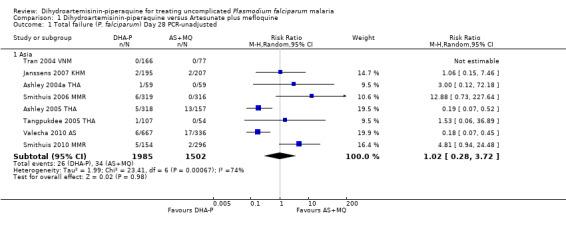
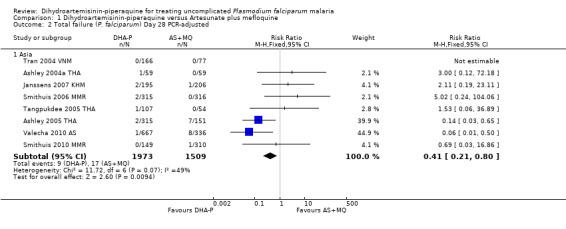
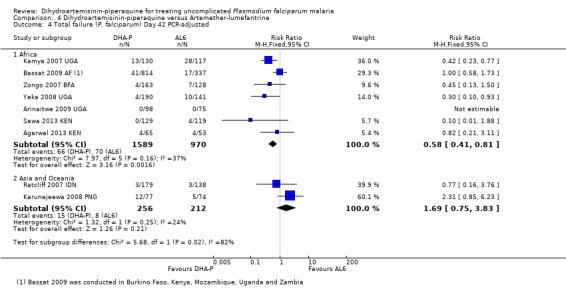
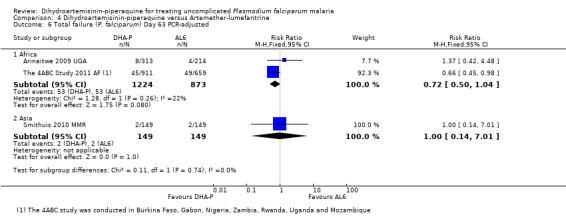
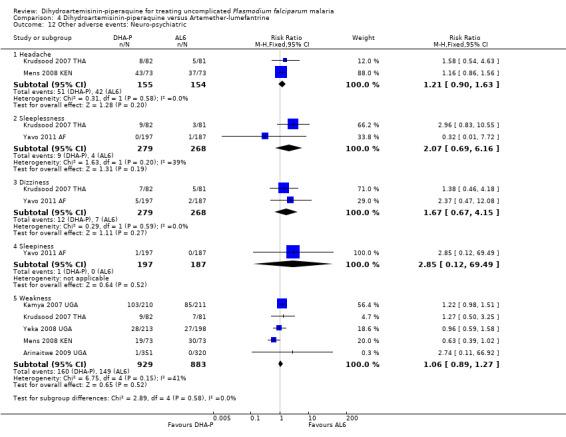
We included 27 trials, enrolling 16,382 adults and children, and conducted between 2002 and 2010. Most trials excluded infants aged less than six months and pregnant women. DHA-P versus artemether-lumefantrineIn Africa, over 28 days follow-up, DHA-P is superior to artemether-lumefantrine at preventing further parasitaemia (PCR-unadjusted treatment failure: RR 0.34, 95% CI 0.30 to 0.39, nine trials, 6200 participants, high quality evidence), and although PCR-adjusted treatment failure was below 5% for both ACTs, it was consistently lower with DHA-P (PCR-adjusted treatment failure: RR 0.42, 95% CI 0.29 to 0.62, nine trials, 5417 participants, high quality evidence). DHA-P has a longer prophylactic effect on new infections which may last for up to 63 days (PCR-unadjusted treatment failure: RR 0.71, 95% CI 0.65 to 0.78, two trials, 3200 participants, high quality evidence).In Asia and Oceania, no differences have been shown at day 28 (four trials, 1143 participants, moderate quality evidence), or day 63 (one trial, 323 participants, low quality evidence).Compared to artemether-lumefantrine, no difference was seen in prolonged QTc (low quality evidence), and no cardiac arrhythmias were reported. The frequency of other adverse events is probably similar with both combinations (moderate quality evidence). DHA-P versus artesunate plus mefloquineIn Asia, over 28 days follow-up, DHA-P is as effective as artesunate plus mefloquine at preventing further parasitaemia (PCR-unadjusted treatment failure: eight trials, 3487 participants, high quality evidence). Once adjusted by PCR to exclude new infections, treatment failure at day 28 was below 5% for both ACTs in all eight trials, but lower with DHA-P in two trials (PCR-adjusted treatment failure: RR 0.41 95% CI 0.21 to 0.80, eight trials, 3482 participants, high quality evidence). Both combinations contain partner drugs with very long half-lives and no consistent benefit in preventing new infections has been seen over 63 days follow-up (PCR-unadjusted treatment failure: five trials, 2715 participants, moderate quality evidence).In the only trial from South America, there were fewer recurrent parastaemias over 63 days with artesunate plus mefloquine (PCR-unadjusted treatment failure: RR 6.19, 95% CI 1.40 to 27.35, one trial, 445 participants, low quality evidence), but no differences were seen once adjusted for new infections (PCR-adjusted treatment failure: one trial, 435 participants, low quality evidence).DHA-P is associated with less nausea, vomiting, dizziness, sleeplessness, and palpitations compared to artesunate plus mefloquine (moderate quality evidence). DHA-P was associated with more frequent prolongation of the QTc interval (low quality evidence), but no cardiac arrhythmias were reported.
AUTHORS' CONCLUSIONS: In Africa, dihydroartemisinin-piperaquine reduces overall treatment failure compared to artemether-lumefantrine, although both drugs have PCR-adjusted failure rates of less than 5%. In Asia, dihydroartemisinin-piperaquine is as effective as artesunate plus mefloquine, and is better tolerated.
背景
世界卫生组织(WHO)推荐以青蒿素为基础的联合疗法(ACT)用于治疗非复杂性恶性疟原虫疟疾。本综述旨在通过概述双氢青蒿素哌喹(DHA-P)与其他推荐的ACTs的相对效果,协助疟疾控制项目的决策制定。
目的
评估与其他ACTs相比,DHA-P治疗成人和儿童非复杂性恶性疟原虫疟疾的有效性和安全性。
检索方法
我们检索了Cochrane传染病组专业注册库;Cochrane图书馆中发表的Cochrane对照试验中心注册库(CENTRAL);MEDLINE;EMBASE;LILACS,以及截至2013年7月的对照试验元注册库(mRCT)。
入选标准
将三天疗程的DHA-P与三天疗程的另一种WHO推荐的ACT用于治疗非复杂性恶性疟原虫疟疾的随机对照试验。
数据收集与分析
两位作者独立评估试验的入选资格和偏倚风险,并提取数据。我们根据WHO“评估和监测抗疟药疗效的方案”分析主要结局,并使用风险比(RR)和95%置信区间(CI)比较药物。次要结局是对配子体、血红蛋白和不良事件的影响。我们使用GRADE方法评估证据质量。
主要结果
我们纳入了27项试验,涉及16382名成人和儿童,试验时间为2002年至2010年。大多数试验排除了6个月以下的婴儿和孕妇。
DHA-P与蒿甲醚-本芴醇相比
在非洲,经过28天的随访,DHA-P在预防进一步的寄生虫血症方面优于蒿甲醚-本芴醇(PCR未调整的治疗失败率:RR 0.34,95%CI 0.30至0.39,9项试验,6200名参与者,高质量证据),尽管两种ACTs的PCR调整后的治疗失败率均低于5%,但DHA-P的该比率始终较低(PCR调整后的治疗失败率:RR 0.42,95%CI 0.29至0.62,9项试验,5417名参与者,高质量证据)。DHA-P对新感染有更长的预防作用,可能持续长达63天(PCR未调整的治疗失败率:RR 0.71,95%CI 0.65至0.78,2项试验,3200名参与者,高质量证据)。
在亚洲和大洋洲,在第28天(4项试验,1143名参与者,中等质量证据)或第63天(1项试验,323名参与者,低质量证据)未显示出差异。
与蒿甲醚-本芴醇相比,QTc延长无差异(低质量证据),且未报告心律失常。两种联合用药的其他不良事件发生率可能相似(中等质量证据)。
DHA-P与青蒿琥酯加甲氟喹相比
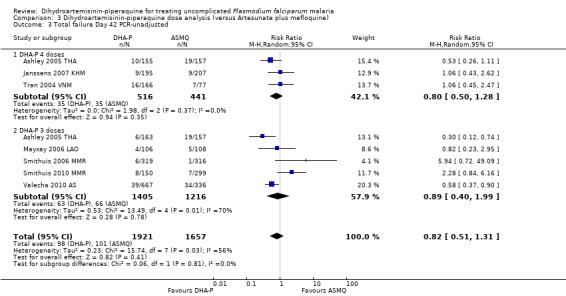
在亚洲,经过28天的随访,DHA-P在预防进一步的寄生虫血症方面与青蒿琥酯加甲氟喹一样有效(PCR未调整的治疗失败率:8项试验,3487名参与者,高质量证据)。一旦通过PCR调整以排除新感染,在所有8项试验中,两种ACTs在第28天的治疗失败率均低于5%,但在2项试验中DHA-P的治疗失败率更低(PCR调整后的治疗失败率:RR 0.41,95%CI 0.21至0.80,8项试验,3482名参与者,高质量证据)。两种联合用药都含有半衰期很长的辅助药物,在63天的随访中,在预防新感染方面未发现一致的益处(PCR未调整的治疗失败率:5项试验,2715名参与者,中等质量证据)。
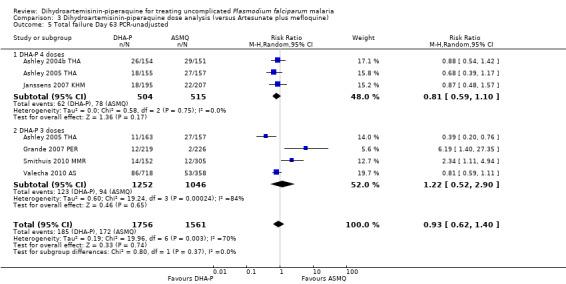
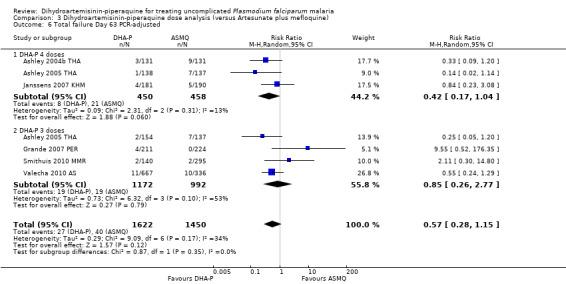
在南美洲唯一的试验中,青蒿琥酯加甲氟喹在63天内复发性寄生虫血症较少(PCR未调整的治疗失败率:RR 6.19,95%CI 1.40至27.35,1项试验,445名参与者,低质量证据),但在调整新感染后未发现差异(PCR调整后的治疗失败率:1项试验,435名参与者,低质量证据)。
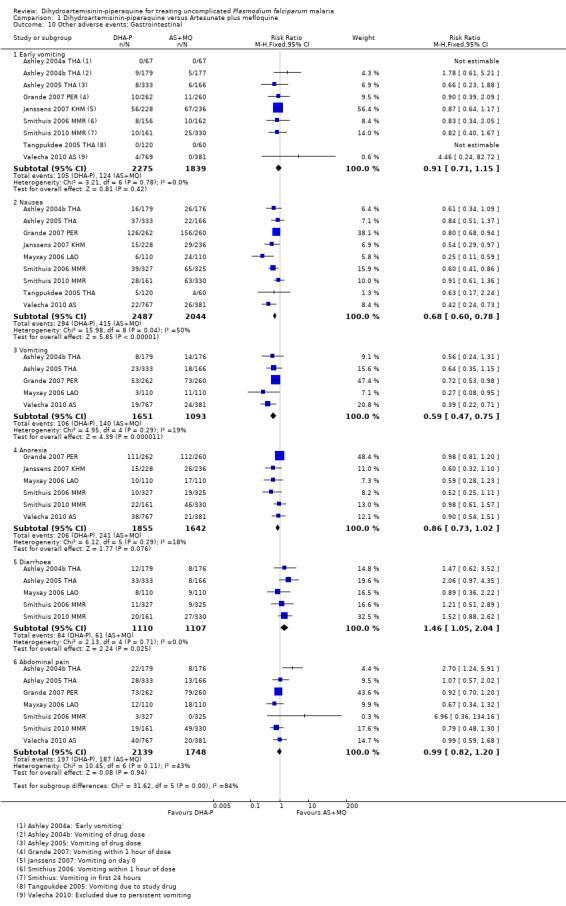
与青蒿琥酯加甲氟喹相比,DHA-P引起的恶心、呕吐、头晕、失眠和心悸较少(中等质量证据)。DHA-P与QTc间期延长更频繁相关(低质量证据),但未报告心律失常。
作者结论
在非洲,与蒿甲醚-本芴醇相比,双氢青蒿素哌喹可降低总体治疗失败率,尽管两种药物的PCR调整后的失败率均低于5%。在亚洲,双氢青蒿素哌喹与青蒿琥酯加甲氟喹一样有效,且耐受性更好。












 Zotero 插件