
p53 失活通过 E2F-1 介导的转录上调 p73 的表达。
p53 inactivation upregulates p73 expression through E2F-1 mediated transcription.
机构信息
Department of Pathology, University of Oklahoma Health Sciences Center, Oklahoma City, Oklahoma, United States of America.
出版信息
PLoS One. 2012;7(8):e43564. doi: 10.1371/journal.pone.0043564. Epub 2012 Aug 30.
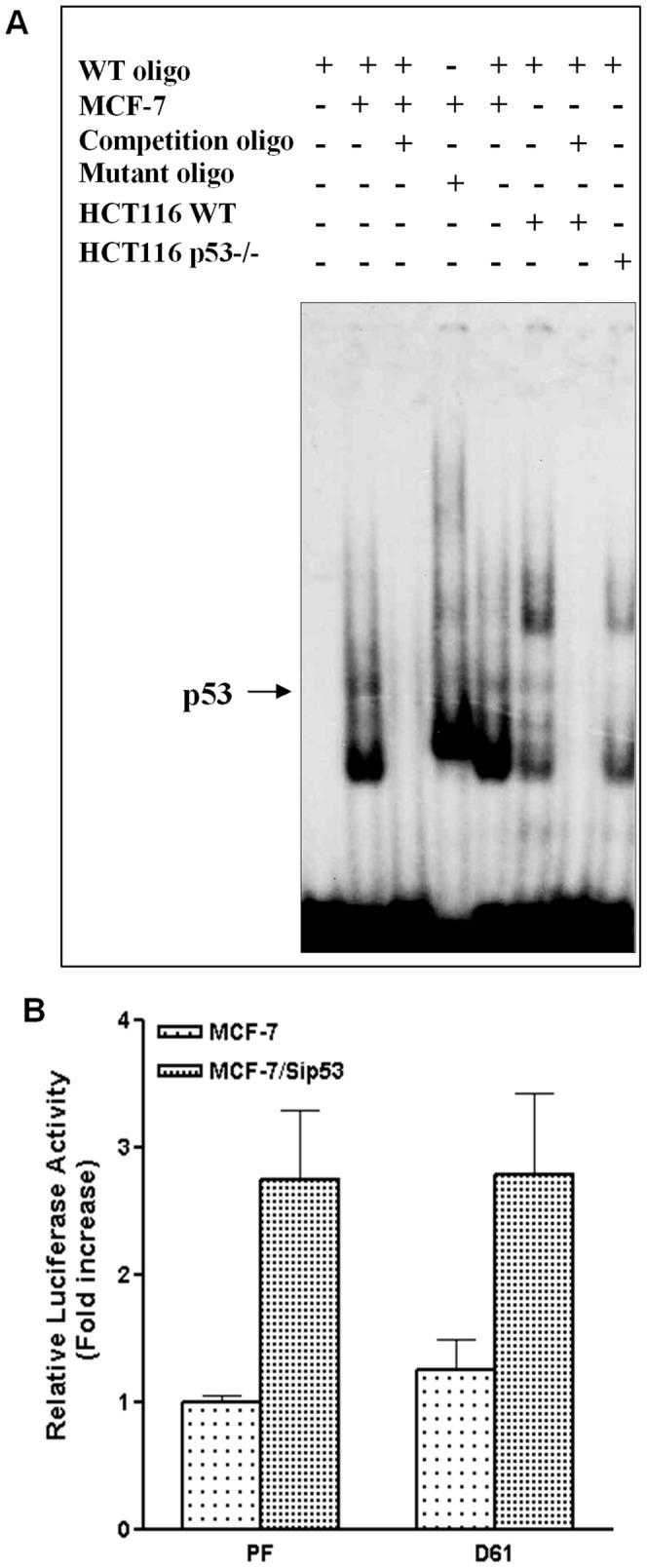
While p73 overexpression has been associated with increased apoptosis in cancer tissues, p73 overexpressing tumors appear to be of high grade malignancy. Why this putative tumor suppressor is overexpressed in cancer cells and what the function of overexpressed p73 is in breast cancers are critical questions to be addressed. By investigating the effect of p53 inactivation on p73 expression, we found that both protein and mRNA levels of TAp73 were increased in MCF-7/p53siRNA cells, MCF-7/p53mt135 cells and HCT-116/p53-/- cells, as compared to wild type control, suggesting that p53 inactivation by various forms upregulates p73. We showed that p53 knockdown induced p73 was mainly regulated at the transcriptional level. However, although p53 has a putative binding site in the TAp73 promoter, deletion of this binding site did not affect p53 knockdown mediated activation of TAp73 promoter. Chromatin immuno-precipitation (ChIP) data demonstrated that loss of p53 results in enhanced occupancy of E2F-1 in the TAp73 promoter. The responsive sequence of p53 inactivation mediated p73 upregulation was mapped to the proximal promoter region of the TAp73 gene. To test the role of E2F-1 in p53 inactivation mediated regulation of p73 transcription, we found that p53 knockdown enhanced E2F-1 dependent p73 transcription, and mutations in E2F-1 binding sites in the TAp73 promoter abrogated p53 knockdown mediated activation of TAp73 promoter. Moreover, we demonstrated that p21 is a mediator of p53-E2F crosstalk in the regulation of p73 transcription. We concluded that p53 knockdown/inactivation may upregulate TAp73 expression through E2F-1 mediated transcriptional regulation. p53 inactivation mediated upregulation of p73 suggests an intrinsic rescuing mechanism in response to p53 mutation/inactivation. These findings support further analysis of the correlation between p53 status and p73 expression and its prognostic/predictive significance in human cancers.
虽然 p73 的过表达与癌症组织中的细胞凋亡增加有关,但 p73 过表达的肿瘤似乎具有高度恶性。为什么这种假定的肿瘤抑制因子在癌细胞中过表达,以及过表达的 p73 在乳腺癌中的功能是什么,这些都是需要解决的关键问题。通过研究 p53 失活对 p73 表达的影响,我们发现 MCF-7/p53siRNA 细胞、MCF-7/p53mt135 细胞和 HCT-116/p53-/-细胞中的 TAp73 蛋白和 mRNA 水平均高于野生型对照,表明各种形式的 p53 失活均可上调 p73。我们表明,p53 敲低诱导的 p73 主要受转录水平调控。然而,尽管 p53 在 TAp73 启动子中具有假定的结合位点,但缺失该结合位点并不影响 p53 敲低介导的 TAp73 启动子激活。染色质免疫沉淀 (ChIP) 数据表明,p53 的缺失导致 E2F-1 在 TAp73 启动子上的占有率增强。p53 失活介导的 p73 上调的响应序列被映射到 TAp73 基因的近端启动子区域。为了测试 E2F-1 在 p53 失活介导的 p73 转录调控中的作用,我们发现 p53 敲低增强了 E2F-1 依赖的 p73 转录,并且 TAp73 启动子中 E2F-1 结合位点的突变消除了 p53 敲低介导的 TAp73 启动子激活。此外,我们证明 p21 是 p53-E2F 串扰在调节 p73 转录中的介质。我们得出结论,p53 敲低/失活可能通过 E2F-1 介导的转录调控上调 TAp73 表达。p53 失活介导的 p73 上调表明,在 p53 突变/失活时存在内在的挽救机制。这些发现支持进一步分析 p53 状态与 p73 表达之间的相关性及其在人类癌症中的预后/预测意义。




 Zotero 插件