
采用体外高通量筛选检测方法来鉴定潜在的内分泌干扰化学物。
Using in vitro high throughput screening assays to identify potential endocrine-disrupting chemicals.
机构信息
Department of Environmental Sciences and Engineering, University of North Carolina, Chapel Hill, North Carolina, USA.
出版信息
Environ Health Perspect. 2013 Jan;121(1):7-14. doi: 10.1289/ehp.1205065. Epub 2012 Sep 28.
BACKGROUND
Over the past 20 years, an increased focus on detecting environmental chemicals that pose a risk of adverse effects due to endocrine disruption has driven the creation of the U.S. Environmental Protection Agency (EPA) Endocrine Disruptor Screening Program (EDSP). Thousands of chemicals are subject to the EDSP; thus, processing these chemicals using current test batteries could require millions of dollars and decades. A need for increased throughput and efficiency motivated the development of methods using in vitro high throughput screening (HTS) assays to prioritize chemicals for EDSP Tier 1 screening (T1S).
OBJECTIVE
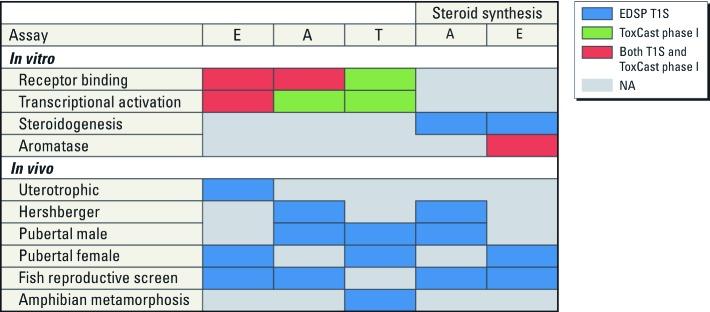
In this study we used U.S. EPA ToxCast HTS assays for estrogen, androgen, steroidogenic, and thyroid-disrupting mechanisms to classify compounds and compare ToxCast results to in vitro and in vivo data from EDSP T1S assays.
METHOD
We implemented an iterative model that optimized the ability of endocrine-related HTS assays to predict components of EDSP T1S and related results. Balanced accuracy was used as a measure of model performance.
RESULTS
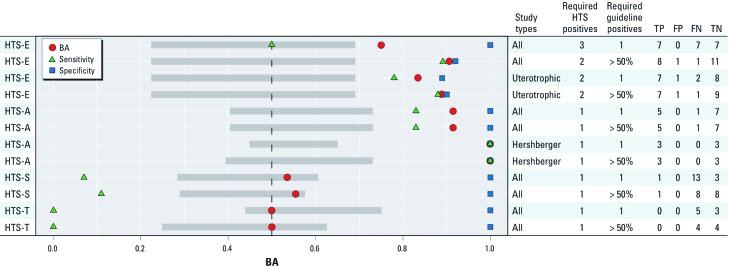
ToxCast estrogen receptor and androgen receptor assays predicted the results of relevant EDSP T1S assays with balanced accuracies of 0.91 (p < 0.001) and 0.92 (p < 0.001), respectively. Uterotrophic and Hershberger assay results were predicted with balanced accuracies of 0.89 (p < 0.001) and 1 (p < 0.001), respectively. Models for steroidogenic and thyroid-related effects could not be developed with the currently published ToxCast data.
CONCLUSIONS
Overall, results suggest that current ToxCast assays can accurately identify chemicals with potential to interact with the estrogenic and androgenic pathways, and could help prioritize chemicals for EDSP T1S assays.
背景
在过去的 20 年中,人们越来越关注检测环境化学物质,这些化学物质由于内分泌干扰而具有不良影响的风险,这推动了美国环境保护署(EPA)内分泌干扰物筛选计划(EDSP)的创建。数千种化学物质都受到 EDSP 的约束;因此,使用当前的测试电池处理这些化学物质可能需要数百万美元和数十年的时间。为了提高产量和效率,我们需要开发使用体外高通量筛选(HTS)测定法的方法,以便将化学物质优先用于 EDSP 第 1 层筛选(T1S)。
目的
在这项研究中,我们使用美国环保署 ToxCast HTS 测定法来检测雌激素、雄激素、类固醇生成和甲状腺干扰机制,对化合物进行分类,并将 ToxCast 结果与 EDSP T1S 测定法的体外和体内数据进行比较。
方法
我们实施了一种迭代模型,该模型优化了与内分泌相关的 HTS 测定法预测 EDSP T1S 成分和相关结果的能力。平衡准确性被用作衡量模型性能的指标。
结果
ToxCast 雌激素受体和雄激素受体测定法分别以 0.91(p < 0.001)和 0.92(p < 0.001)的平衡准确性预测了相关 EDSP T1S 测定法的结果。子宫增重和 Hershberger 测定法的结果分别以 0.89(p < 0.001)和 1(p < 0.001)的平衡准确性进行了预测。目前使用 ToxCast 数据无法开发类固醇生成和甲状腺相关作用的模型。
结论
总体而言,结果表明,目前的 ToxCast 测定法可以准确识别可能与雌激素和雄激素途径相互作用的化学物质,并有助于优先考虑 EDSP T1S 测定法的化学物质。


 Zotero 插件