
常见感染因子与单克隆 B 细胞淋巴增生症:一项健康成年人横断面流行病学研究。
Common infectious agents and monoclonal B-cell lymphocytosis: a cross-sectional epidemiological study among healthy adults.
机构信息
Unit of Infections and Cancer, IDIBELL, Institut Català d' Oncologia, L' Hospitalet de Llobregat, Barcelona, Spain.
出版信息
PLoS One. 2012;7(12):e52808. doi: 10.1371/journal.pone.0052808. Epub 2012 Dec 28.
BACKGROUND
Risk factors associated with monoclonal B-cell lymphocytosis (MBL), a potential precursor of chronic lymphocytic leukaemia (CLL), remain unknown.
METHODS
Using a cross-sectional study design, we investigated demographic, medical and behavioural risk factors associated with MBL. "Low-count" MBL (cases) were defined as individuals with very low median absolute count of clonal B-cells, identified from screening of healthy individuals and the remainder classified as controls. 452 individuals completed a questionnaire with their general practitioner, both blind to the MBL status of the subject. Odds ratios (OR) and 95% confidence interval (CI) for MBL were estimated by means of unconditional logistic regression adjusted for confounding factors.
RESULTS
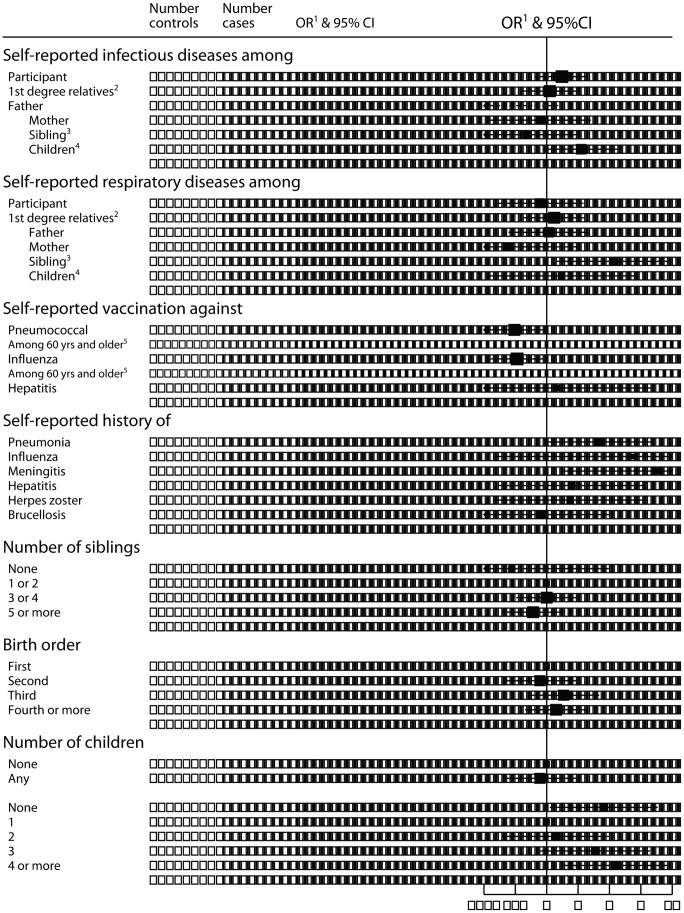
MBL were detected in 72/452 subjects (16%). Increasing age was strongly associated with MBL (P-trend<0.001). MBL was significantly less common among individuals vaccinated against pneumococcal or influenza (OR 0.49, 95% confidence interval (CI): 0.25 to 0.95; P-value=0.03 and OR: 0.52, 95% CI: 0.29 to 0.93, P-value=0.03, respectively). Albeit based on small numbers, cases were more likely to report infectious diseases among their children, respiratory disease among their siblings and personal history of pneumonia and meningitis. No other distinguishing epidemiological features were identified except for family history of cancer and an inverse relationship with diabetes treatment. All associations described above were retained after restricting the analysis to CLL-like MBL.
CONCLUSION
Overall, these findings suggest that exposure to infectious agents leading to serious clinical manifestations in the patient or its surroundings may trigger immune events leading to MBL. This exploratory study provides initial insights and directions for future research related to MBL, a potential precursor of chronic lymphocytic leukaemia. Further work is warranted to confirm these findings.
背景
与单克隆 B 细胞淋巴增生症(MBL)相关的风险因素,即慢性淋巴细胞白血病(CLL)的潜在前体,目前尚不清楚。
方法
使用横断面研究设计,我们研究了与 MBL 相关的人口统计学、医学和行为风险因素。“低计数”MBL(病例)定义为克隆 B 细胞中位数绝对计数极低的个体,从健康个体的筛查中确定,其余个体归类为对照。452 名个体在全科医生的指导下完成了一份问卷,他们对研究对象的 MBL 状况均不知情。采用调整混杂因素的非条件逻辑回归估计 MBL 的比值比(OR)和 95%置信区间(CI)。
结果
在 452 名个体中,72 名(16%)检测到 MBL。年龄增长与 MBL 显著相关(P 趋势<0.001)。与接种肺炎球菌或流感疫苗的个体相比,MBL 显著较少(OR 0.49,95%置信区间(CI):0.25 至 0.95;P 值=0.03 和 OR:0.52,95%CI:0.29 至 0.93,P 值=0.03)。尽管数量较少,但病例更有可能报告其子女的传染病、其兄弟姐妹的呼吸道疾病以及个人肺炎和脑膜炎病史。除了癌症家族史和糖尿病治疗的反比关系外,没有发现其他具有鉴别意义的流行病学特征。在将分析限制为 CLL 样 MBL 后,保留了上述所有关联。
结论
总的来说,这些发现表明,暴露于导致患者或其周围环境发生严重临床表现的感染性病原体可能会引发导致 MBL 的免疫事件。这项探索性研究为与 MBL 相关的未来研究提供了初步见解和方向,MBL 是 CLL 的潜在前体。需要进一步的工作来证实这些发现。
 Zotero 插件