
RTEL1 基因的结构突变导致先天性角化不良。
Constitutional mutations in RTEL1 cause severe dyskeratosis congenita.
机构信息
Centre for Paediatrics, Barts and The London School of Medicine and Dentistry, Queen Mary University of London, Barts and The London Children's Hospital, London, UK.
出版信息
Am J Hum Genet. 2013 Mar 7;92(3):448-53. doi: 10.1016/j.ajhg.2013.02.001. Epub 2013 Feb 28.
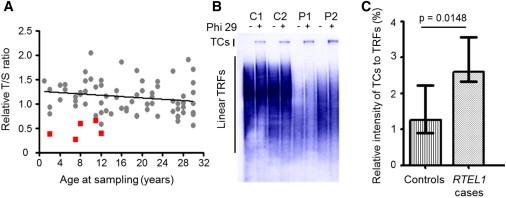
Dyskeratosis congenita (DC) and its phenotypically severe variant, Hoyeraal-Hreidarsson syndrome (HHS), are multisystem bone-marrow-failure syndromes in which the principal pathology is defective telomere maintenance. The genetic basis of many cases of DC and HHS remains unknown. Using whole-exome sequencing, we identified biallelic mutations in RTEL1, encoding a helicase essential for telomere maintenance and regulation of homologous recombination, in an individual with familial HHS. Additional screening of RTEL1 identified biallelic mutations in 6/23 index cases with HHS but none in 102 DC or DC-like cases. All 11 mutations in ten HHS individuals from seven families segregated in an autosomal-recessive manner, and telomere lengths were significantly shorter in cases than in controls (p = 0.0003). This group had significantly higher levels of telomeric circles, produced as a consequence of incorrect processing of telomere ends, than did controls (p = 0.0148). These biallelic RTEL1 mutations are responsible for a major subgroup (∼29%) of HHS. Our studies show that cells harboring these mutations have significant defects in telomere maintenance, but not in homologous recombination, and that incorrect resolution of T-loops is a mechanism for telomere shortening and disease causation in humans. They also demonstrate the severe multisystem consequences of its dysfunction.
先天性角化不良症 (DC) 及其表型严重变体 Hoyeraal-Hreidarsson 综合征 (HHS) 是多系统骨髓衰竭综合征,其主要病理学是端粒维持缺陷。许多 DC 和 HHS 病例的遗传基础仍然未知。通过全外显子组测序,我们在一名具有家族性 HHS 的个体中发现编码维持端粒和调节同源重组所必需的解旋酶的 RTEL1 基因的双等位基因突变。对 RTEL1 的进一步筛选在 6/23 名 HHS 指数病例中发现了双等位基因突变,但在 102 名 DC 或类似 DC 的病例中均未发现。来自七个家庭的 11 个突变在 10 个 HHS 个体中呈常染色体隐性遗传方式,病例组的端粒长度明显短于对照组 (p = 0.0003)。这组患者的端粒环水平明显高于对照组 (p = 0.0148),端粒环是由于不正确处理端粒末端而产生的。这些双等位 RTEL1 突变是 HHS 的一个主要亚组(约 29%)的原因。我们的研究表明,携带这些突变的细胞在端粒维持方面存在明显缺陷,但在同源重组方面没有缺陷,并且 T 环的不正确解决是人类端粒缩短和疾病发病的机制。它们还表明其功能障碍的严重多系统后果。

 Zotero 插件