
试验样本量对治疗效果估计的影响:荟萃流行病学研究。
Influence of trial sample size on treatment effect estimates: meta-epidemiological study.
机构信息
INSERM, U738, Paris, France.
出版信息
BMJ. 2013 Apr 24;346:f2304. doi: 10.1136/bmj.f2304.
OBJECTIVE
To assess the influence of trial sample size on treatment effect estimates within meta-analyses.
DESIGN
Meta-epidemiological study.
DATA SOURCES
93 meta-analyses (735 randomised controlled trials) assessing therapeutic interventions with binary outcomes, published in the 10 leading journals of each medical subject category of the Journal Citation Reports or in the Cochrane Database of Systematic Reviews.
DATA EXTRACTION
Sample size, outcome data, and risk of bias extracted from each trial.
DATA SYNTHESIS
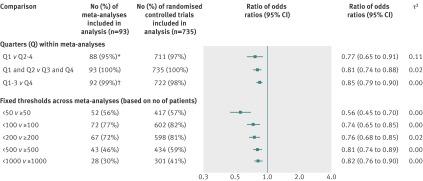
Trials within each meta-analysis were sorted by their sample size: using quarters within each meta-analysis (from quarter 1 with 25% of the smallest trials, to quarter 4 with 25% of the largest trials), and using size groups across meta-analyses (ranging from <50 to ≥ 1000 patients). Treatment effects were compared within each meta-analysis between quarters or between size groups by average ratios of odds ratios (where a ratio of odds ratios less than 1 indicates larger effects in smaller trials).
RESULTS
Treatment effect estimates were significantly larger in smaller trials, regardless of sample size. Compared with quarter 4 (which included the largest trials), treatment effects were, on average, 32% larger in trials in quarter 1 (which included the smallest trials; ratio of odds ratios 0.68, 95% confidence interval 0.57 to 0.82), 17% larger in trials in quarter 2 (0.83, 0.75 to 0.91), and 12% larger in trials in quarter 3 (0.88, 0.82 to 0.95). Similar results were obtained when comparing treatment effect estimates between different size groups. Compared with trials of 1000 patients or more, treatment effects were, on average, 48% larger in trials with fewer than 50 patients (0.52, 0.41 to 0.66) and 10% larger in trials with 500-999 patients (0.90, 0.82 to 1.00).
CONCLUSIONS
Treatment effect estimates differed within meta-analyses solely based on trial sample size, with stronger effect estimates seen in small to moderately sized trials than in the largest trials.
目的
评估临床试验样本量对荟萃分析中治疗效果估计的影响。
设计
荟萃分析的元研究。
资料来源
93 项评估治疗干预效果的荟萃分析(735 项随机对照试验),这些试验的结局为二分类,发表在《期刊引证报告》(JCR)中每个医学专业领域的前 10 种期刊或 Cochrane 系统评价数据库中。
资料提取
从每项试验中提取样本量、结局数据和偏倚风险。
资料综合
将每个荟萃分析内的试验按样本量排序:在每个荟萃分析中使用四分位数(第 1 四分位数包含 25%最小的试验,第 4 四分位数包含 25%最大的试验),或在多个荟萃分析中使用大小组(从 <50 例到 ≥1000 例)。在每个荟萃分析中,通过比较各四分位数或各大小组之间的平均比值比(OR 比值小于 1 表明小样本试验的效果更大),比较各试验内的治疗效果。
结果
无论样本量大小如何,小样本试验的治疗效果估计值均显著更大。与第 4 四分位数(包含最大的试验)相比,第 1 四分位数(包含最小的试验)的试验平均治疗效果大 32%(OR 比值 0.68,95%置信区间 0.57 至 0.82),第 2 四分位数大 17%(0.83,0.75 至 0.91),第 3 四分位数大 12%(0.88,0.82 至 0.95)。当比较不同大小组之间的治疗效果估计值时,也得到了类似的结果。与样本量超过 1000 例的试验相比,样本量少于 50 例的试验平均治疗效果大 48%(0.52,0.41 至 0.66),样本量为 500-999 例的试验平均治疗效果大 10%(0.90,0.82 至 1.00)。
结论
仅基于试验样本量,治疗效果估计值在荟萃分析内存在差异,小至中等样本量的试验效果强于最大的试验。

 Zotero 插件