
姜状三七块根中多酚提取物的组蛋白去乙酰化酶(HDAC)抑制和抗增殖活性:芥子酸作为 HDAC 抑制剂。
Histone deacetylase (HDAC) inhibitory and antiproliferative activities of phenolic-rich extracts derived from the rhizome of Hydnophytum formicarum Jack.: sinapinic acid acts as HDAC inhibitor.
机构信息
Department of Biochemistry, Faculty of Science, Khon Kaen University, Khon Kaen 40002, Thailand.
出版信息
BMC Complement Altern Med. 2013 Sep 22;13:232. doi: 10.1186/1472-6882-13-232.
BACKGROUND
The rhizome of Hydnophytum formicarum Jack., a medicinal plant known in Thai as Hua-Roi-Roo, has been used in Thai traditional herbal medicine for treatment of cancer. We assessed the ability of its ethanolic and phenolic-rich extracts and its major phenolic compound, sinapinic acid, possessing histone deacetylase (HDAC) inhibitory activity to inhibit proliferation of 5 human cancer cell lines.
METHODS
HeLa cells were used to study HDAC inhibitory activity of the extracts, sinapinic acid, and a well-known HDAC inhibitor sodium butyrate. Five human cancer cell lines and one non-cancer cell line were used to study antiproliferative activities of the plant extracts, sinapinic acid and sodium butyrate, comparatively.
RESULTS
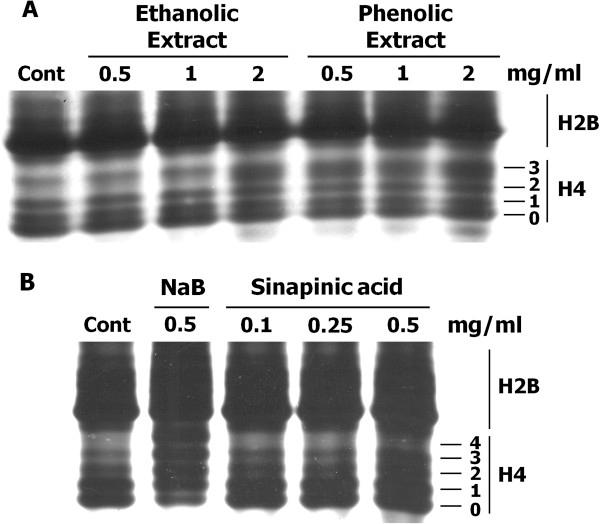
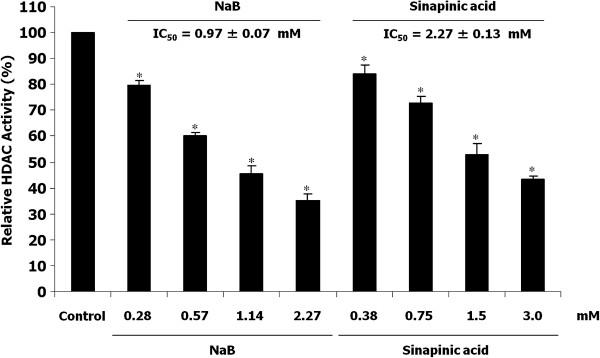
Results indicated that ethanolic and phenolic-rich extracts of H. formicarum Jack. rhizome possessed both antiproliferative activity and HDAC inhibitory activity in HeLa cells. Sinapinic acid, despite its lower HDAC inhibitory activity than the well-known HDAC inhibitor sodium butyrate, inhibited the growth of HeLa and HT29 cells more effectively than sodium butyrate. However, sinapinic acid inhibited the growth of HCT116 and Jurkat cells less effectively than sodium butyrate. The non-cancer cell line (Vero cells) and breast cancer cell line (MCF-7 cells) appeared to be resistant to both sinapinic acid and sodium butyrate. The growth inhibitory effects of the ethanolic and phenolic-rich extracts and sinapinic acid in HeLa cells were mediated by induction of apoptosis.
CONCLUSIONS
The results of this study support the efficacy of H. formicarum Jack. rhizome ethanolic and phenolic-rich extracts for the treatment of cervical cancer, colon cancer, and T- cell leukemia in an alternative medicine. Further studies of other active ingredients from this plant are needed.
背景
水龙骨(Hydnophytum formicarum Jack.)的根茎,一种在泰语中被称为 Hua-Roi-Roo 的药用植物,已被用于泰国传统草药治疗癌症。我们评估了其乙醇和富含酚类的提取物及其主要酚类化合物芥子酸(具有组蛋白去乙酰化酶(HDAC)抑制活性)抑制 5 个人类癌细胞系增殖的能力。
方法
我们使用 HeLa 细胞来研究提取物、芥子酸和一种已知的 HDAC 抑制剂丁酸钠对 HDAC 抑制活性的影响。使用 5 个人类癌细胞系和 1 个非癌细胞系比较研究植物提取物、芥子酸和丁酸钠的抗增殖活性。
结果
结果表明,水龙骨根茎的乙醇和富含酚类的提取物具有在 HeLa 细胞中的增殖抑制活性和 HDAC 抑制活性。芥子酸尽管其 HDAC 抑制活性低于已知的 HDAC 抑制剂丁酸钠,但比丁酸钠更有效地抑制 HeLa 和 HT29 细胞的生长。然而,芥子酸对 HCT116 和 Jurkat 细胞的生长抑制作用不如丁酸钠有效。非癌细胞系(Vero 细胞)和乳腺癌细胞系(MCF-7 细胞)似乎对芥子酸和丁酸钠均具有抗性。乙醇和富含酚类的提取物以及芥子酸在 HeLa 细胞中的生长抑制作用是通过诱导细胞凋亡介导的。
结论
本研究结果支持水龙骨根茎乙醇和富含酚类的提取物在替代医学中治疗宫颈癌、结肠癌和 T 细胞白血病的功效。需要进一步研究该植物的其他活性成分。


 Zotero 插件