
分子特异性、趋同和约束塑造了在营养贫瘠环境中的适应性进化。
Molecular specificity, convergence and constraint shape adaptive evolution in nutrient-poor environments.
机构信息
Center for Genomics and Systems Biology, Department of Biology, New York University, New York, New York, United States of America.
出版信息
PLoS Genet. 2014 Jan;10(1):e1004041. doi: 10.1371/journal.pgen.1004041. Epub 2014 Jan 9.
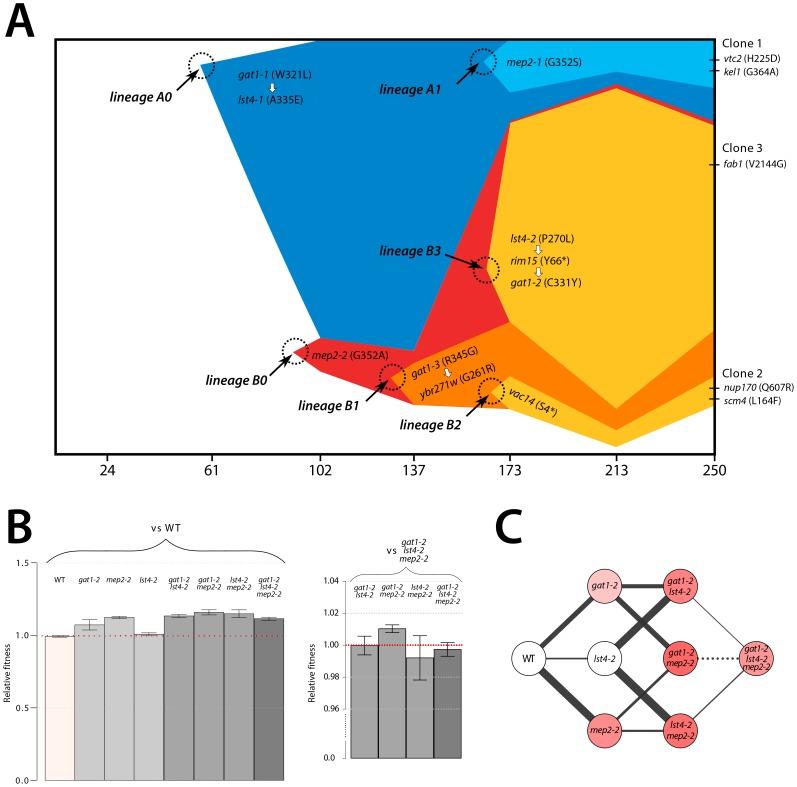
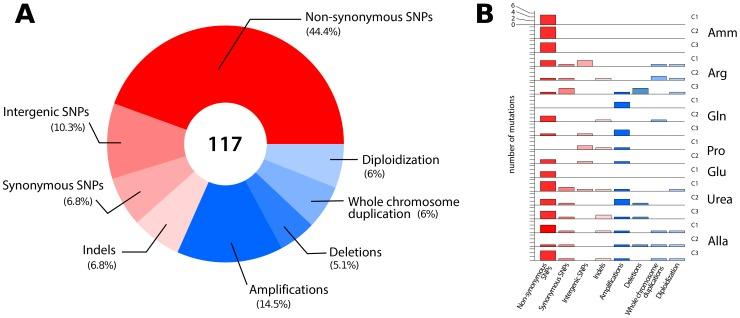
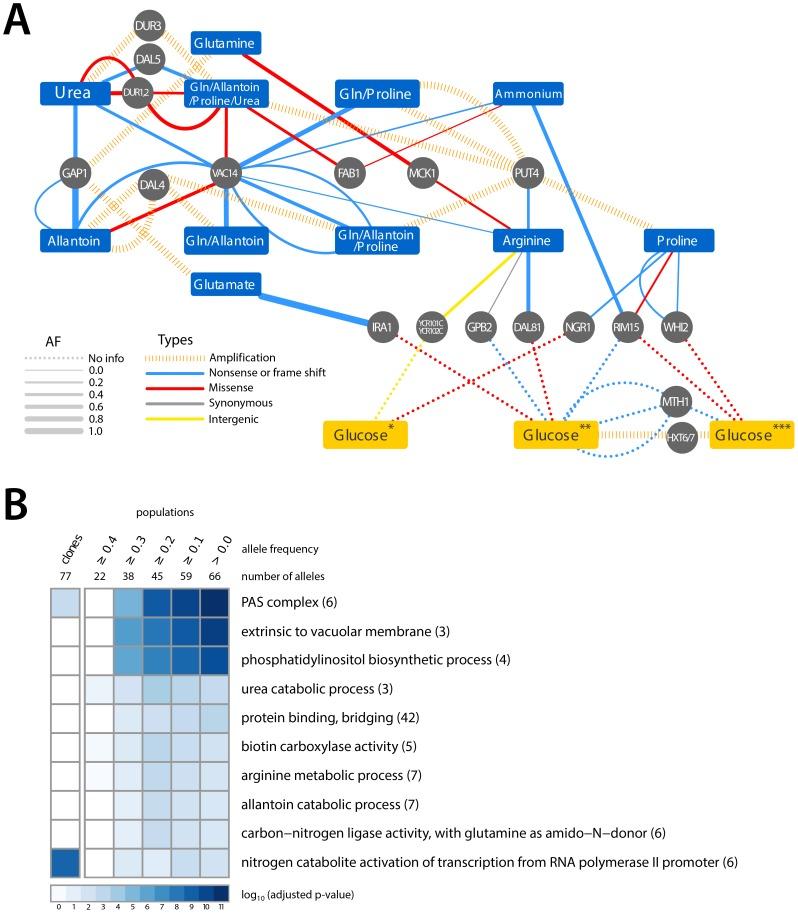
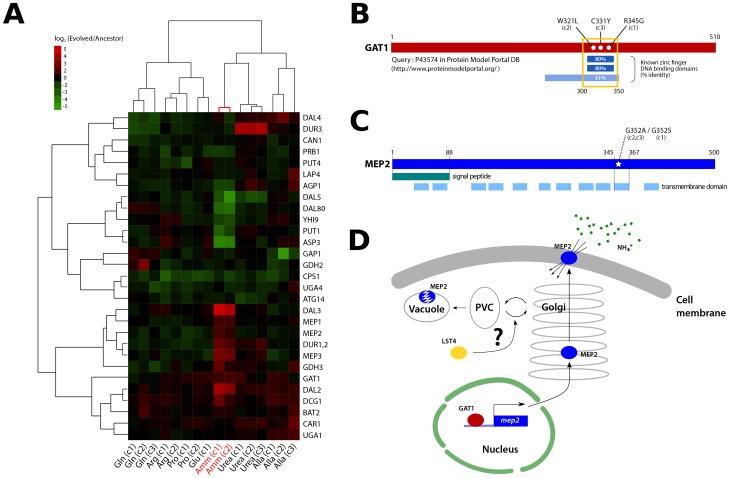
One of the central goals of evolutionary biology is to explain and predict the molecular basis of adaptive evolution. We studied the evolution of genetic networks in Saccharomyces cerevisiae (budding yeast) populations propagated for more than 200 generations in different nitrogen-limiting conditions. We find that rapid adaptive evolution in nitrogen-poor environments is dominated by the de novo generation and selection of copy number variants (CNVs), a large fraction of which contain genes encoding specific nitrogen transporters including PUT4, DUR3 and DAL4. The large fitness increases associated with these alleles limits the genetic heterogeneity of adapting populations even in environments with multiple nitrogen sources. Complete identification of acquired point mutations, in individual lineages and entire populations, identified heterogeneity at the level of genetic loci but common themes at the level of functional modules, including genes controlling phosphatidylinositol-3-phosphate metabolism and vacuole biogenesis. Adaptive strategies shared with other nutrient-limited environments point to selection of genetic variation in the TORC1 and Ras/PKA signaling pathways as a general mechanism underlying improved growth in nutrient-limited environments. Within a single population we observed the repeated independent selection of a multi-locus genotype, comprised of the functionally related genes GAT1, MEP2 and LST4. By studying the fitness of individual alleles, and their combination, as well as the evolutionary history of the evolving population, we find that the order in which these mutations are acquired is constrained by epistasis. The identification of repeatedly selected variation at functionally related loci that interact epistatically suggests that gene network polymorphisms (GNPs) may be a frequent outcome of adaptive evolution. Our results provide insight into the mechanistic basis by which cells adapt to nutrient-limited environments and suggest that knowledge of the selective environment and the regulatory mechanisms important for growth and survival in that environment greatly increase the predictability of adaptive evolution.
进化生物学的核心目标之一是解释和预测适应性进化的分子基础。我们研究了在不同氮限制条件下繁殖超过 200 代的酿酒酵母(出芽酵母)群体中遗传网络的进化。我们发现,在氮贫乏环境中的快速适应性进化主要由从头产生和选择拷贝数变异(CNVs)主导,其中很大一部分包含编码特定氮转运体的基因,包括 PUT4、DUR3 和 DAL4。这些等位基因与较大的适应性增加相关,即使在有多种氮源的环境中,也限制了适应种群的遗传异质性。在个体谱系和整个种群中对获得的点突变的完整鉴定,确定了遗传基因座水平的异质性,但在功能模块水平上存在共同主题,包括控制磷酸肌醇-3-磷酸代谢和液泡生物发生的基因。与其他营养限制环境共享的适应性策略表明,TORC1 和 Ras/PKA 信号通路中遗传变异的选择是在营养限制环境中改善生长的一般机制。在单个种群中,我们观察到由功能相关基因 GAT1、MEP2 和 LST4 组成的多基因座基因型的重复独立选择。通过研究单个等位基因及其组合的适应性,以及进化群体的进化历史,我们发现这些突变的获取顺序受到上位性的限制。在功能相关基因座中反复选择相互作用的上位性的变化表明,基因网络多态性(GNPs)可能是适应性进化的常见结果。我们的研究结果深入了解了细胞适应营养限制环境的机制基础,并表明选择性环境的知识以及对该环境中生长和生存重要的调节机制极大地提高了适应性进化的可预测性。

 Zotero 插件