
微小隐孢子虫IId家族:克隆群体及其从西亚向其他地理区域的扩散
Cryptosporidium parvum IId family: clonal population and dispersal from Western Asia to other geographical regions.
作者信息
Wang Rongjun, Zhang Longxian, Axén Charlotte, Bjorkman Camilla, Jian Fuchun, Amer Said, Liu Aiqin, Feng Yaoyu, Li Guoquan, Lv Chaochao, Zhao Zifang, Qi Meng, Dong Haiju, Wang Helei, Sun Yanru, Ning Changshen, Xiao Lihua
机构信息
College of Animal Science and Veterinary Medicine, Henan Agricultural University, Zhengzhou, China.
Department for Animal Health and Antimicrobial Strategies, Swedish National Veterinary Institute, Uppsala, Sweden.
出版信息
Sci Rep. 2014 Feb 27;4:4208. doi: 10.1038/srep04208.
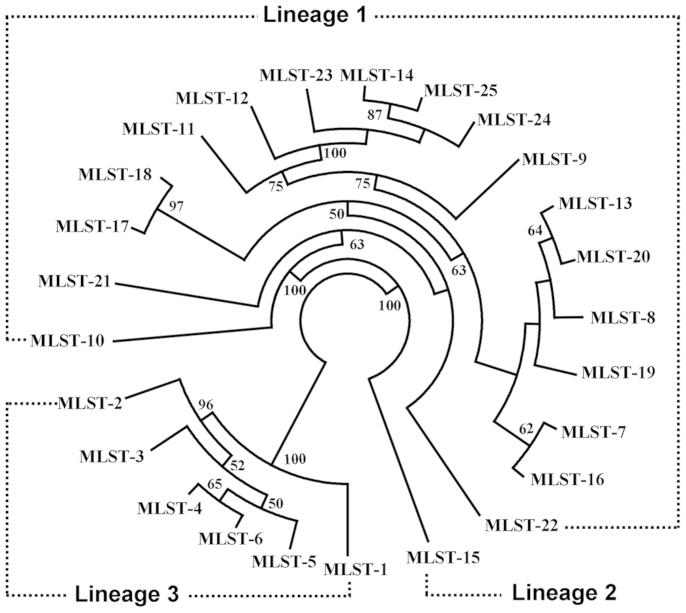
In this study, 111 Cryptosporidium parvum IId isolates from several species of animals in China, Sweden, and Egypt were subtyped by multilocus sequence typing (MLST). One to eleven subtypes were detected at each of the 12 microsatellite, minisatellite, and single nucleotide polymorphism (SNP) loci, forming 25 MLST subtypes. Host-adaptation and significant geographical segregation were both observed in the MLST subtypes. A clonal population structure was seen in C. parvum IId isolates from China and Sweden. Three ancestral lineages and the same RPGR sequence were shared by these isolates examined. Therefore, the present genetic observations including the higher nucleotide diversity of C. parvum IId GP60 sequences in Western Asia, as well as the unique distribution of IId subtypes (almost exclusively found in Asia, Europe, and Egypt) and in combination with the domestication history of cattle, sheep, and goats, indicated that C. parvum IId subtypes were probably dispersed from Western Asia to other geographical regions. More population genetic structure studies involving various C. parvum subtype families using high-resolution tools are needed to better elucidate the origin and dissemination of C. parvum in the world.
在本研究中,运用多位点序列分型(MLST)技术对来自中国、瑞典和埃及多种动物的111株微小隐孢子虫IId分离株进行了亚型分析。在12个微卫星、小卫星和单核苷酸多态性(SNP)位点中,每个位点检测到1至11个亚型,共形成25个MLST亚型。在MLST亚型中观察到了宿主适应性和显著的地理隔离现象。在中国和瑞典的微小隐孢子虫IId分离株中发现了克隆群体结构。这些检测的分离株共有三个祖先谱系和相同的RPGR序列。因此,目前的遗传学观察结果,包括西亚微小隐孢子虫IId GP60序列较高的核苷酸多样性,以及IId亚型的独特分布(几乎仅在亚洲、欧洲和埃及发现),并结合牛、羊和山羊的驯化历史,表明微小隐孢子虫IId亚型可能是从西亚传播到其他地理区域的。需要更多使用高分辨率工具对各种微小隐孢子虫亚型家族进行的群体遗传结构研究,以更好地阐明微小隐孢子虫在世界范围内的起源和传播。



 Zotero 插件