
比较基因组学研究揭示了在欧洲出现的与疫情相关的种群及其向美国的传播。
Comparative genomics of reveals the emergence of an outbreak-associated population in Europe and its spread to the United States.
机构信息
Department of Biology and Biotechnology, University of Pavia, 27100 Pavia, Italy.
UMR BIPAR, Anses, Laboratoire de Santé Animale, INRAE, École Nationale Vétérinaire d'Alfort, 94700 Maisons-Alfort, France.
出版信息
Genome Res. 2024 Jul 23;34(6):877-887. doi: 10.1101/gr.278830.123.
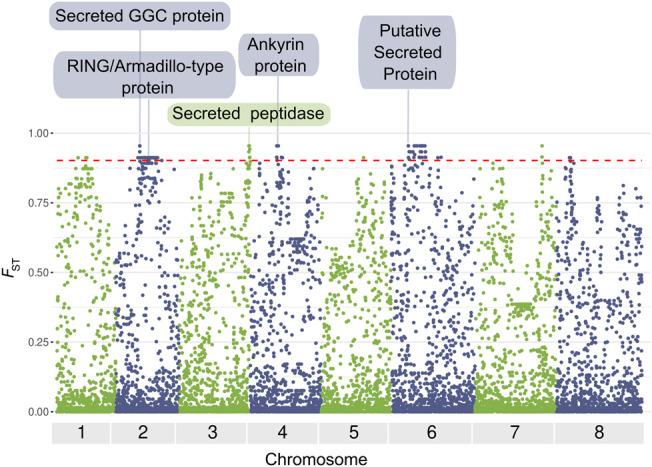
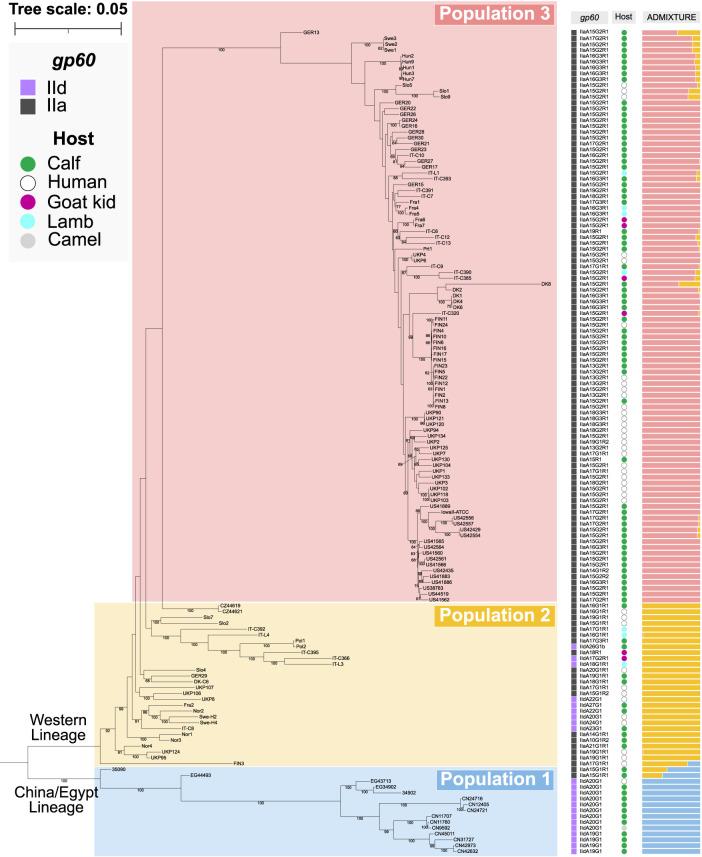
The zoonotic parasite is a global cause of gastrointestinal disease in humans and ruminants. Sequence analysis of the highly polymorphic gene enabled the classification of isolates into multiple groups (e.g., IIa, IIc, Id) and a large number of subtypes. In Europe, subtype IIaA15G2R1 is largely predominant and has been associated with many water- and food-borne outbreaks. In this study, we generated new whole-genome sequence (WGS) data from 123 human- and ruminant-derived isolates collected in 13 European countries and included other available WGS data from Europe, Egypt, China, and the United States (n = 72) in the largest comparative genomics study to date. We applied rigorous filters to exclude mixed infections and analyzed a data set from 141 isolates from the zoonotic groups IIa (n = 119) and IId (n = 22). Based on 28,047 high-quality, biallelic genomic SNPs, we identified three distinct and strongly supported populations: Isolates from China (IId) and Egypt (IIa and IId) formed population 1; a minority of European isolates (IIa and IId) formed population 2; and the majority of European (IIa, including all IIaA15G2R1 isolates) and all isolates from the United States (IIa) clustered in population 3. Based on analyses of the population structure, population genetics, and recombination, we show that population 3 has recently emerged and expanded throughout Europe to then, possibly from the United Kingdom, reach the United States, where it also expanded. The reason(s) for the successful spread of population 3 remain elusive, although genes under selective pressure uniquely in this population were identified.
该人畜共患寄生虫是人类和反刍动物全球范围内胃肠道疾病的一个原因。高度多态性基因的序列分析使能够将分离株分类为多个组(例如 IIa、IIc、Id)和大量亚型。在欧洲,亚型 IIaA15G2R1 占主导地位,并且与许多水传播和食源性暴发有关。在这项研究中,我们从 13 个欧洲国家采集的 123 个人源和反刍动物来源的分离株中生成了新的全基因组序列(WGS)数据,并将欧洲、埃及、中国和美国的其他可用 WGS 数据(n = 72)纳入迄今为止最大的比较基因组学研究中。我们应用严格的过滤器排除混合感染,并分析了来自人畜共患组 IIa(n = 119)和 IId(n = 22)的 141 个分离株的数据集。基于 28,047 个高质量、双等位基因基因组 SNPs,我们确定了三个截然不同且得到有力支持的群体:来自中国(IId)和埃及(IIa 和 IId)的分离株形成群体 1;少数欧洲分离株(IIa 和 IId)形成群体 2;而大多数欧洲(IIa,包括所有 IIaA15G2R1 分离株)和来自美国的所有分离株(IIa)聚集在群体 3。基于群体结构、群体遗传学和重组分析,我们表明群体 3最近出现并在整个欧洲扩张,然后可能从英国到达美国,在美国也扩张了。群体 3 成功传播的原因仍不清楚,尽管鉴定出了该群体中独特的受选择压力影响的基因。


 Zotero 插件