
在细菌细胞外构建鞭毛。
Building a flagellum outside the bacterial cell.
作者信息
Evans Lewis D B, Hughes Colin, Fraser Gillian M
机构信息
University of Cambridge, Department of Pathology, Tennis Court Road, Cambridge CB2 1QP, UK.
University of Cambridge, Department of Pathology, Tennis Court Road, Cambridge CB2 1QP, UK.
出版信息
Trends Microbiol. 2014 Oct;22(10):566-72. doi: 10.1016/j.tim.2014.05.009. Epub 2014 Jun 24.
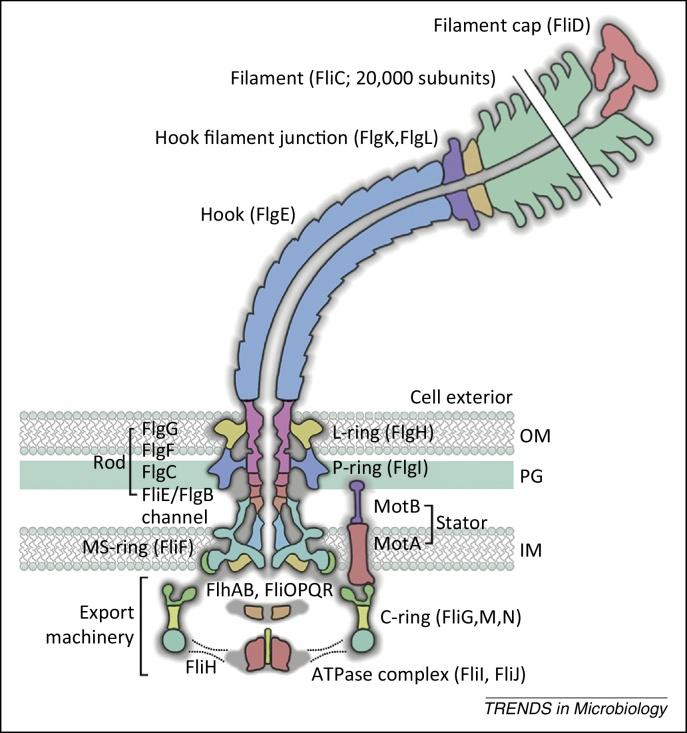
Flagella, the helical propellers that extend from the bacterial surface, are a paradigm for how complex molecular machines can be built outside the living cell. Their assembly requires ordered export of thousands of structural subunits across the cell membrane and this is achieved by a type III export machinery located at the flagellum base, after which subunits transit through a narrow channel at the core of the flagellum to reach the assembly site at the tip of the nascent structure, up to 20μm from the cell surface. Here we review recent findings that provide new insights into flagellar export and assembly, and a new and unanticipated mechanism for constant rate flagellum growth.
鞭毛是从细菌表面伸出的螺旋状推进器,是在活细胞外构建复杂分子机器的范例。它们的组装需要数千个结构亚基有序地穿过细胞膜输出,这是通过位于鞭毛基部的III型输出机制实现的,之后亚基通过鞭毛核心的狭窄通道到达新生结构顶端的组装位点,该位点距离细胞表面可达20μm。在这里,我们回顾了最近的研究发现,这些发现为鞭毛输出和组装提供了新的见解,以及一种新的、意想不到的恒定速率鞭毛生长机制。



 Zotero 插件