
儿童期发病的克罗恩病的两阶段全基因组甲基化分析表明,VMP1/MIR21和HLA基因座存在表观遗传改变。
Two-stage genome-wide methylation profiling in childhood-onset Crohn's Disease implicates epigenetic alterations at the VMP1/MIR21 and HLA loci.
作者信息
Adams Alex T, Kennedy Nicholas A, Hansen Richard, Ventham Nicholas T, OʼLeary Kate R, Drummond Hazel E, Noble Colin L, El-Omar Emad, Russell Richard K, Wilson David C, Nimmo Elaine R, Hold Georgina L, Satsangi Jack
机构信息
*Gastrointestinal Unit, Centre for Genetics and Experimental Medicine, Institute of Genetics and Molecular Medicine, Western General Hospital, Edinburgh, United Kingdom; †Gastrointestinal Research Group, Division of Applied Medicine, University of Aberdeen, Aberdeen, United Kingdom; ‡Department of Paediatric Gastroenterology, Royal Hospital for Sick Children, Glasgow, United Kingdom; and §Paediatric Gastroenterology and Nutrition, Child Life and Health, University of Edinburgh, Royal Hospital for Sick Children, Edinburgh, United Kingdom.
出版信息
Inflamm Bowel Dis. 2014 Oct;20(10):1784-93. doi: 10.1097/MIB.0000000000000179.
BACKGROUND
As a result of technological and analytical advances, genome-wide characterization of key epigenetic alterations is now feasible in complex diseases. We hypothesized that this may provide important insights into gene-environmental interactions in Crohn's disease (CD) and is especially pertinent to early onset disease.
METHODS
The Illumina 450K platform was applied to assess epigenome-wide methylation profiles in circulating leukocyte DNA in discovery and replication pediatric CD cohorts and controls. Data were corrected for differential leukocyte proportions. Targeted replication was performed in adults using pyrosequencing. Methylation changes were correlated with gene expression in blood and intestinal mucosa.
RESULTS
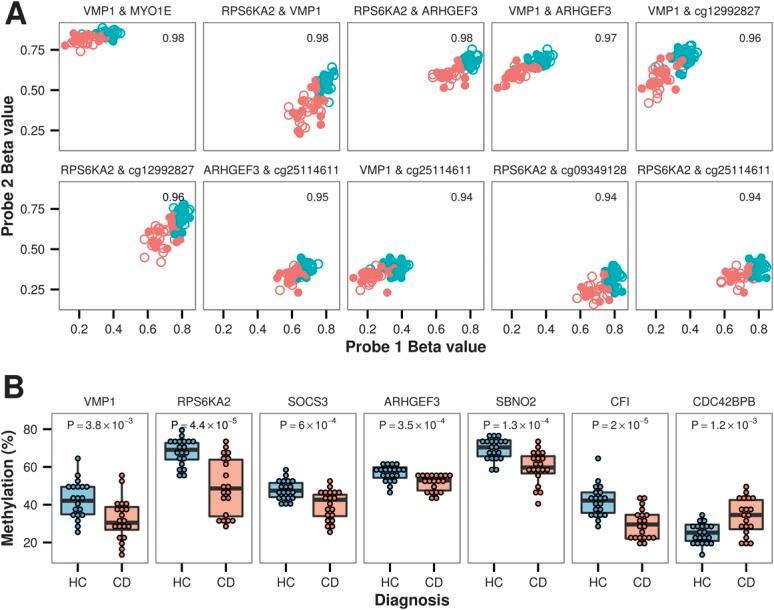
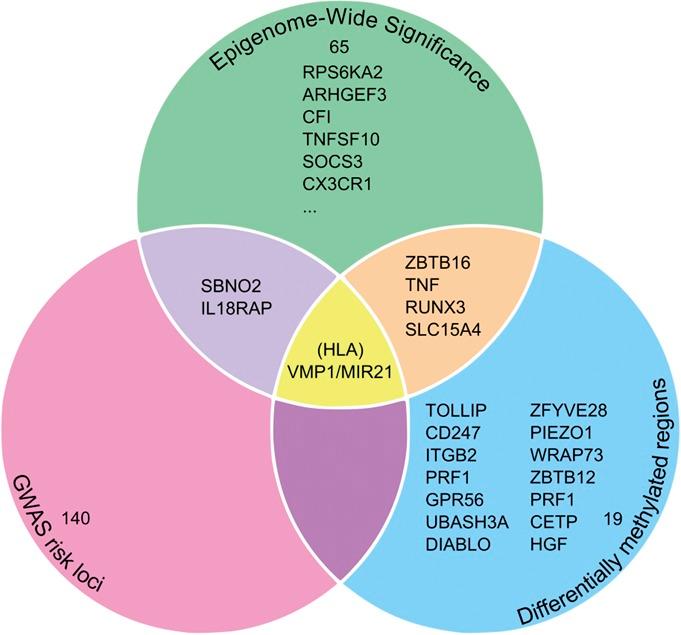
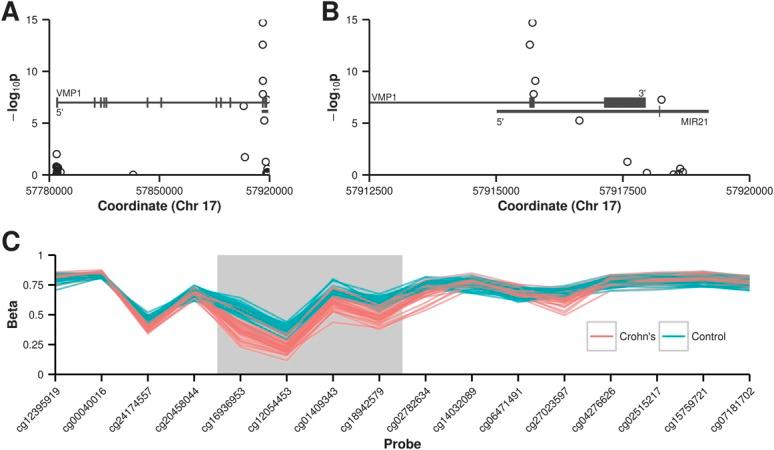
We identified 65 individual CpG sites with methylation alterations achieving epigenome-wide significance after Bonferroni correction (P < 1.1 × 10(-7)), and 19 differently methylated regions displaying unidirectional methylation change. There was a highly significant enrichment of methylation changes around GWAS single nucleotide polymorphisms (P = 3.7 × 10(-7)), notably the HLA region and MIR21. Two-locus discriminant analysis in the discovery cohort predicted disease in the pediatric replication cohort with high accuracy (area under the curve, 0.98). The findings strongly implicate the transcriptional start site of MIR21 as a region of extended epigenetic alteration, containing the most significant individual probes (P = 1.97 × 10(-15)) within a GWAS risk locus. In extension studies, we confirmed hypomethylation of MIR21 in adults (P = 6.6 × 10(-5), n = 172) and show increased mRNA expression in leukocytes (P < 0.005, n = 66) and in the inflamed intestine (P = 1.4 × 10(-6), n = 99).
CONCLUSIONS
We demonstrate highly significant and replicable differences in DNA methylation in CD, defining the disease-associated epigenome. The data strongly implicate known GWAS loci, with compelling evidence implicating MIR21 and the HLA region.
背景
由于技术和分析方法的进步,现在对复杂疾病中关键表观遗传改变进行全基因组特征分析已成为可能。我们推测,这可能为深入了解克罗恩病(CD)中的基因-环境相互作用提供重要线索,尤其适用于早发性疾病。
方法
应用Illumina 450K平台评估发现队列和重复验证队列中的儿童CD患者及对照者循环白细胞DNA中的全基因组甲基化谱。对数据进行白细胞比例差异校正。在成人中使用焦磷酸测序进行靶向重复验证。甲基化变化与血液和肠黏膜中的基因表达相关。
结果
我们鉴定出65个单个CpG位点,其甲基化改变在Bonferroni校正后达到全基因组显著水平(P < 1.1×10⁻⁷),以及19个显示单向甲基化变化的差异甲基化区域。GWAS单核苷酸多态性周围的甲基化变化高度富集(P = 3.7×10⁻⁷),尤其是HLA区域和MIR21。发现队列中的两位点判别分析在儿童重复验证队列中对疾病的预测准确率很高(曲线下面积为0.98)。研究结果强烈表明,MIR21的转录起始位点是表观遗传改变扩展的区域,包含GWAS风险位点内最显著的单个探针(P = 1.97×10⁻¹⁵)。在扩展研究中,我们证实成人中MIR21存在低甲基化(P = 6.6×10⁻⁵,n = 172),并显示白细胞(P < 0.005,n = 66)和炎症肠组织(P = 1.4×10⁻⁶,n = 99)中mRNA表达增加。
结论
我们证明了CD患者DNA甲基化存在高度显著且可重复的差异,确定了与疾病相关的表观基因组。数据有力地表明了已知的GWAS位点,有令人信服的证据表明MIR21和HLA区域与之相关。


 Zotero 插件