
随机分配至三种基于贝伐单抗方案的晚期结直肠癌患者的循环生物标志物
Circulating biomarkers in advanced colorectal cancer patients randomly assigned to three bevacizumab-based regimens.
作者信息
Martinetti Antonia, Miceli Rosalba, Sottotetti Elisa, Di Bartolomeo Maria, de Braud Filippo, Gevorgyan Arpine, Dotti Katia Fiorella, Bajetta Emilio, Campiglio Manuela, Bianchi Francesca, Bregni Giacomo, Pietrantonio Filippo
机构信息
Medical Oncology Department, Fondazione IRCCS Istituto Nazionale dei Tumori, Via G. Venezian, Milan 1-20133, Italy.
Medical Statistics, Biometry and Bioinformatics Unit, Fondazione IRCCS Istituto Nazionale dei Tumori, Via G. Venezian, Milan 1-20133, Italy.
出版信息
Cancers (Basel). 2014 Aug 29;6(3):1753-68. doi: 10.3390/cancers6031753.
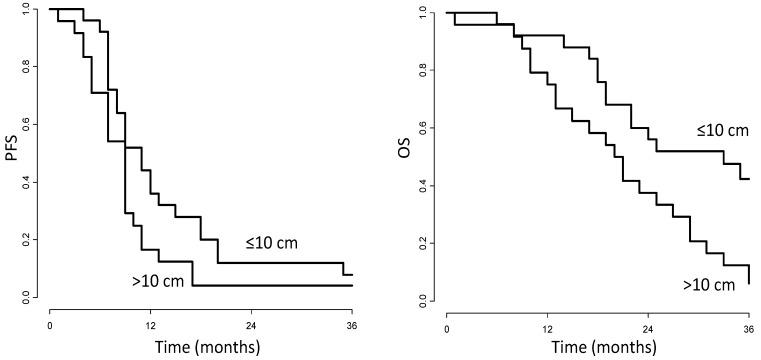
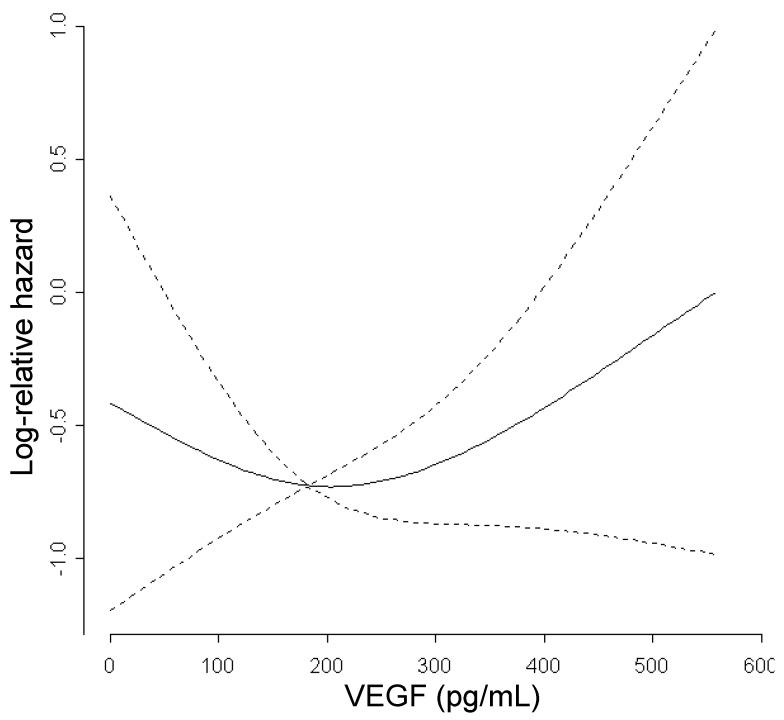
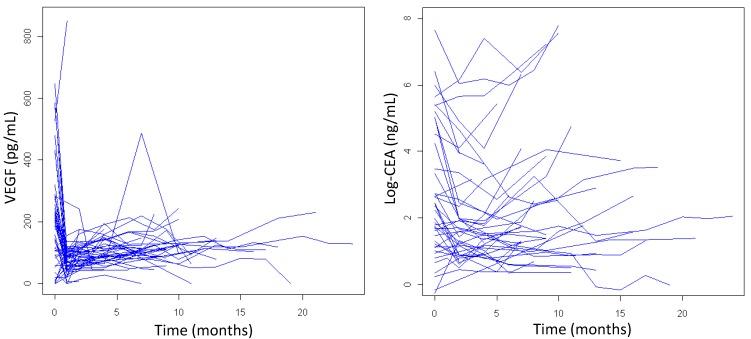
The need to identify biomarkers for bevacizumab-based treatment in advanced colorectal cancer is imperative. The aim of this study was to investigate the prognostic role of circulating VEGF, PDGF, SDF-1, osteopontin and CEA in patients randomly assigned to three bevacizumab-based regimens. Plasma samples from 50 patients treated at a single Institution were analysed using the multiplex assay BioPlex™ 2200 (Bio-Rad Laboratories, Inc, Berkeley, CA, USA) at baseline, before first three cycles and subsequently every three cycles until disease progression. Prognostic analyses of baseline values were performed using multivariable Cox models, including disease extension >10 cm or ≤10 cm (measured as the sum of the diameters for all target lesions) as adjustment factor. The association between progression-free and overall survival and biomarkers modulation during treatment was studied using multivariable Cox models, which included summary statistics synthesizing during-treatment modulation together with disease extension. The biomarkers significantly associated with disease extension were baseline CEA (p = 0.012) and SDF-1 (p = 0.030). High values of VEGF and SDF-1 tended to be associated with worse prognosis, especially in terms of overall survival. The negative prognostic trend was more marked for baseline CEA as compared to other biomarkers; increasing values during treatment was significantly related to worse prognosis independently of disease extension (p = 0.007 and 0.016 for progression-free and overall survival, respectively). VEGF is related to bevacizumab pharmacodynamics and is associated to other angiogenic cytokines; some of the proposed biomarkers such as SDF-1 and CEA should be further validated for prognosis assessment and monitoring of bevacizumab-based treatment of advanced colorectal cancer.
在晚期结直肠癌中,识别基于贝伐单抗治疗的生物标志物迫在眉睫。本研究的目的是调查循环血管内皮生长因子(VEGF)、血小板衍生生长因子(PDGF)、基质细胞衍生因子-1(SDF-1)、骨桥蛋白和癌胚抗原(CEA)在随机分配接受三种基于贝伐单抗方案治疗的患者中的预后作用。在一家机构接受治疗的50例患者的血浆样本,在基线、前三个周期之前以及随后每三个周期直至疾病进展时,使用多重检测BioPlex™ 2200(美国加利福尼亚州伯克利市伯乐公司)进行分析。使用多变量Cox模型对基线值进行预后分析,将疾病扩展>10 cm或≤10 cm(以所有靶病变直径总和衡量)作为调整因子。使用多变量Cox模型研究无进展生存期和总生存期与治疗期间生物标志物调节之间的关联,该模型包括综合治疗期间调节的汇总统计数据以及疾病扩展情况。与疾病扩展显著相关的生物标志物是基线CEA(p = 0.012)和SDF-1(p = 0.030)。VEGF和SDF-1的高值往往与较差的预后相关,尤其是在总生存期方面。与其他生物标志物相比,基线CEA的负面预后趋势更为明显;治疗期间值的增加与较差的预后显著相关,与疾病扩展无关(无进展生存期和总生存期的p值分别为0.007和0.016)。VEGF与贝伐单抗的药效学相关,并与其他血管生成细胞因子相关;一些提出的生物标志物,如SDF-1和CEA,应进一步验证用于晚期结直肠癌基于贝伐单抗治疗的预后评估和监测。

 Zotero 插件