
低收入和中等收入国家降低心血管疾病风险的任务转移干预措施:随机对照试验的系统评价
Task shifting interventions for cardiovascular risk reduction in low-income and middle-income countries: a systematic review of randomised controlled trials.
作者信息
Ogedegbe Gbenga, Gyamfi Joyce, Plange-Rhule Jacob, Surkis Alisa, Rosenthal Diana Margot, Airhihenbuwa Collins, Iwelunmor Juliet, Cooper Richard
机构信息
Department of Population Health, NYU School of Medicine, NYU Langone Medical Center, New York, USA.
NYU Global Institute of Public Health, New York University, New York, USA.
出版信息
BMJ Open. 2014 Oct 16;4(10):e005983. doi: 10.1136/bmjopen-2014-005983.
OBJECTIVE
To evaluate evidence from published randomised controlled trials (RCTs) for the use of task-shifting strategies for cardiovascular disease (CVD) risk reduction in low-income and middle-income countries (LMICs).
DESIGN
Systematic review of RCTs that utilised a task-shifting strategy in the management of CVD in LMICs.
DATA SOURCES
We searched the following databases for relevant RCTs: PubMed from the 1940s, EMBASE from 1974, Global Health from 1910, Ovid Health Star from 1966, Web of Knowledge from 1900, Scopus from 1823, CINAHL from 1937 and RCTs from ClinicalTrials.gov.
ELIGIBILITY CRITERIA FOR SELECTING STUDIES
We focused on RCTs published in English, but without publication year. We included RCTs in which the intervention used task shifting (non-physician healthcare workers involved in prescribing of medications, treatment and/or medical testing) and non-physician healthcare providers in the management of CV risk factors and diseases (hypertension, diabetes, hyperlipidaemia, stroke, coronary artery disease or heart failure), as well as RCTs that were conducted in LMICs. We excluded studies that are not RCTs.
RESULTS
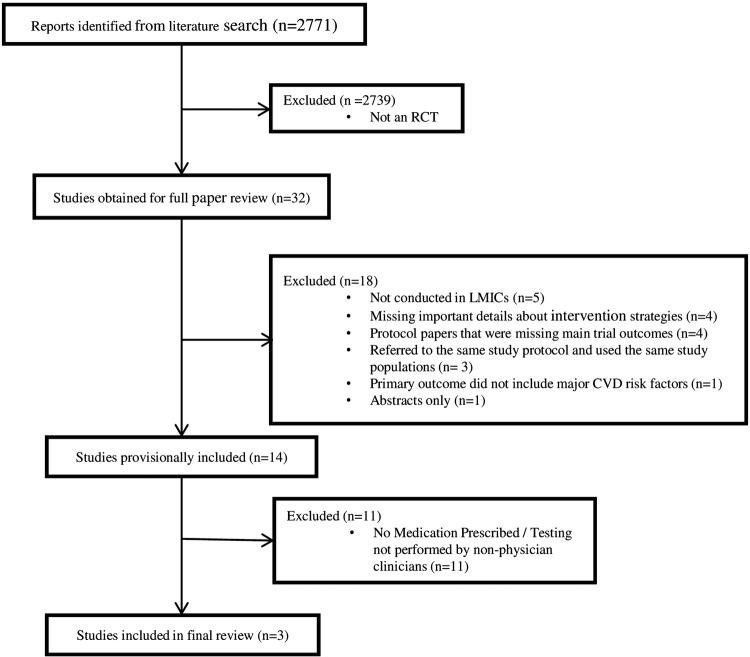
Of the 2771 articles identified, only three met the predefined criteria. All three trials were conducted in practice-based settings among patients with hypertension (2 studies) and diabetes (1 study), with one study also incorporating home visits. The duration of the studies ranged from 3 to 12 months, and the task-shifting strategies included provision of medication prescriptions by nurses, community health workers and pharmacists and telephone follow-up posthospital discharge. Both hypertension studies reported a significant mean blood pressure reduction (2/1 mm Hg and 30/15 mm Hg), and the diabetes trial reported a reduction in the glycated haemoglobin levels of 1.87%.
CONCLUSIONS
There is a dearth of evidence on the implementation of task-shifting strategies to reduce the burden of CVD in LMICs. Effective task-shifting interventions targeted at reducing the global CVD epidemic in LMICs are urgently needed.
目的
评估已发表的随机对照试验(RCT)证据,以了解在低收入和中等收入国家(LMICs)使用任务转移策略降低心血管疾病(CVD)风险的情况。
设计
对在LMICs中利用任务转移策略管理CVD的RCT进行系统评价。
数据来源
我们在以下数据库中搜索相关RCT:20世纪40年代起的PubMed、1974年起的EMBASE、1910年起的Global Health、1966年起的Ovid Health Star、1900年起的Web of Knowledge、1823年起的Scopus、1937年起的CINAHL以及ClinicalTrials.gov上的RCT。
选择研究的纳入标准
我们重点关注英文发表且无发表年份限制的RCT。纳入的RCT需使用任务转移(非医师医护人员参与药物处方、治疗和/或医学检测)策略,并由非医师医护人员管理心血管危险因素和疾病(高血压、糖尿病、高脂血症、中风、冠状动脉疾病或心力衰竭);同时需在LMICs开展。排除非RCT研究。
结果
在识别出的2771篇文章中,仅有3篇符合预设标准。所有3项试验均在基于实践的环境中针对高血压患者(2项研究)和糖尿病患者(1项研究)开展,其中1项研究还包括家访。研究时长为3至12个月,任务转移策略包括护士、社区卫生工作者和药剂师提供药物处方以及出院后电话随访。两项高血压研究均报告平均血压显著降低(分别为2/1 mmHg和30/15 mmHg),糖尿病试验报告糖化血红蛋白水平降低1.87%。
结论
关于在LMICs实施任务转移策略以减轻CVD负担的证据匮乏。迫切需要有效的任务转移干预措施来应对LMICs全球CVD流行问题。
 Zotero 插件