
对于肌酐清除率增加的重症患者,哌拉西林的标准剂量是否足够?
Are standard doses of piperacillin sufficient for critically ill patients with augmented creatinine clearance?
作者信息
Udy Andrew A, Lipman Jeffrey, Jarrett Paul, Klein Kerenaftali, Wallis Steven C, Patel Kashyap, Kirkpatrick Carl M J, Kruger Peter S, Paterson David L, Roberts Michael S, Roberts Jason A
机构信息
Department of Intensive Care and Hyperbaric Medicine, The Alfred Hospital, Commercial Road, Melbourne, Victoria, 3181, Australia.
Burns, Trauma, and Critical Care Research Centre, The University of Queensland, Butterfield Street, Brisbane, Queensland, 4029, Australia.
出版信息
Crit Care. 2015 Jan 30;19(1):28. doi: 10.1186/s13054-015-0750-y.
INTRODUCTION
The aim of this study was to explore the impact of augmented creatinine clearance and differing minimum inhibitory concentrations (MIC) on piperacillin pharmacokinetic/pharmacodynamic (PK/PD) target attainment (time above MIC (fT>MIC)) in critically ill patients with sepsis receiving intermittent dosing.
METHODS
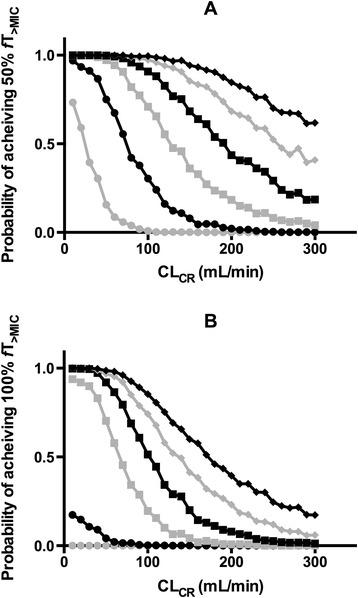
To be eligible for enrolment, critically ill patients with sepsis had to be receiving piperacillin-tazobactam 4.5 g intravenously (IV) by intermittent infusion every 6 hours for presumed or confirmed nosocomial infection without significant renal impairment (defined by a plasma creatinine concentration greater than 171 μmol/L or the need for renal replacement therapy). Over a single dosing interval, blood samples were drawn to determine unbound plasma piperacillin concentrations. Renal function was assessed by measuring creatinine clearance (CLCR). A population PK model was constructed, and the probability of target attainment (PTA) for 50% and 100% fT>MIC was calculated for varying MIC and CLCR values.
RESULTS
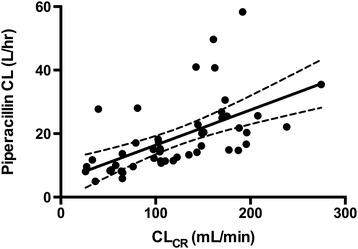
In total, 48 patients provided data. Increasing CLCR values were associated with lower trough plasma piperacillin concentrations (P < 0.01), such that with an MIC of 16 mg/L, 100% fT>MIC would be achieved in only one-third (n = 16) of patients. Mean piperacillin clearance was approximately 1.5-fold higher than in healthy volunteers and correlated with CLCR (r = 0.58, P < 0.01). A reduced PTA for all MIC values, when targeting either 50% or 100% fT>MIC, was noted with increasing CLCR measures.
CONCLUSIONS
Standard intermittent piperacillin-tazobactam dosing is unlikely to achieve optimal piperacillin exposures in a significant proportion of critically ill patients with sepsis, owing to elevated drug clearance. These data suggest that CLCR can be employed as a useful tool to determine whether piperacillin PK/PD target attainment is likely with a range of MIC values.
引言
本研究旨在探讨肌酐清除率增加及不同最低抑菌浓度(MIC)对接受间歇给药的脓毒症重症患者哌拉西林药代动力学/药效学(PK/PD)目标达成率(高于MIC的时间(fT>MIC))的影响。
方法
符合入组条件的脓毒症重症患者必须因疑似或确诊的医院感染接受每6小时1次静脉间歇输注4.5g哌拉西林-他唑巴坦治疗,且无明显肾功能损害(定义为血浆肌酐浓度大于171μmol/L或需要肾脏替代治疗)。在单个给药间隔内采集血样以测定未结合的血浆哌拉西林浓度。通过测量肌酐清除率(CLCR)评估肾功能。构建群体PK模型,并针对不同的MIC和CLCR值计算50%和100% fT>MIC时的目标达成概率(PTA)。
结果
共有48例患者提供了数据。CLCR值增加与较低的哌拉西林血浆谷浓度相关(P<0.01),因此当MIC为16mg/L时,仅三分之一(n = 16)的患者可实现100% fT>MIC。哌拉西林的平均清除率比健康志愿者高约1.5倍,且与CLCR相关(r = 0.58,P<0.01)。随着CLCR测量值增加,针对50%或100% fT>MIC的所有MIC值的PTA均降低。
结论
由于药物清除率升高,标准的间歇哌拉西林-他唑巴坦给药在相当比例的脓毒症重症患者中不太可能实现最佳的哌拉西林暴露。这些数据表明,CLCR可作为一种有用的工具,用于确定在一系列MIC值下是否可能达成哌拉西林PK/PD目标。

 Zotero 插件