
谁从政府医疗补贴中受益?对中国医疗福利分配公平性的评估。
Who benefits from government healthcare subsidies? An assessment of the equity of healthcare benefits distribution in China.
作者信息
Chen Mingsheng, Fang Guixia, Wang Lidan, Wang Zhonghua, Zhao Yuxin, Si Lei
机构信息
School of Health Policy & Management, Nanjing Medical University, Nanjing, China.
School of Health Administration, Anhui Medical University, Hefei, China.
出版信息
PLoS One. 2015 Mar 17;10(3):e0119840. doi: 10.1371/journal.pone.0119840. eCollection 2015.
BACKGROUND
Improving the equitable distribution of government healthcare subsidies (GHS), particularly among low-income citizens, is a major goal of China's healthcare sector reform in China.
OBJECTIVES
This study investigates the distribution of GHS in China between socioeconomic populations at two different points in time, examines the comparative distribution of healthcare benefits before and after healthcare reforms in Northwest China, compares the parity of distribution between urban and rural areas, and explores factors that influence equitable GHS distribution.
METHODS
Benefit incidence analysis of GHS progressivity was performed, and concentration and Kakwani indices for outpatient, inpatient, and total healthcare were calculated. Two rounds of household surveys that used multistage stratified samples were conducted in 2003 (13,564 respondents) and 2008 (12,973 respondents). Data on socioeconomics, healthcare payments, and healthcare utilization were collected using household interviews.
RESULTS
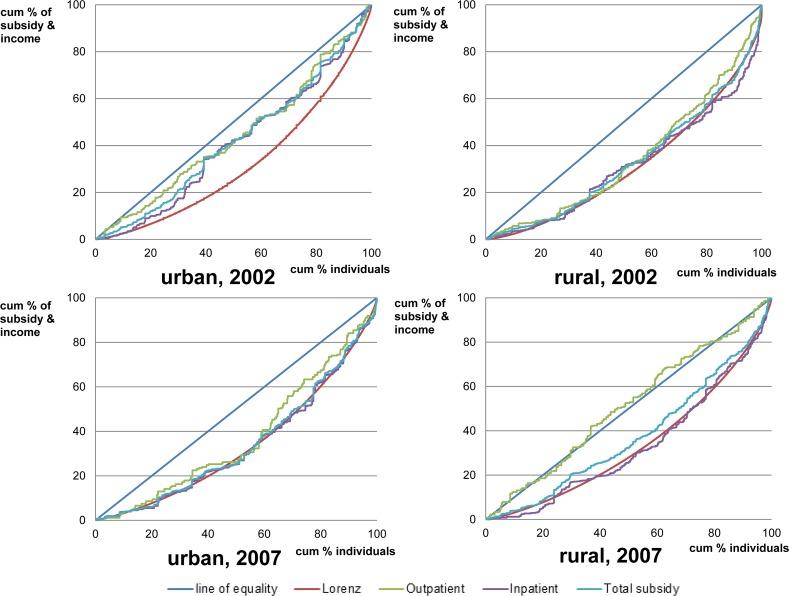
High-income individuals generally reap larger benefits from GHS, as reflected by positive concentration indices, which indicates a regressive system. Concentration indices for inpatient care were 0.2199 (95% confidence interval [CI], 0.0829 to 0.3568) and 0.4445 (95% CI, 0.3000 to 0.5890) in 2002 (urban vs. rural, respectively), and 0.3925 (95% CI, 0.2528 to 0.5322) and 0.4084 (95% CI, 0.2977 to 0.5190) in 2007. Outpatient healthcare subsidies showed different distribution patterns in urban and rural areas following the redesign of rural healthcare insurance programs (urban vs. rural: 0.1433 [95% CI, 0.0263 to 0.2603] and 0.3662 [95% CI, 0.2703 to 0.4622] in 2002, respectively; 0.3063 [95% CI, 0.1657 to 0.4469] and -0.0273 [95% CI, -0.1702 to 0.1156] in 2007).
CONCLUSIONS
Our study demonstrates an inequitable distribution of GHS in China from 2002 to 2007; however, the inequity was reduced, especially in rural outpatient services. Future healthcare reforms in China should not only focus on expanding the coverage, but also on improving the equity of distribution of healthcare benefits.
背景
改善政府医疗补贴(GHS)的公平分配,尤其是在低收入公民中,是中国医疗部门改革的主要目标。
目的
本研究调查了中国不同时间点社会经济人群之间GHS的分配情况,考察了中国西北医疗改革前后医疗福利的比较分配情况,比较了城乡之间的分配公平性,并探讨了影响GHS公平分配的因素。
方法
进行了GHS累进性的受益发生率分析,并计算了门诊、住院和总医疗的集中指数和卡克瓦尼指数。2003年(13564名受访者)和2008年(12973名受访者)进行了两轮采用多阶段分层抽样的家庭调查。通过家庭访谈收集社会经济、医疗支付和医疗利用的数据。
结果
高收入个体通常从GHS中获得更大的利益,这通过正的集中指数反映出来,这表明该系统是累退的。2002年住院护理的集中指数分别为0.2199(95%置信区间[CI],0.0829至0.3568)和0.4445(95%CI,0.3000至0.5890)(城市与农村),2007年分别为0.3925(95%CI,0.2528至0.5322)和0.4084(95%CI,0.2977至0.5190)。农村医疗保险计划重新设计后,门诊医疗补贴在城乡地区呈现不同的分配模式(2002年城市与农村分别为0.1433[95%CI,0.0263至0.2603]和0.3662[95%CI,0.2703至0.4622];2007年分别为0.3063[95%CI,0.1657至0.4469]和 -0.0273[95%CI,-0.1702至0.1156])。
结论
我们的研究表明,2002年至2007年中国GHS分配不公平;然而,不公平性有所降低,尤其是在农村门诊服务方面。中国未来的医疗改革不仅应关注扩大覆盖范围,还应关注改善医疗福利分配的公平性。

 Zotero 插件