
具有生物学和临床相关性的头颈癌亚型:基因表达数据的荟萃分析
Head and neck cancer subtypes with biological and clinical relevance: Meta-analysis of gene-expression data.
作者信息
De Cecco Loris, Nicolau Monica, Giannoccaro Marco, Daidone Maria Grazia, Bossi Paolo, Locati Laura, Licitra Lisa, Canevari Silvana
机构信息
Functional Genomics and Bioinformatics, Department of Experimental Oncology and Molecular Medicine, Fondazione IRCCS Istituto Nazionale dei Tumori, Milan, Italy.
Department of Mathematics, Stanford University, Stanford, CA, USA.
出版信息
Oncotarget. 2015 Apr 20;6(11):9627-42. doi: 10.18632/oncotarget.3301.
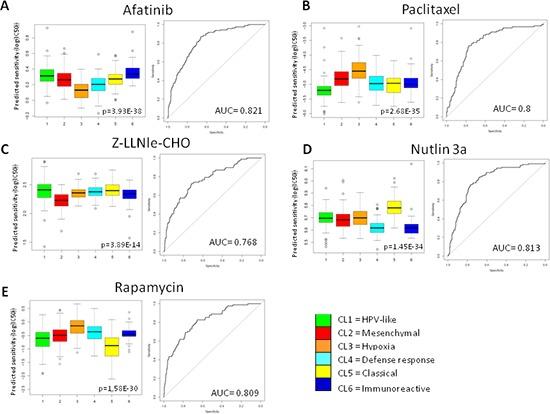
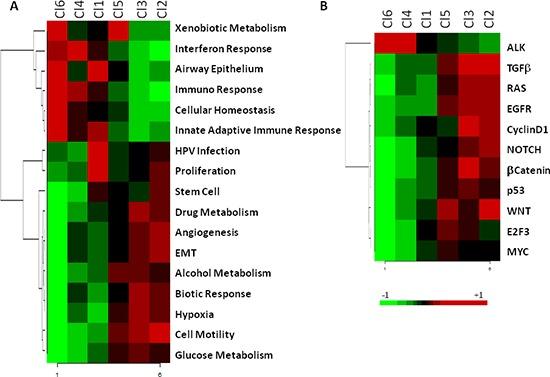
Head and neck squamous cell carcinoma (HNSCC) is a disease with heterogeneous clinical behavior and response to therapies. Despite the introduction of multimodality treatment, 40-50% of patients with advanced disease recur. Therefore, there is an urgent need to improve the classification beyond the current parameters in clinical use to better stratify patients and the therapeutic approaches. Following a meta-analysis approach we built a large training set to whom we applied a Disease-Specific Genomic Analysis (DSGA) to identify the disease component embedded into the tumor data. Eleven independent microarray datasets were used as validation sets. Six different HNSCC subtypes that summarize the aberrant alterations occurring during tumor progression were identified. Based on their main biological characteristics and de-regulated signaling pathways, the subtypes were designed as immunoreactive, inflammatory, human papilloma virus (HPV)-like, classical, hypoxia associated, and mesenchymal. Our findings highlighted a more aggressive behavior for mesenchymal and hypoxia-associated subtypes. The Genomics Drug Sensitivity Project was used to identify potential associations with drug sensitivity and significant differences were observed among the six subtypes. To conclude, we report a robust molecularly defined subtype classification in HNSCC that can improve patient selection and pave the way to the development of appropriate therapeutic strategies.
头颈部鳞状细胞癌(HNSCC)是一种临床行为和对治疗反应具有异质性的疾病。尽管引入了多模式治疗,但40%-50%的晚期疾病患者会复发。因此,迫切需要超越目前临床使用的参数进行分类,以更好地对患者和治疗方法进行分层。我们采用荟萃分析方法构建了一个大型训练集,并对其应用疾病特异性基因组分析(DSGA),以识别嵌入肿瘤数据中的疾病成分。11个独立的微阵列数据集用作验证集。确定了六种不同的HNSCC亚型,这些亚型总结了肿瘤进展过程中发生的异常改变。根据其主要生物学特征和失调的信号通路,这些亚型被设计为免疫反应型、炎症型、人乳头瘤病毒(HPV)样型、经典型、缺氧相关型和间充质型。我们的研究结果突出了间充质型和缺氧相关型亚型更具侵袭性的行为。利用基因组药物敏感性项目来确定与药物敏感性的潜在关联,并在六种亚型之间观察到显著差异。总之,我们报告了一种在HNSCC中稳健的分子定义亚型分类,它可以改善患者选择,并为制定合适的治疗策略铺平道路。




 Zotero 插件