
单次冻融循环可高效溶解包涵体蛋白并将其重折叠为生物活性形式。
A single freeze-thawing cycle for highly efficient solubilization of inclusion body proteins and its refolding into bioactive form.
作者信息
Qi Xingmei, Sun Yifan, Xiong Sidong
机构信息
Jiangsu Key Laboratory of Infection and Immunity, Institutes of Biology and Medical Sciences, Soochow University, Suzhou, Jiangsu, 215123, China.
出版信息
Microb Cell Fact. 2015 Feb 22;14:24. doi: 10.1186/s12934-015-0208-6.
BACKGROUND
Mild solubilization of inclusion bodies has attracted attention in recent days, with an objective to preserve the existing native-like secondary structure of proteins, reduce protein aggregation during refolding and recovering high amount of bioactive proteins from inclusion bodies.
RESULTS
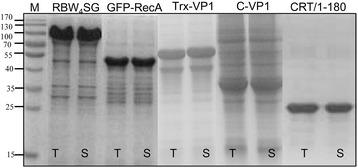
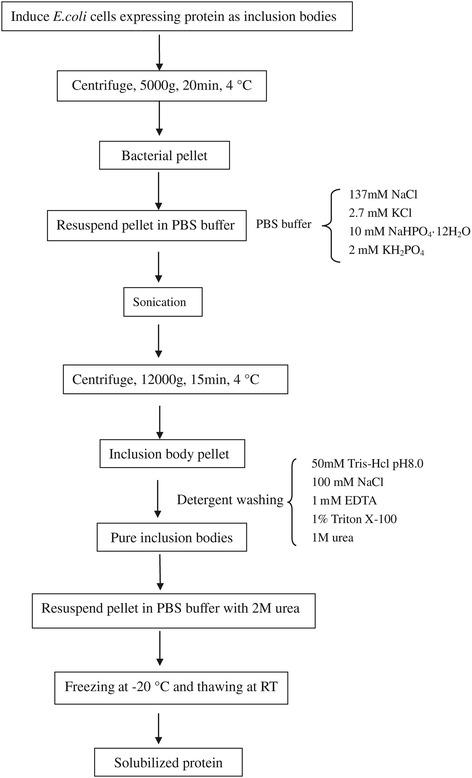
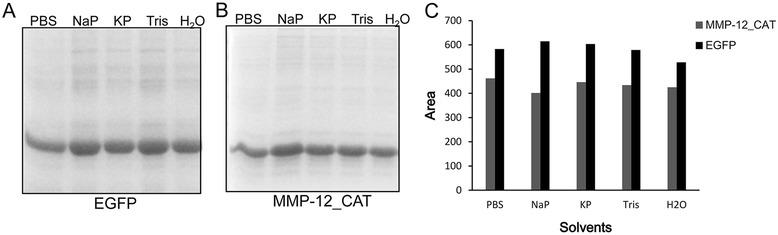
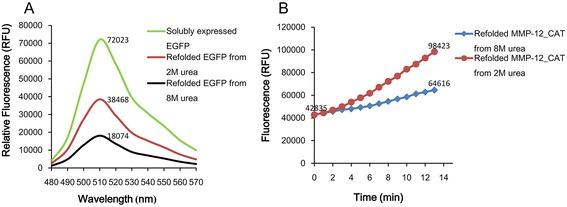
Here we presented an efficient method for mild solubilization of inclusion bodies by using a freeze-thawing process in the presence of low concentration of urea. We used two different proteins to demonstrate the advantage of this method over the traditional urea-denatured method: enhanced green fluorescent protein (EGFP) and the catalytic domain of human macrophage metalloelastase (MMP-12_CAT). Firstly, PBS buffer at pH 8 containing different molar concentration of urea (0-8 M) were used to solubilize EGFP and MMP-12-CAT inclusion bodies and the solubility achieved in 2 M urea in PBS buffer by freeze-thawing method was comparable to that of PBS buffer containing 8 M urea by traditional urea-denatured method. Secondly, different solvents were used to solubilize EGFP and MMP-12_CAT from inclusion bodies and the results indicated that a wide range of buffers containing 2 M urea could efficiently solubilize EGFP and MMP-12_CAT inclusion bodies by freeze-thawing method. Thirdly, the effect of pH and freezing temperature on the solubility of EGFP and MMP-12_CAT inclusion bodies were studied, revealing that solubilization of inclusion bodies by freeze-thawing method is pH dependent and the optimal freezing temperature indicated here is -20°C. Forth, the solubilized EGFP and MMP-12_CAT from inclusion bodies were refolded by rapid dilution and dialysis, respectively. The results showed that the refolded efficiency is much higher (more than twice) from freeze-thawing method than the traditional urea-denatured method. The freeze-thawing method containing 2 M urea also effectively solubilized a number of proteins as inclusion bodies in E.coli.
CONCLUSIONS
Mild solubilization of inclusion body proteins using the freeze-thawing method is simple, highly efficient and generally applicable. The method can be utilized to prepare large quantities of bioactive soluble proteins from inclusion bodies for basic research and industrial purpose.
背景
近年来,包涵体的温和溶解受到关注,目的是保留蛋白质现有的类似天然的二级结构,减少重折叠过程中的蛋白质聚集,并从包涵体中回收大量生物活性蛋白质。
结果
在此,我们提出了一种在低浓度尿素存在下通过冻融过程对包涵体进行温和溶解的有效方法。我们使用两种不同的蛋白质来证明该方法相对于传统尿素变性方法的优势:增强型绿色荧光蛋白(EGFP)和人巨噬细胞金属弹性蛋白酶的催化结构域(MMP-12_CAT)。首先,使用含有不同摩尔浓度尿素(0 - 8 M)的pH 8的PBS缓冲液来溶解EGFP和MMP-12-CAT包涵体,通过冻融法在PBS缓冲液中2 M尿素中实现的溶解度与通过传统尿素变性法在含有8 M尿素的PBS缓冲液中的溶解度相当。其次,使用不同的溶剂从包涵体中溶解EGFP和MMP-12_CAT,结果表明,一系列含有2 M尿素的缓冲液可以通过冻融法有效地溶解EGFP和MMP-12_CAT包涵体。第三,研究了pH和冷冻温度对EGFP和MMP-12_CAT包涵体溶解度的影响,发现通过冻融法溶解包涵体依赖于pH,此处表明的最佳冷冻温度为-20°C。第四,分别通过快速稀释和透析对从包涵体中溶解的EGFP和MMP-12_CAT进行重折叠。结果表明,冻融法的重折叠效率比传统尿素变性法高得多(超过两倍)。含有2 M尿素的冻融法也有效地溶解了大肠杆菌中作为包涵体的许多蛋白质。
结论
使用冻融法对包涵体蛋白进行温和溶解简单、高效且普遍适用。该方法可用于从包涵体中制备大量生物活性可溶性蛋白,用于基础研究和工业目的。




 Zotero 插件