
连接原核生物和真核生物之间差距的复杂古菌。
Complex archaea that bridge the gap between prokaryotes and eukaryotes.
作者信息
Spang Anja, Saw Jimmy H, Jørgensen Steffen L, Zaremba-Niedzwiedzka Katarzyna, Martijn Joran, Lind Anders E, van Eijk Roel, Schleper Christa, Guy Lionel, Ettema Thijs J G
机构信息
Department of Cell and Molecular Biology, Science for Life Laboratory, Uppsala University, SE-75123 Uppsala, Sweden.
Department of Biology, Centre for Geobiology, University of Bergen, N-5020 Bergen, Norway.
出版信息
Nature. 2015 May 14;521(7551):173-179. doi: 10.1038/nature14447. Epub 2015 May 6.
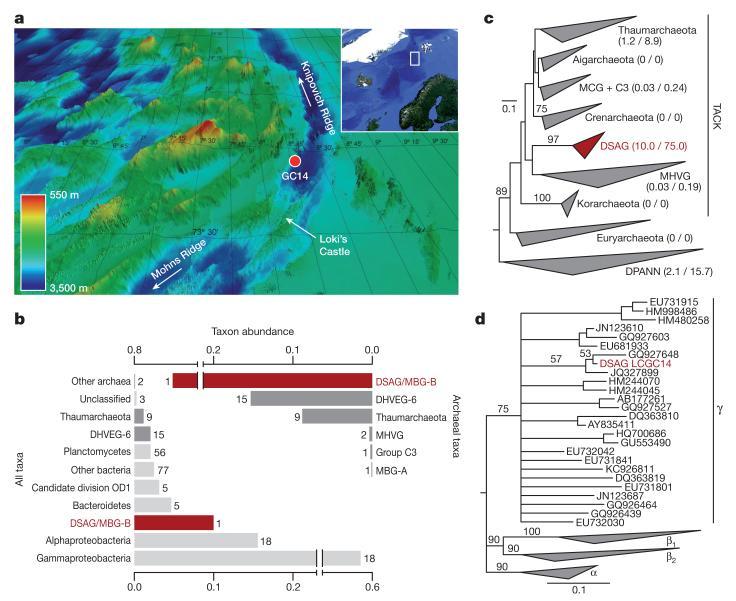
The origin of the eukaryotic cell remains one of the most contentious puzzles in modern biology. Recent studies have provided support for the emergence of the eukaryotic host cell from within the archaeal domain of life, but the identity and nature of the putative archaeal ancestor remain a subject of debate. Here we describe the discovery of 'Lokiarchaeota', a novel candidate archaeal phylum, which forms a monophyletic group with eukaryotes in phylogenomic analyses, and whose genomes encode an expanded repertoire of eukaryotic signature proteins that are suggestive of sophisticated membrane remodelling capabilities. Our results provide strong support for hypotheses in which the eukaryotic host evolved from a bona fide archaeon, and demonstrate that many components that underpin eukaryote-specific features were already present in that ancestor. This provided the host with a rich genomic 'starter-kit' to support the increase in the cellular and genomic complexity that is characteristic of eukaryotes.
真核细胞的起源仍是现代生物学中最具争议性的谜题之一。最近的研究支持了真核宿主细胞起源于古菌生命域的观点,但假定的古菌祖先的身份和性质仍是一个争论的话题。在此,我们描述了“洛基古菌门”的发现,这是一个新的候选古菌门,在系统基因组分析中它与真核生物形成一个单系群,并且其基因组编码了一套扩展的真核生物标志性蛋白,这暗示了其具备复杂的膜重塑能力。我们的结果为真核宿主从真正的古菌进化而来的假说提供了有力支持,并表明许多支撑真核生物特有特征的成分在那个祖先中就已存在。这为宿主提供了一个丰富的基因组“启动套件”,以支持真核生物特有的细胞和基因组复杂性的增加。



 Zotero 插件