
老年肺炎患者上呼吸道微生物群失调
Dysbiosis of upper respiratory tract microbiota in elderly pneumonia patients.
作者信息
de Steenhuijsen Piters Wouter A A, Huijskens Elisabeth G W, Wyllie Anne L, Biesbroek Giske, van den Bergh Menno R, Veenhoven Reinier H, Wang Xinhui, Trzciński Krzysztof, Bonten Marc J, Rossen John W A, Sanders Elisabeth A M, Bogaert Debby
机构信息
Department of Paediatric Immunology and Infectious Diseases, The Wilhelmina Children's Hospital/University Medical Center Utrecht, Utrecht, The Netherlands.
Laboratory of Medical Microbiology and Immunology, St Elisabeth Hospital, Tilburg, The Netherlands.
出版信息
ISME J. 2016 Jan;10(1):97-108. doi: 10.1038/ismej.2015.99. Epub 2015 Jul 7.
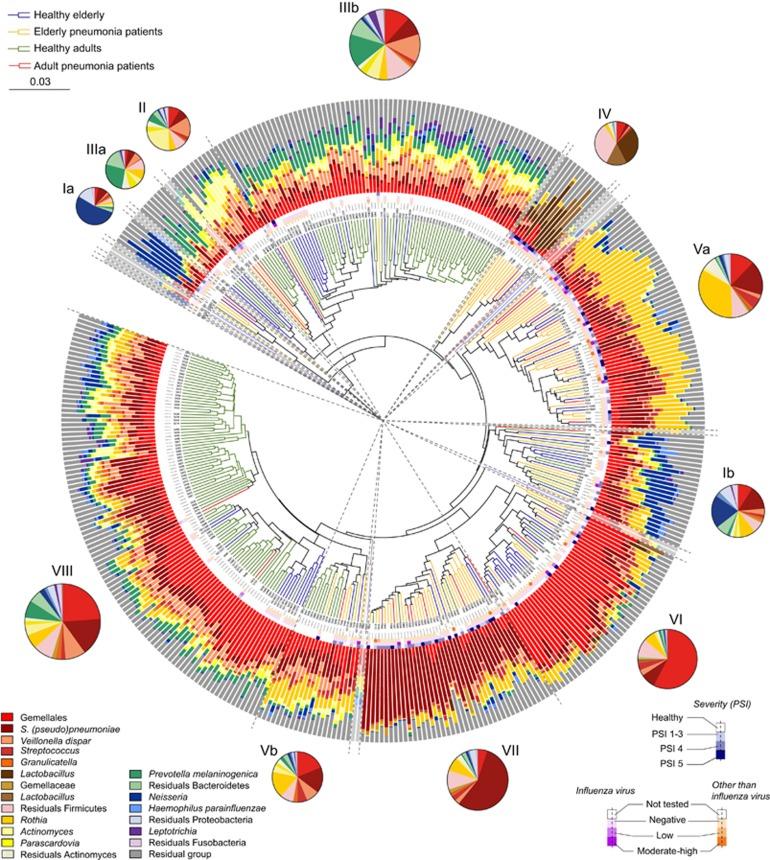
Bacterial pneumonia is a major cause of morbidity and mortality in elderly. We hypothesize that dysbiosis between regular residents of the upper respiratory tract (URT) microbiome, that is balance between commensals and potential pathogens, is involved in pathogen overgrowth and consequently disease. We compared oropharyngeal microbiota of elderly pneumonia patients (n=100) with healthy elderly (n=91) by 16S-rRNA-based sequencing and verified our findings in young adult pneumonia patients (n=27) and young healthy adults (n=187). Microbiota profiles differed significantly between elderly pneumonia patients and healthy elderly (PERMANOVA, P<0.0005). Highly similar differences were observed between microbiota profiles of young adult pneumonia patients and their healthy controls. Clustering resulted in 11 (sub)clusters including 95% (386/405) of samples. We observed three microbiota profiles strongly associated with pneumonia (P<0.05) and either dominated by lactobacilli (n=11), Rothia (n=51) or Streptococcus (pseudo)pneumoniae (n=42). In contrast, three other microbiota clusters (in total n=183) were correlated with health (P<0.05) and were all characterized by more diverse profiles containing higher abundances of especially Prevotella melaninogenica, Veillonella and Leptotrichia. For the remaining clusters (n=99), the association with health or disease was less clear. A decision tree model based on the relative abundance of five bacterial community members in URT microbiota showed high specificity of 95% and sensitivity of 84% (89% and 73%, respectively, after cross-validation) for differentiating pneumonia patients from healthy individuals. These results suggest that pneumonia in elderly and young adults is associated with dysbiosis of the URT microbiome with bacterial overgrowth of single species and absence of distinct anaerobic bacteria. Whether the observed microbiome changes are a cause or a consequence of the development of pneumonia or merely coincide with disease status remains a question for future research.
细菌性肺炎是老年人发病和死亡的主要原因。我们推测,上呼吸道(URT)微生物群常住菌群之间的生态失调,即共生菌与潜在病原体之间的平衡,与病原体过度生长及随后的疾病有关。我们通过基于16S - rRNA的测序比较了老年肺炎患者(n = 100)与健康老年人(n = 91)的口咽微生物群,并在年轻成人肺炎患者(n = 27)和年轻健康成年人(n = 187)中验证了我们的发现。老年肺炎患者和健康老年人的微生物群谱存在显著差异(PERMANOVA,P < 0.0005)。在年轻成人肺炎患者与其健康对照的微生物群谱之间也观察到高度相似的差异。聚类产生了11个(亚)簇,包括95%(386/405)的样本。我们观察到三种与肺炎密切相关的微生物群谱(P < 0.05),分别以乳酸杆菌为主(n = 11)、罗氏菌为主(n = 51)或肺炎链球菌(假肺炎链球菌)为主(n = 42)。相比之下,其他三个微生物群簇(共n = 183)与健康相关(P < 0.05),其特征均为菌群更为多样,尤其是产黑素普雷沃菌、韦荣球菌和纤毛菌的丰度更高。对于其余的簇(n = 99),与健康或疾病的关联不太明确。基于URT微生物群中五个细菌群落成员相对丰度的决策树模型在区分肺炎患者和健康个体方面显示出95%的高特异性和84%的敏感性(交叉验证后分别为89%和73%)。这些结果表明,老年人和年轻人的肺炎与URT微生物群生态失调有关,表现为单一物种的细菌过度生长且缺乏明显的厌氧菌。观察到的微生物群变化是肺炎发生的原因还是结果,或者仅仅与疾病状态同时出现,仍是未来研究的一个问题。
 Zotero 插件