
奥巴托克斯是膜限制性Mcl-1的直接强效拮抗剂,与诱导Bim的治疗具有合成致死性。
Obatoclax is a direct and potent antagonist of membrane-restricted Mcl-1 and is synthetic lethal with treatment that induces Bim.
作者信息
Nguyen Mai, Cencic Regina, Ertel Franziska, Bernier Cynthia, Pelletier Jerry, Roulston Anne, Silvius John R, Shore Gordon C
机构信息
Department of Biochemistry, McGill University, Montreal, Québec, Canada.
Goodman Cancer Research Center, McGill University, Montreal, Québec, Canada.
出版信息
BMC Cancer. 2015 Aug 1;15:568. doi: 10.1186/s12885-015-1582-5.
BACKGROUND
Obatoclax is a clinical stage drug candidate that has been proposed to target and inhibit prosurvival members of the Bcl-2 family, and thereby contribute to cancer cell lethality. The insolubility of this compound, however, has precluded the use of many classical drug-target interaction assays for its study. Thus, a direct demonstration of the proposed mechanism of action, and preferences for individual Bcl-2 family members, remain to be established.
METHODS
Employing modified proteins and lipids, we recapitulated the constitutive association and topology of mitochondrial outer membrane Mcl-1 and Bak in synthetic large unilamellar liposomes, and measured bakdependent bilayer permeability. Additionally, cellular and tumor models, dependent on Mcl-1 for survival, were employed.
RESULTS
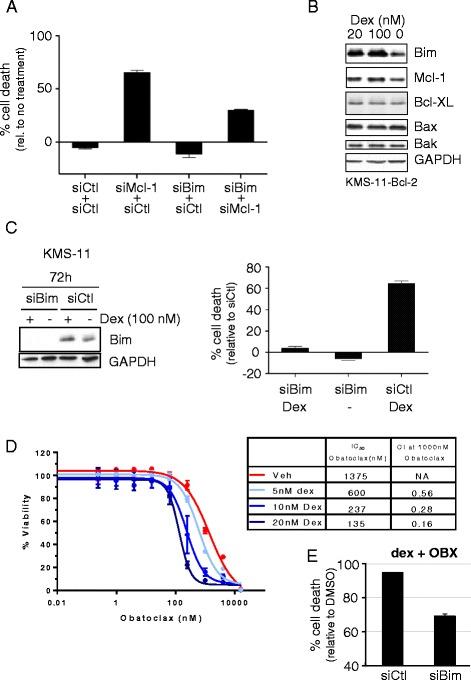
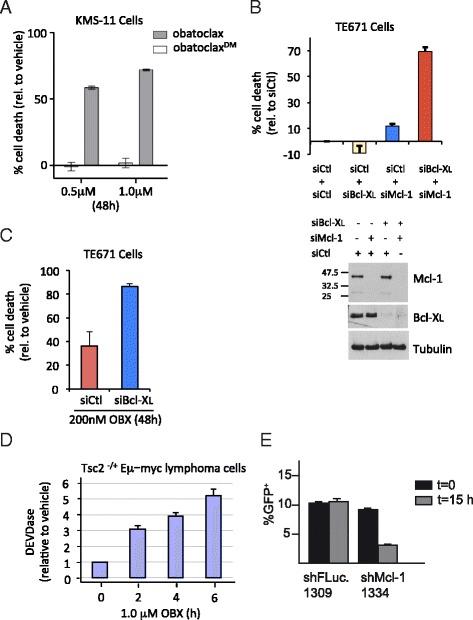
We show that regulation of bilayer permeabilization by the tBid - Mcl-1 - Bak axis closely resemblesthe tBid - Bcl-XL - Bax model. Obatoclax rapidly and completely partitioned into liposomal lipid but also rapidly exchanged between liposome particles. In this system, obatoclax was found to be a direct and potent antagonist of liposome-bound Mcl-1 but not of liposome-bound Bcl-XL, and did not directly influence Bak. A 2.5 molar excess of obatoclax relative to Mcl-1 overcame Mcl-1-mediated inhibition of tBid-Bak activation. Similar results were found for induction of Bak oligomers by Bim. Obatoclax exhibited potent lethality in a cellmodel dependent on Mcl-1 for viability but not in cells dependent on Bcl-XL. Molecular modeling predicts that the 3-methoxy moiety of obatoclax penetrates into the P2 pocket of the BH3 binding site of Mcl-1. A desmethoxy derivative of obatoclax failed to inhibit Mcl-1 in proteoliposomes and did not kill cells whose survival depends on Mcl-1. Systemic treatment of mice bearing Tsc2(+) (/) (-) Em-myc lymphomas (whose cells depend on Mcl-1 for survival) with obatoclax conferred a survival advantage compared to vehicle alone (median 31 days vs 22 days, respectively; p=0.003). In an Akt-lymphoma mouse model, the anti-tumor effects of obatoclax synergized with doxorubicin. Finally, treatment of the multiple myeloma KMS11 cell model (dependent on Mcl-1 for survival) with dexamethasone induced Bim and Bim-dependent lethality. As predicted for an Mcl-1 antagonist, obatoclax and dexamethasone were synergistic in this model.
CONCLUSIONS
Taken together, these findings indicate that obatoclax is a potent antagonist of membranerestricted Mcl-1. Obatoclax represents an attractive chemical series to generate second generation Mcl-1 inhibitors.
背景
obatoclax是一种处于临床阶段的候选药物,已被提出可靶向并抑制Bcl-2家族的促生存成员,从而导致癌细胞死亡。然而,该化合物的不溶性使得许多经典的药物-靶点相互作用分析方法无法用于其研究。因此,其提出的作用机制以及对单个Bcl-2家族成员的偏好仍有待确定。
方法
我们利用修饰的蛋白质和脂质,在合成的大单层脂质体中重现了线粒体外膜Mcl-1和Bak的组成性结合及拓扑结构,并测量了依赖Bak的双层膜通透性。此外,还采用了依赖Mcl-1生存的细胞和肿瘤模型。
结果
我们发现,tBid-Mcl-1-Bak轴对双层膜通透性的调节与tBid-Bcl-XL-Bax模型非常相似。Obatoclax能快速且完全地分配到脂质体脂质中,但也能在脂质体颗粒之间快速交换。在这个系统中,发现obatoclax是脂质体结合的Mcl-1的直接且强效拮抗剂,但不是脂质体结合的Bcl-XL的拮抗剂,并且不直接影响Bak。相对于Mcl-1,2.5摩尔过量的obatoclax克服了Mcl-1介导的对tBid-Bak激活的抑制作用。对于Bim诱导的Bak寡聚体也发现了类似结果。Obatoclax在依赖Mcl-1生存的细胞模型中表现出强效致死性,但在依赖Bcl-XL的细胞中则不然。分子建模预测,obatoclax的3-甲氧基部分可穿透到Mcl-1的BH3结合位点的P2口袋中。Obatoclax的去甲氧基衍生物在蛋白脂质体中未能抑制Mcl-1,也不能杀死其生存依赖于Mcl-1的细胞。用obatoclax对携带Tsc2(+)/(-)Em-myc淋巴瘤(其细胞依赖Mcl-1生存)的小鼠进行全身治疗,与单独使用载体相比,具有生存优势(中位生存期分别为31天和22天;p = 0.003)。在Akt淋巴瘤小鼠模型中,obatoclax的抗肿瘤作用与阿霉素协同。最后,用地塞米松治疗多发性骨髓瘤KMS11细胞模型(依赖Mcl-1生存)可诱导Bim及Bim依赖性致死性。正如对Mcl-1拮抗剂的预测,obatoclax和地塞米松在该模型中具有协同作用。
结论
综上所述,这些发现表明obatoclax是膜结合型Mcl-1的强效拮抗剂。Obatoclax代表了一个有吸引力的化学系列,可用于开发第二代Mcl-1抑制剂。



 Zotero 插件