
普通人群中慢性广泛性疼痛患病率的系统评价与荟萃分析。
A systematic review and meta-analysis of the prevalence of chronic widespread pain in the general population.
作者信息
Mansfield Kathryn E, Sim Julius, Jordan Joanne L, Jordan Kelvin P
机构信息
Department of Non-communicable Disease Epidemiology, Faculty of Epidemiology and Population Health, London School of Hygiene and Tropical Medicine, London, United Kingdom Arthritis Research UK Primary Care Centre, Research Institute for Primary Care & Health Sciences, Keele University, Keele, Staffordshire, United Kingdom.
出版信息
Pain. 2016 Jan;157(1):55-64. doi: 10.1097/j.pain.0000000000000314.
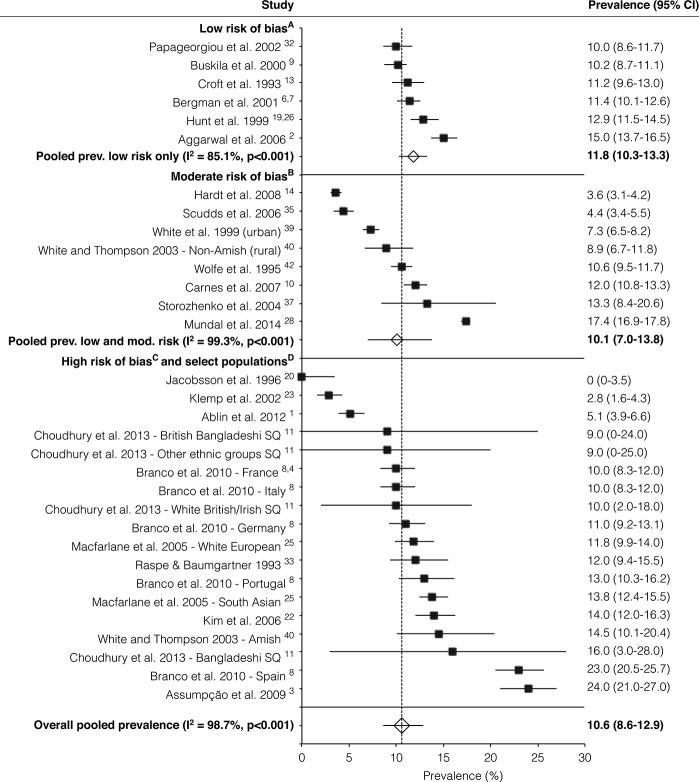
Chronic widespread pain (CWP) is common and associated with poor general health. There has been no attempt to derive a robust prevalence estimate of CWP or assess how this is influenced by sociodemographic factors. This study therefore aimed to determine, through a systematic review and meta-analysis, the prevalence of CWP in the adult general population and explore variation in prevalence by age, sex, geographical location, and criteria used to define CWP. MEDLINE, Embase, CINAHL, and AMED were searched using a search strategy combining key words and related database-specific subject terms to identify relevant cohort or cross-sectional studies published since 1990. Included articles were assessed for risk of bias. Prevalence figures for CWP (American College of Rheumatology criteria) were stratified according to geographical location, age, and sex. Potential sources of variation were investigated using subgroup analyses and meta-regression. Twenty-five articles met the eligibility criteria. Estimates for CWP prevalence ranged from 0% to 24%, with most estimates between 10% and 15%. The random-effects pooled prevalence was 10.6% (95% confidence intervals: 8.6-12.9). When only studies at low risk of bias were considered pooled, prevalence increased to 11.8% (95% confidence intervals: 10.3-13.3), with reduced but still high heterogeneity. Prevalence was higher in women and in those aged more than 40 years. There was some limited evidence of geographic variation and cultural differences. One in 10 adults in the general population report chronic widespread pain with possible sociocultural variation. The possibility of cultural differences in pain reporting should be considered in future research and the clinical assessment of painful conditions.
慢性广泛性疼痛(CWP)很常见,且与总体健康状况不佳相关。目前尚未有人尝试得出CWP的可靠患病率估计值,也未评估社会人口学因素对其的影响。因此,本研究旨在通过系统评价和荟萃分析,确定成年普通人群中CWP的患病率,并探讨患病率在年龄、性别、地理位置以及用于定义CWP的标准方面的差异。使用结合关键词和特定数据库相关主题词的检索策略,对MEDLINE、Embase、CINAHL和AMED进行检索,以识别自1990年以来发表的相关队列研究或横断面研究。对纳入的文章进行偏倚风险评估。根据地理位置、年龄和性别对CWP(美国风湿病学会标准)的患病率数据进行分层。使用亚组分析和荟萃回归研究潜在的变异来源。25篇文章符合纳入标准。CWP患病率的估计值在0%至24%之间,大多数估计值在10%至15%之间。随机效应合并患病率为10.6%(95%置信区间:8.6 - 12.9)。仅考虑低偏倚风险的研究时,合并患病率增至11.8%(95%置信区间:10.3 - 13.3),异质性降低但仍较高。女性和40岁以上人群的患病率更高。有一些有限的证据表明存在地理差异和文化差异。普通人群中每10名成年人中有1人报告有慢性广泛性疼痛,可能存在社会文化差异。在未来的研究和疼痛状况的临床评估中,应考虑疼痛报告中文化差异的可能性。


 Zotero 插件