
恶性疟原虫的核小体图谱揭示了染色质结构和调控序列的动态变化。
The nucleosome landscape of Plasmodium falciparum reveals chromatin architecture and dynamics of regulatory sequences.
作者信息
Kensche Philip Reiner, Hoeijmakers Wieteke Anna Maria, Toenhake Christa Geeke, Bras Maaike, Chappell Lia, Berriman Matthew, Bártfai Richárd
机构信息
Department of Molecular Biology, Radboud University, 6525GA Nijmegen, The Netherlands.
Parasite Genomics Group, Wellcome Trust Sanger Institute, CB10 1SA Hinxton, UK.
出版信息
Nucleic Acids Res. 2016 Mar 18;44(5):2110-24. doi: 10.1093/nar/gkv1214. Epub 2015 Nov 17.
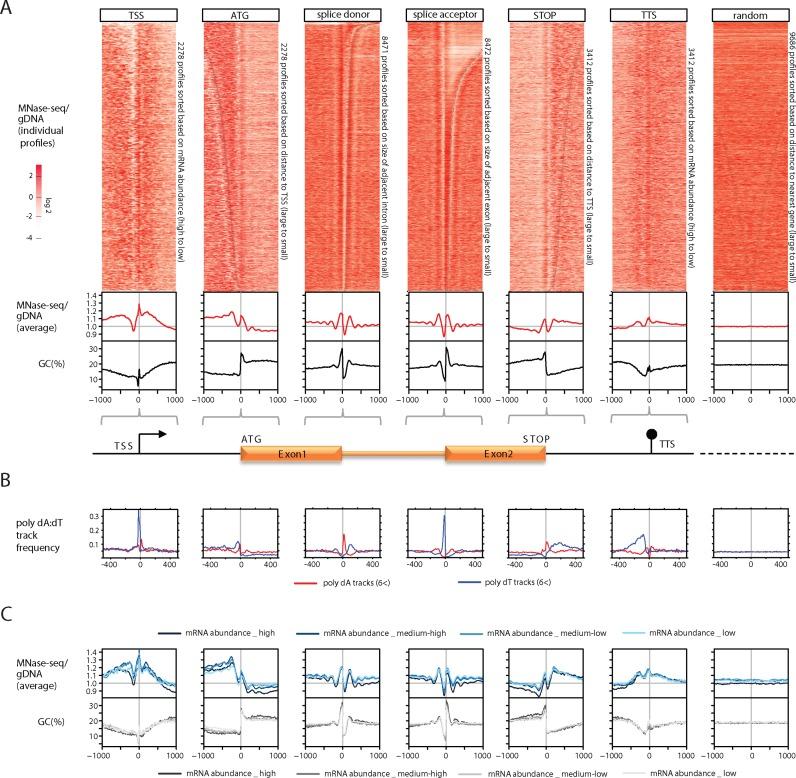
In eukaryotes, the chromatin architecture has a pivotal role in regulating all DNA-associated processes and it is central to the control of gene expression. For Plasmodium falciparum, a causative agent of human malaria, the nucleosome positioning profile of regulatory regions deserves particular attention because of their extreme AT-content. With the aid of a highly controlled MNase-seq procedure we reveal how positioning of nucleosomes provides a structural and regulatory framework to the transcriptional unit by demarcating landmark sites (transcription/translation start and end sites). In addition, our analysis provides strong indications for the function of positioned nucleosomes in splice site recognition. Transcription start sites (TSSs) are bordered by a small nucleosome-depleted region, but lack the stereotypic downstream nucleosome arrays, highlighting a key difference in chromatin organization compared to model organisms. Furthermore, we observe transcription-coupled eviction of nucleosomes on strong TSSs during intraerythrocytic development and demonstrate that nucleosome positioning and dynamics can be predictive for the functionality of regulatory DNA elements. Collectively, the strong nucleosome positioning over splice sites and surrounding putative transcription factor binding sites highlights the regulatory capacity of the nucleosome landscape in this deadly human pathogen.
在真核生物中,染色质结构在调控所有与DNA相关的过程中起着关键作用,并且是基因表达控制的核心。对于人类疟疾的病原体恶性疟原虫而言,由于其调控区域的AT含量极高,调控区域的核小体定位图谱值得特别关注。借助高度可控的微球菌核酸酶测序(MNase-seq)程序,我们揭示了核小体的定位如何通过划定标志性位点(转录/翻译起始和终止位点)为转录单元提供结构和调控框架。此外,我们的分析为定位核小体在剪接位点识别中的功能提供了有力证据。转录起始位点(TSSs)由一个小的核小体缺失区域界定,但缺乏典型的下游核小体阵列,这突出了与模式生物相比染色质组织的关键差异。此外,我们观察到在红细胞内发育过程中,强转录起始位点上的核小体发生转录偶联驱逐,并证明核小体定位和动态变化可预测调控DNA元件的功能。总体而言,剪接位点及周围假定转录因子结合位点上强烈的核小体定位突出了这种致命人类病原体中核小体景观的调控能力。



 Zotero 插件