
一种POT1突变表明科茨综合征存在端粒末端填充缺陷和端粒截短。
A POT1 mutation implicates defective telomere end fill-in and telomere truncations in Coats plus.
作者信息
Takai Hiroyuki, Jenkinson Emma, Kabir Shaheen, Babul-Hirji Riyana, Najm-Tehrani Nasrin, Chitayat David A, Crow Yanick J, de Lange Titia
机构信息
The Rockefeller University, New York, New York 10065, USA;
Manchester Centre for Genomic Medicine, Institute of Human Development, Faculty of Medical and Human Sciences, Manchester Academic Health Sciences Centre, University of Manchester, Manchester M13 9PT, United Kingdom;
出版信息
Genes Dev. 2016 Apr 1;30(7):812-26. doi: 10.1101/gad.276873.115. Epub 2016 Mar 24.
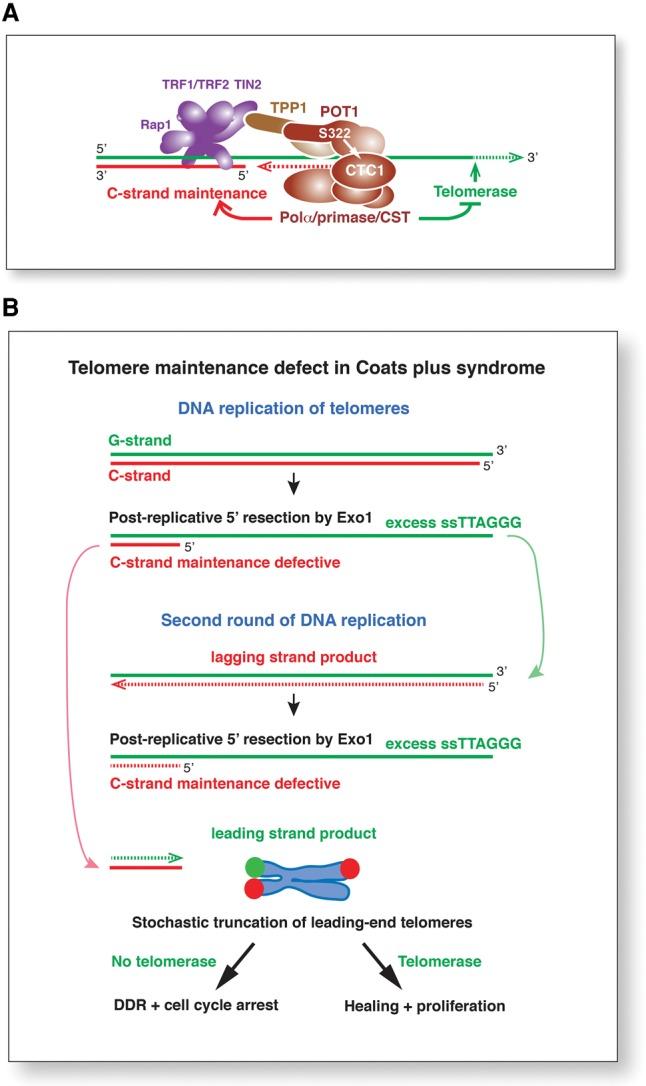
Coats plus (CP) can be caused by mutations in the CTC1 component of CST, which promotes polymerase α (polα)/primase-dependent fill-in throughout the genome and at telomeres. The cellular pathology relating to CP has not been established. We identified a homozygous POT1 S322L substitution (POT1(CP)) in two siblings with CP. POT1(CP)induced a proliferative arrest that could be bypassed by telomerase. POT1(CP)was expressed at normal levels, bound TPP1 and telomeres, and blocked ATR signaling. POT1(CP)was defective in regulating telomerase, leading to telomere elongation rather than the telomere shortening observed in other telomeropathies. POT1(CP)was also defective in the maintenance of the telomeric C strand, causing extended 3' overhangs and stochastic telomere truncations that could be healed by telomerase. Consistent with shortening of the telomeric C strand, metaphase chromosomes showed loss of telomeres synthesized by leading strand DNA synthesis. We propose that CP is caused by a defect in POT1/CST-dependent telomere fill-in. We further propose that deficiency in the fill-in step generates truncated telomeres that halt proliferation in cells lacking telomerase, whereas, in tissues expressing telomerase (e.g., bone marrow), the truncations are healed. The proposed etiology can explain why CP presents with features distinct from those associated with telomerase defects (e.g., dyskeratosis congenita).
科茨综合征附加型(CP)可由CST复合物中CTC1成分的突变引起,该成分可促进全基因组及端粒处依赖于聚合酶α(polα)/引发酶的填补过程。与CP相关的细胞病理学尚未明确。我们在两名患有CP的同胞中鉴定出纯合的POT1 S322L替代突变(POT1(CP))。POT1(CP)诱导增殖停滞,而端粒酶可绕过这一停滞。POT1(CP)以正常水平表达,与TPP1和端粒结合,并阻断ATR信号传导。POT1(CP)在调节端粒酶方面存在缺陷,导致端粒延长,而非像其他端粒病那样出现端粒缩短。POT1(CP)在维持端粒C链方面也存在缺陷,导致3'端悬垂延长和随机的端粒截断,而端粒酶可修复这些截断。与端粒C链缩短一致,中期染色体显示前导链DNA合成所合成的端粒缺失。我们提出CP是由POT1/CST依赖的端粒填补缺陷引起的。我们进一步提出,填补步骤的缺陷会产生截断的端粒,从而使缺乏端粒酶的细胞增殖停滞,而在表达端粒酶的组织(如骨髓)中,这些截断会被修复。所提出的病因可以解释为什么CP呈现出与端粒酶缺陷(如先天性角化不良)相关特征不同的症状。


 Zotero 插件