
黑色素瘤细胞中吲哚胺2,3-双加氧酶2的基因沉默通过抑制烟酰胺腺嘌呤二核苷酸(NAD+)诱导细胞凋亡,并抑制体内肿瘤生长。
Gene silencing of indoleamine 2,3-dioxygenase 2 in melanoma cells induces apoptosis through the suppression of NAD+ and inhibits in vivo tumor growth.
作者信息
Liu Yanling, Zhang Yujuan, Zheng Xiufen, Zhang Xusheng, Wang Hongmei, Li Qin, Yuan Keng, Zhou Nanjing, Yu Yanrong, Song Na, Fu Jiamin, Min Weiping
机构信息
Institute of Immunotherapy of Nanchang University, and Jiangxi Academy of Medical Sciences, Nanchang, China.
Jiangxi University of Technology, Nanchang, China.
出版信息
Oncotarget. 2016 May 31;7(22):32329-40. doi: 10.18632/oncotarget.8617.
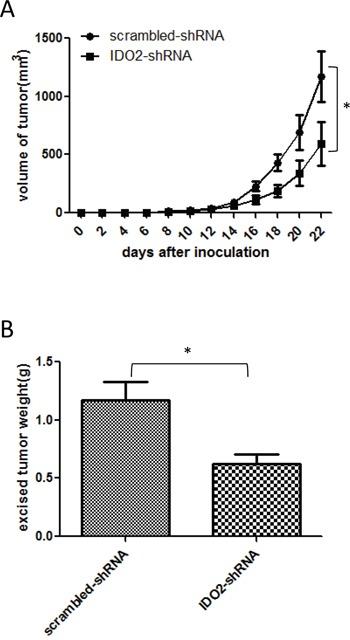
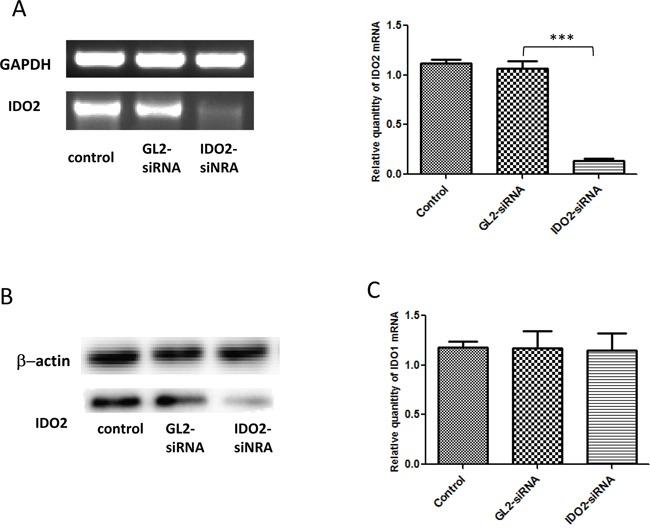
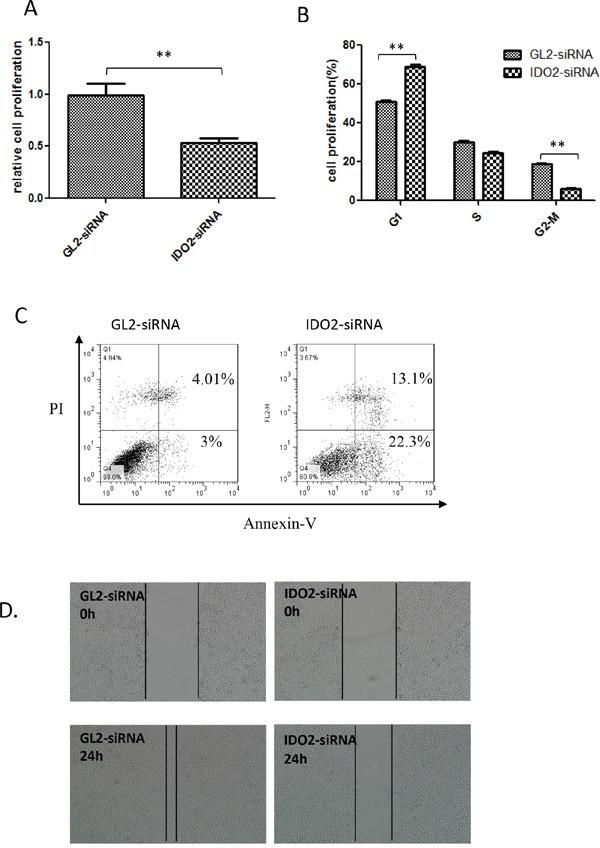
Indoleamine 2,3-dioxygenase 2 (IDO2) is a newly discovered enzyme that catalyzes the initial and rate-limiting step in the degradation of tryptophan. As a homologous protein of IDO1, IDO2 plays an inhibitory role in T cell proliferation, and it is essential for regulatory T cell (Treg) generation in healthy conditions. Little is known about the immune-independent functions of IDO2 relevant to its specific contributions to physiology and pathophysiology in cancer cells. The purpose of this study was to assess the impact of IDO2 gene silencing as a way to inhibit B16-BL6 cancer cells in a murine model. Here, for the first time, we show that knockdown of IDO2 using small interfering RNA (siRNA) inhibits cancer cell proliferation, arrests cell cycle in G1, induces greater cell apoptosis, and reduces cell migration in vitro. Knockdown of IDO2 decreased the generation of nicotinamide adenine dinucleotide (NAD+) while increasing the generation of reactive oxygen species (ROS). We further demonstrate that cell apoptosis, induced by IDO2 downregulation, can be weakened by addition of exogenous NAD+, suggesting a novel mechanism by which IDO2 promotes tumor growth through its metabolite product NAD+. In addition to in vitro findings, we also demonstrate that IDO2 silencing in tumor cells using short hairpin RNA (shRNA) delayed tumor formation and arrested tumor growth in vivo. In conclusion, this study demonstrates a new non-immune-associated mechanism of IDO2 in vitro and IDO2 expression in B16-BL6 cells contributes to cancer development and progression. Our research provides evidence of a novel target for gene silencing that has the potential to enhance cancer therapy.
吲哚胺2,3-双加氧酶2(IDO2)是一种新发现的酶,它催化色氨酸降解的起始步骤和限速步骤。作为IDO1的同源蛋白,IDO2在T细胞增殖中起抑制作用,并且在健康状态下对调节性T细胞(Treg)的产生至关重要。关于IDO2与癌细胞生理和病理生理学的特定贡献相关的非免疫相关功能知之甚少。本研究的目的是评估IDO2基因沉默作为抑制小鼠模型中B16-BL6癌细胞的一种方式的影响。在此,我们首次表明,使用小干扰RNA(siRNA)敲低IDO2可抑制癌细胞增殖,使细胞周期停滞在G1期,诱导更多细胞凋亡,并在体外减少细胞迁移。敲低IDO2会减少烟酰胺腺嘌呤二核苷酸(NAD+)的生成,同时增加活性氧(ROS)的生成。我们进一步证明,添加外源性NAD+可减弱由IDO2下调诱导的细胞凋亡,这表明IDO2通过其代谢产物NAD+促进肿瘤生长的新机制。除了体外研究结果,我们还证明,使用短发夹RNA(shRNA)在肿瘤细胞中沉默IDO2可延迟体内肿瘤形成并阻止肿瘤生长。总之,本研究证明了IDO2在体外的一种新的非免疫相关机制,并且B16-BL6细胞中IDO2的表达有助于癌症的发展和进展。我们的研究为基因沉默提供了一个新靶点的证据,该靶点有可能增强癌症治疗效果。


 Zotero 插件